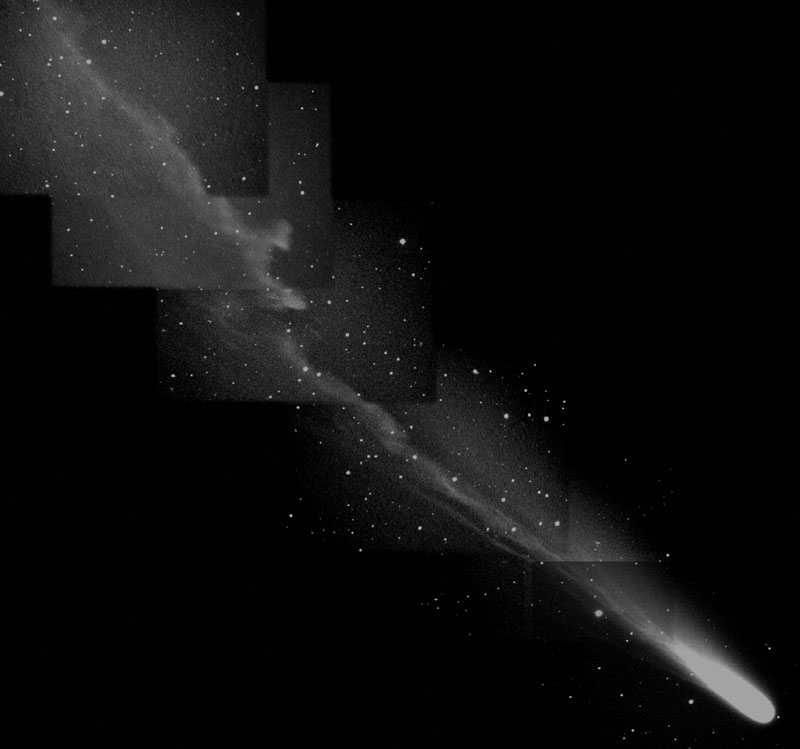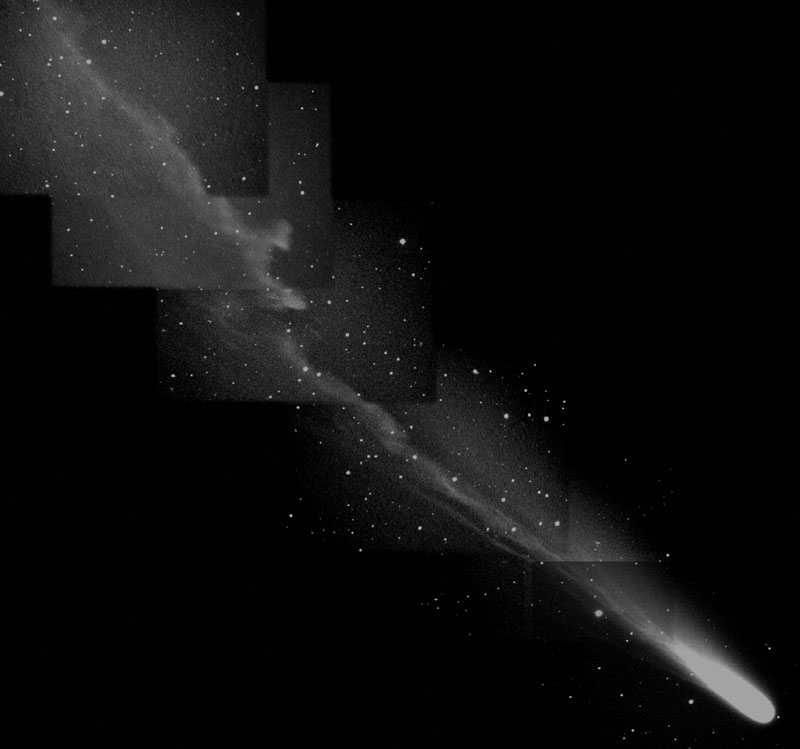
One of the brightest comets of the past five years will likely reach its peak brightness this week. Comet Ikeya-Zhang, officially known as C/2002 C1, can now be seen without aide from a dark location above the western horizon shortly after sunset. Recent luminosity estimates for Comet Ikeya-Zhang place it between magnitudes three and four, making it brighter than most commonly visible stars. The above picture was taken on March 11 near Tucson, Arizona, USA. The image caught Comet Ikeya-Zhang showing a quite detailed ion tail, possibly disrupted by the magnetic field of the Sun's outwardly flowing particle wind. As the activity of comets is notoriously hard to predict, Comet Ikeya-Zhang may still hold some surprises as it rounds the Sun this month and starts back out of the Solar System in April.
Uno de los cometas más brillantes de los últimos cinco años probablemente alcance su máximo brillo esta semana. El cometa Ikeya-Zhang, oficialmente conocido como C/2002 C1, ahora puede observarse sin ayuda desde una ubicación oscura por encima del horizonte occidental poco después de la puesta de sol. Las estimaciones recientes de luminosidad del cometa Ikeya-Zhang lo sitúan entre magnitudes tres y cuatro, lo que lo hace más brillante que la mayoría de las estrellas comúnmente visibles. La imagen anterior fue tomada el 11 de marzo cerca de Tucson, Arizona, EE.UU. La imagen capturó el cometa Ikeya-Zhang mostrando una cola iónica bastante detallada, posiblemente perturbada por el campo magnético del viento de partículas que fluye hacia el exterior del Sol. Dado que la actividad de los cometas es notoriamente difícil de predecir, el cometa Ikeya-Zhang aún podría sorprender cuando rodee el Sol este mes y comience su viaje de regreso fuera del Sistema Solar en abril.