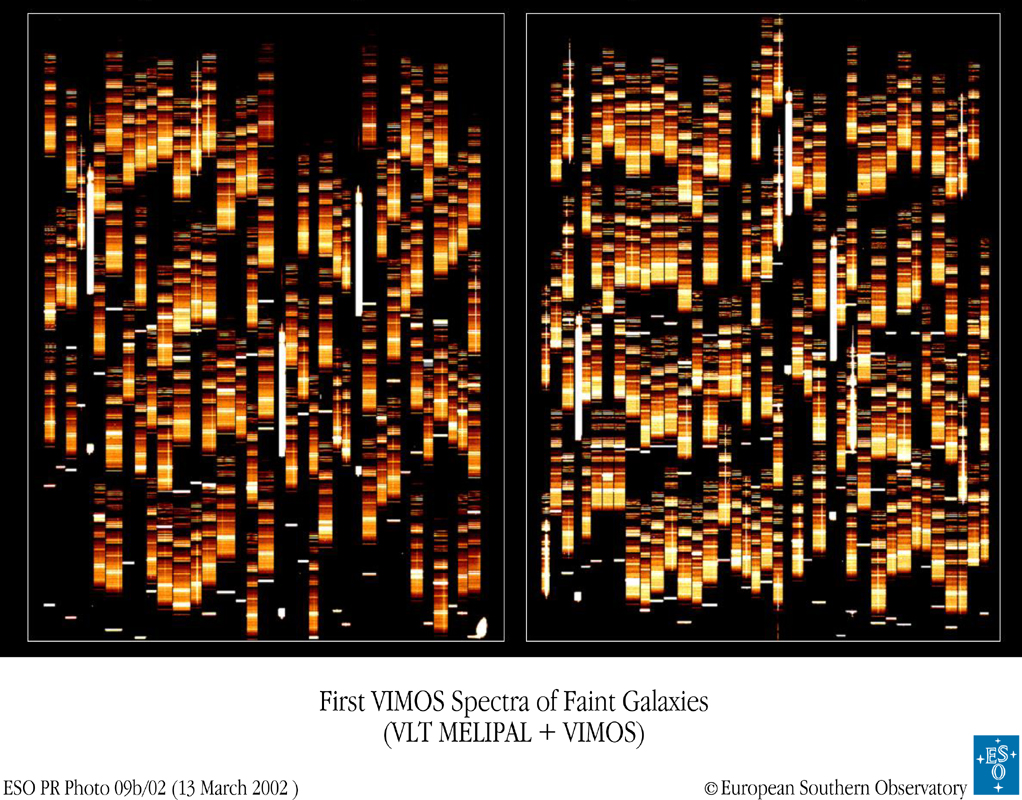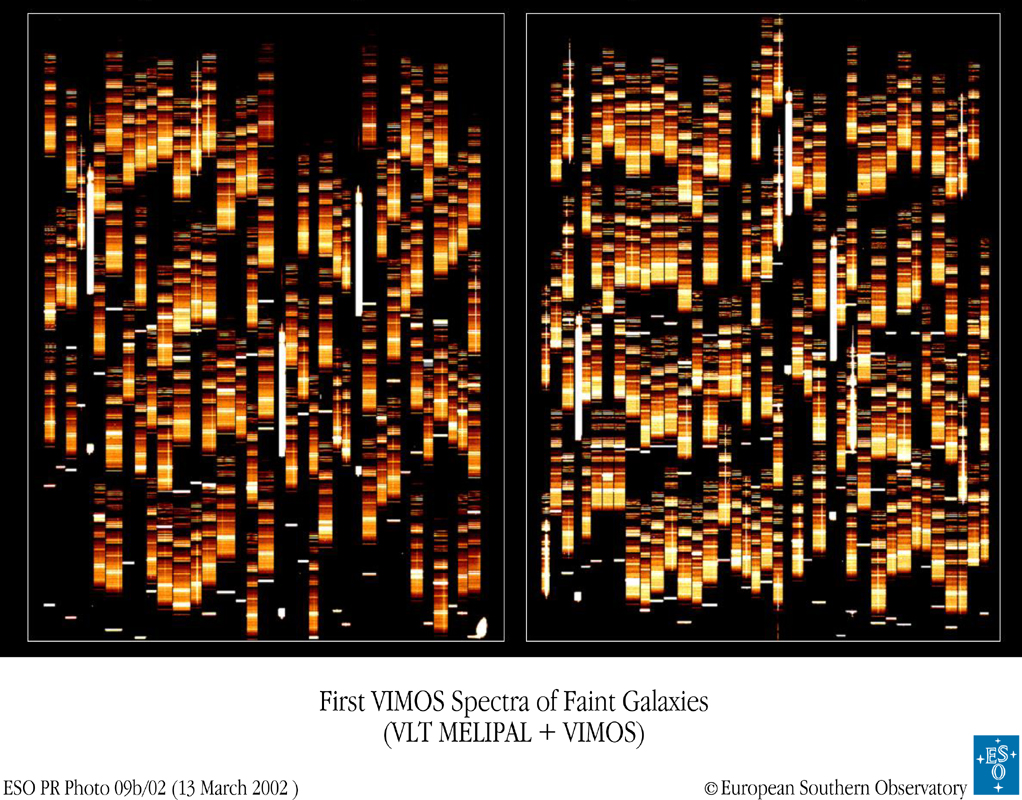
In the distant universe, time appears to run slow. Since time-dilated light appears shifted toward the red end of the spectrum (redshifted), astronomers are able to use cosmological time-slowing to help measure vast distances in the universe. Above, the light from distant galaxies has been broken up into its constituent colors (spectra), allowing astronomers to measure the redshift of known spectral lines. The novelty of the above image is that the distance to hundreds of galaxies can now be measured on a single frame using the Visible MultiObject Spectrograph that has begun operating at the Very Large Telescope array in Chile. Analyzing the space distribution of distant objects will allow insight into when and how stars, galaxies, and quasars formed, clustered, and evolved in the early universe.
En el universo distante, el tiempo parece transcurrir lentamente. Como la luz dilatada en el tiempo aparece desplazada hacia el extremo rojo del espectro (corrimiento al rojo), los astrónomos pueden utilizar el ralentizamiento cosmológico del tiempo para ayudar a medir distancias inmensas en el universo. En la imagen anterior, la luz de galaxias distantes ha sido descompuesta en sus colores constituyentes (espectros), permitiendo a los astrónomos medir el corrimiento al rojo de líneas espectrales conocidas. La novedad de la imagen anterior es que ahora se puede medir la distancia a cientos de galaxias en un único fotograma utilizando el Espectrógrafo Multiobjeto Visible que ha comenzado a operar en el conjunto del Telescopio Muy Grande en Chile. El análisis de la distribución espacial de objetos distantes permitirá obtener información sobre cuándo y cómo se formaron, agruparon y evolucionaron las estrellas, galaxias y cuásares en el universo primitivo.