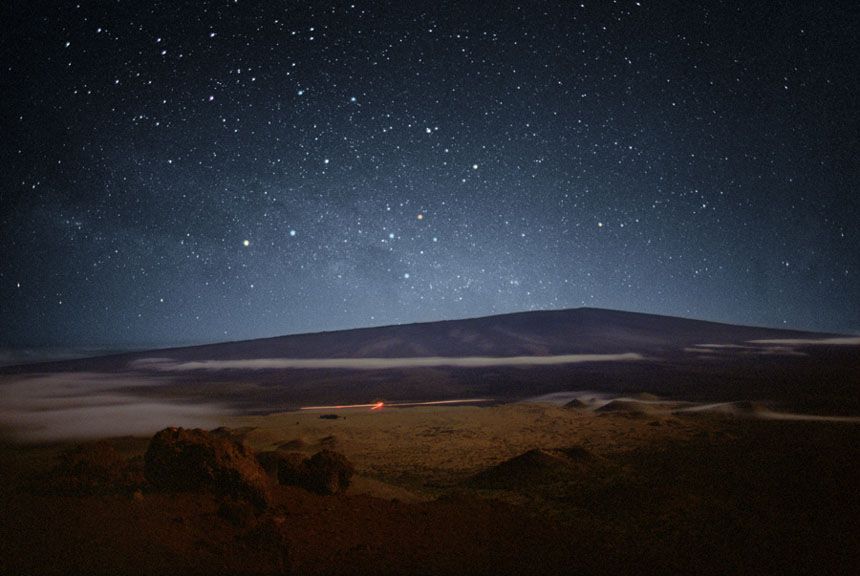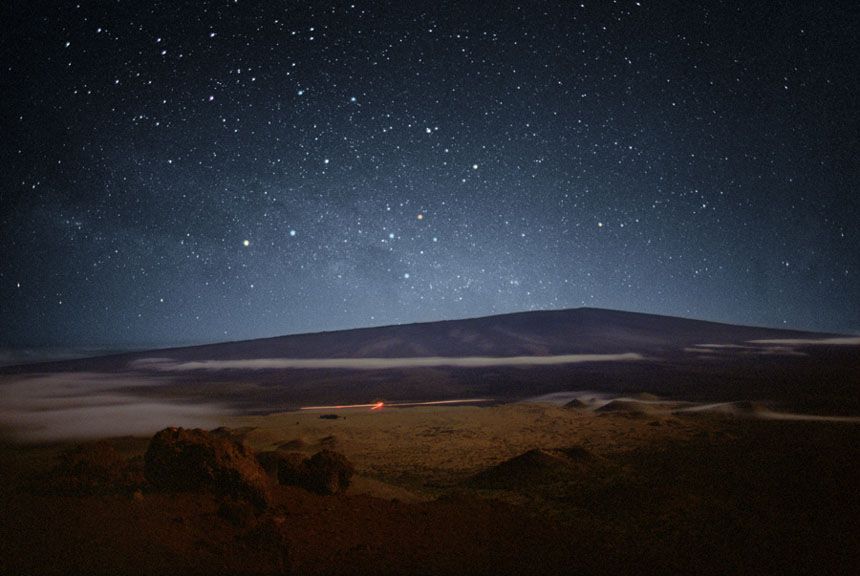
Gazing across this gorgeous skyscape, the Southern Cross and stars of the constellation Centaurus are seen above the outline of Mauna Loa (Long Mountain), planet Earth's largest volcano. Unfamiliar to sky gazers north of about 25 degrees north latitude, the Southern Cross, constellation Crux, is near the horizon to the left of Mauna Loa's summit. A compact constellation of bright stars, the long axis of the cross conveniently points south toward the southern celestial pole. The top of the cross is marked by the lovely pale red star Gamma Crucis, which is in fact a red giant star about 120 light-years distant. Stars of the grand constellation Centaurus almost engulf the Southern Cross with blue giant Beta Centauri, and yellowish Alpha Centauri, appearing as the brightest stars to the left of Gamma Crucis. At a distance of 4.3 light-years, Alpha Centauri, the closest star to the Sun, is actually a triple star system which includes a star similar to the Sun. But what caused the reddish streaks in the foreground of this time exposure? Alas, it is the mundane glow of lights from cars (not molten lava!) traveling the road to Hilo, Hawaii.
Observando este hermoso paisaje celeste, la Cruz del Sur y las estrellas de la constelación Centauro se ven sobre el perfil de Mauna Loa (Montaña Larga), el volcán más grande del planeta Tierra. No familiar para los observadores del cielo al norte de aproximadamente 25 grados de latitud norte, la Cruz del Sur, constelación de Crux, está cerca del horizonte a la izquierda de la cumbre de Mauna Loa. Constelación compacta de estrellas brillantes, el eje largo de la cruz apunta convenientemente hacia el sur, en dirección al polo celeste sur. La parte superior de la cruz está marcada por la hermosa estrella de color rojo pálido Gamma Crucis, que es en realidad una gigante roja a aproximadamente 120 años luz de distancia. Las estrellas de la gran constelación Centauro casi envuelven la Cruz del Sur con la gigante azul Beta Centauri y Alpha Centauri de color amarillento, apareciendo como las estrellas más brillantes a la izquierda de Gamma Crucis. A una distancia de 4,3 años luz, Alpha Centauri, la estrella más cercana al Sol, es en realidad un sistema triple de estrellas que incluye una estrella similar al Sol. Pero, ¿qué causó las rayas rojizas en el primer plano de esta exposición prolongada? Por desgracia, es el brillo mundano de las luces de los automóviles (¡no lava fundida!) que viajan por la carretera hacia Hilo, Hawái.