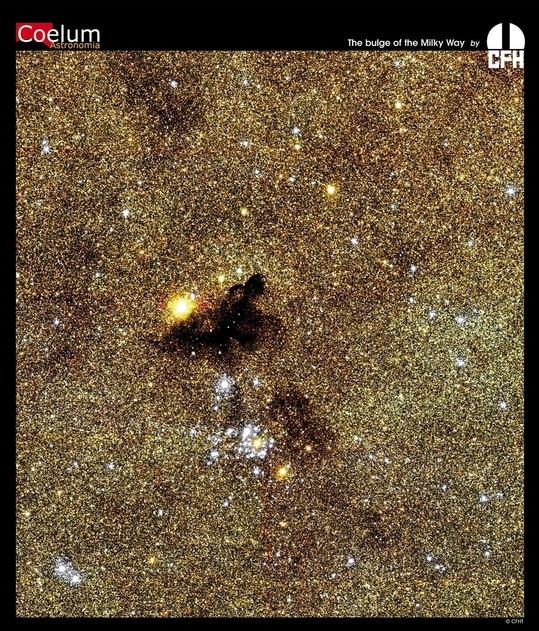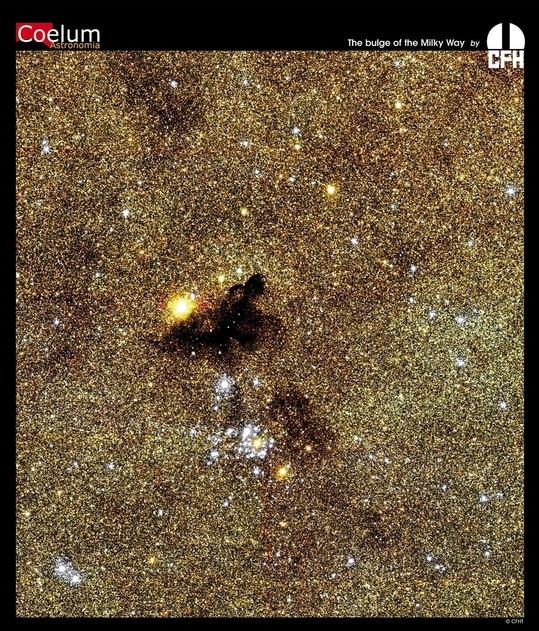
Did you ever have a day when it felt like a dark cloud was following you around? For the open cluster of stars NGC 6520, every day is like this. On the left of the above picture are many of NGC 6520's bright blue stars. They formed only millions of years ago - much more recently than our ancient Sun which formed billions of years ago. On the right is an absorption nebula, molecular cloud Barnard 86, from which the stars of NGC 6520 surely formed. This nebula contains much opaque dust that blocks light from the many stars that would have been visible in the background. Surrounding NGC 6520 is part of the tremendously dense starscape in the bulge of our Milky Way Galaxy, the extended halo of stars that surrounds the center of our Galaxy. NGC 6520 spans about 10 light years and lies about 5500 light years away toward the direction of Sagittarius.
¿Alguna vez has tenido un día en el que sentiste que una nube oscura te seguía? Para el cúmulo abierto de estrellas NGC 6520, cada día es así. A la izquierda de la imagen anterior se encuentran muchas de las brillantes estrellas azules de NGC 6520. Se formaron hace solo millones de años, mucho más recientemente que nuestro antiguo Sol, que se formó hace miles de millones de años. A la derecha hay una nebulosa de absorción, la nube molecular Barnard 86, de la cual las estrellas de NGC 6520 seguramente se formaron. Esta nebulosa contiene mucho polvo opaco que bloquea la luz de muchas estrellas que habrían sido visibles en el fondo. Rodeando a NGC 6520 hay parte del panorama estelar tremendamente denso en el bulbo de nuestra Galaxia Vía Láctea, el halo extendido de estrellas que rodea el centro de nuestra Galaxia. NGC 6520 abarca aproximadamente 10 años luz y se encuentra a unos 5500 años luz de distancia en la dirección de Sagitario.