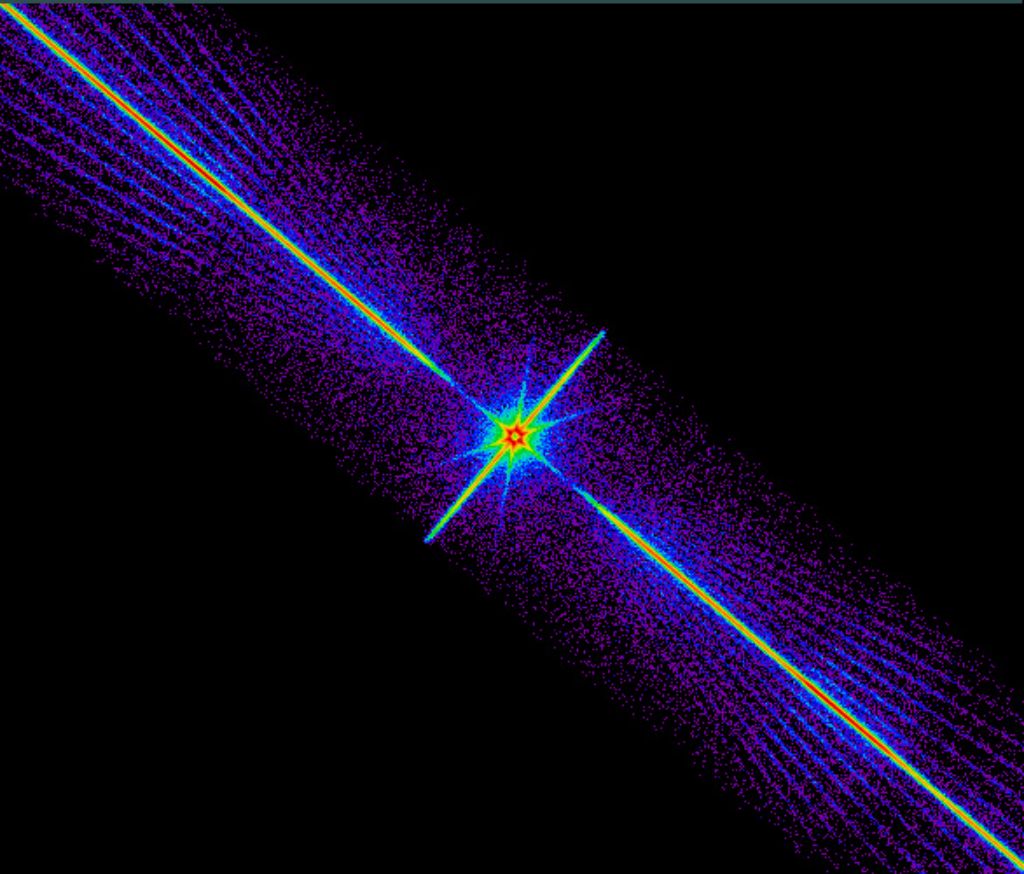
A drop of water or prism of glass can spread out visible sunlight into a rainbow of colors. In order of increasing energy, the well known spectrum of colors in a rainbow runs red, orange, yellow, green, blue, indigo, violet. X-ray light too can be spread out into a spectrum ordered by energy ... but not by drops of water or glass. Instead, the orbiting Chandra X-ray Observatory uses a set of 540 finely ruled, gold gratings to spread out the x-rays, recording the results with digital detectors. The resulting x-ray spectrum reveals much about the compositions, temperatures, and motions within cosmic x-ray sources. This false color Chandra image shows the x-ray spectrum of a star system in Ursa Major cataloged as XTE J1118+480 and thought to consist of a sun-like star orbiting a black hole. Unlike the familiar appearance of a prism's visible light rainbow, the energies here are ordered along radial lines with the highest energy x-rays near the center and lowest energies near the upper left and lower right edges of the image. The central spiky region itself is created by x-rays from the source which are not spread out by the array of gratings.
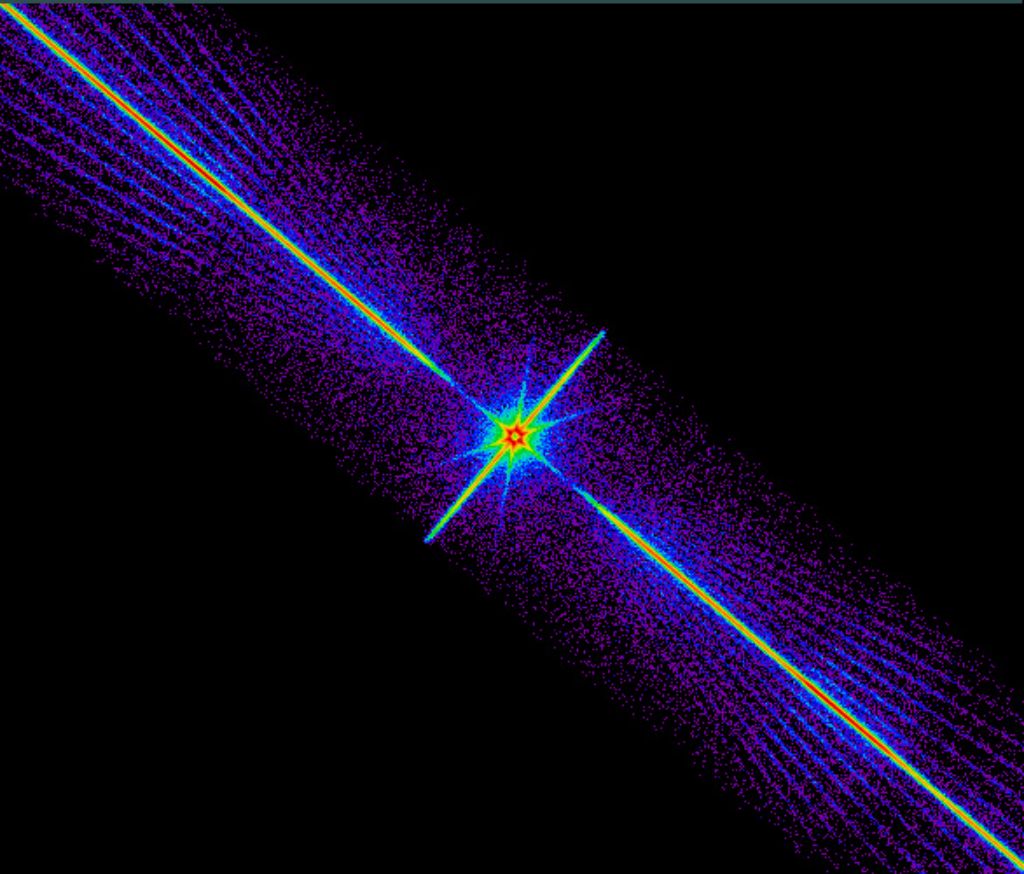
Una gota de agua o un prisma de vidrio puede dispersar la luz solar visible en un arcoíris de colores. En orden de energía creciente, el espectro bien conocido de colores en un arcoíris va rojo, naranja, amarillo, verde, azul, índigo, violeta. La luz de rayos X también puede dispersarse en un espectro ordenado por energía... pero no mediante gotas de agua o vidrio. En su lugar, el Observatorio de Rayos X Chandra en órbita utiliza un conjunto de 540 rejillas de oro finamente grabadas para dispersar los rayos X, registrando los resultados con detectores digitales. El espectro de rayos X resultante revela mucho sobre las composiciones, temperaturas y movimientos dentro de fuentes de rayos X cósmicos. Esta imagen falso color de Chandra muestra el espectro de rayos X de un sistema estelar en la Osa Mayor catalogado como XTE J1118+480 y que se cree que consiste en una estrella similar al Sol orbitando un agujero negro. A diferencia de la apariencia familiar del arcoíris de luz visible de un prisma, las energías aquí se ordenan a lo largo de líneas radiales con los rayos X de mayor energía cerca del centro y las energías más bajas cerca de los bordes superior izquierdo e inferior derecho de la imagen. La región central puntiaguda en sí está creada por rayos X de la fuente que no se dispersan mediante el conjunto de rejillas.