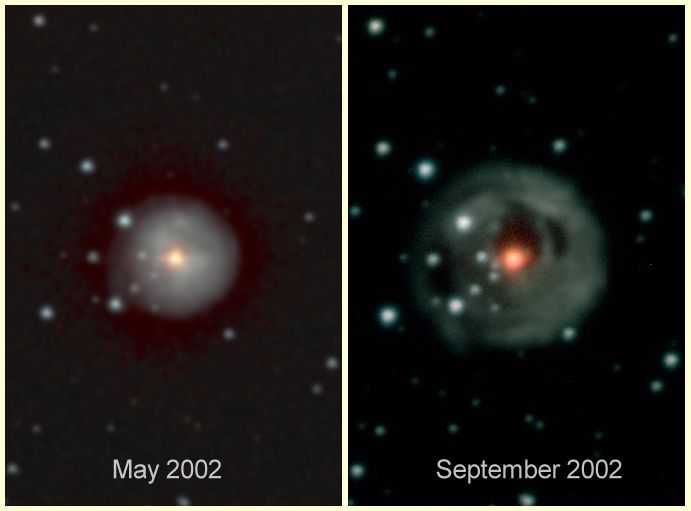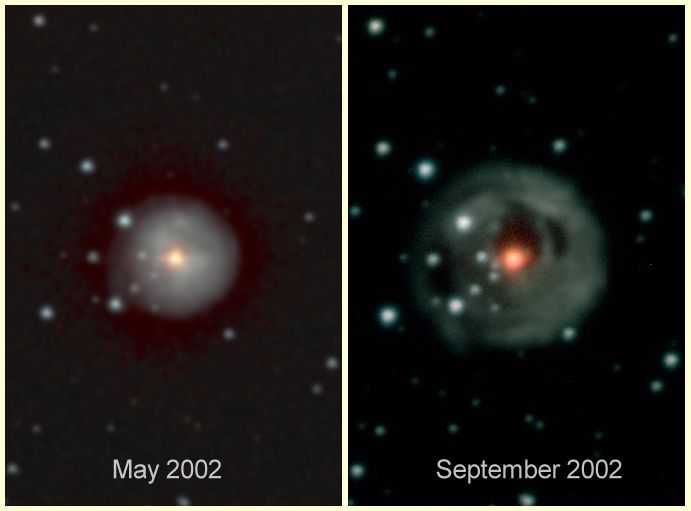
A leading candidate for the most mysterious star found in recent times is variable star V838 Monocerotis. At a distance of about 8,000 light-years, V838 Mon was discovered to be in outburst in January of this year. Initially thought to be a familiar type of classical nova, astronomers quickly realized that instead, V838 Mon may be a totally new addition to the astronomical zoo. Observations indicate that the erupting star transformed itself over a period of months from a small under-luminous star a little hotter than the Sun, to a highly-luminous, cool supergiant star undergoing rapid and complex brightness changes. The transformation defies the conventional understanding of stellar life cycles. A most notable feature of V838 Mon is the "expanding" nebula which now appears to surround it. Seen above in two separate images from the South African Astronomical Observatory's 1 meter telescope, the nebula is probably a light echo from shells of formerly unseen material lost by the star during its previous evolution. Light-years in diameter, the shells progressively reflect the light from V838 Mon's outbursts, providing an opportunity to look back at the history of this remarkable star's behaviour.
Una de las candidatas principales para la estrella más misteriosa descubierta en tiempos recientes es la estrella variable V838 Monocerotis. A una distancia de aproximadamente 8.000 años luz, V838 Mon fue descubierta en erupción en enero de este año. Inicialmente se pensó que se trataba de un familiar tipo de nova clásica, pero los astrónomos rápidamente se dieron cuenta de que, en cambio, V838 Mon podría ser una adición totalmente nueva al zoológico astronómico. Las observaciones indican que la estrella en erupción se transformó durante un período de varios meses, pasando de ser una pequeña estrella subluminosa un poco más caliente que el Sol, a una estrella supergigante muy luminosa y fría que experimenta cambios de brillo rápidos y complejos. La transformación desafía la comprensión convencional de los ciclos de vida estelares. Una característica muy notable de V838 Mon es la nebulosa "expansiva" que ahora parece rodearla. Observada en dos imágenes separadas del telescopio de 1 metro del Observatorio Astronómico de Sudáfrica, la nebulosa es probablemente un eco de luz de capas de material previamente invisible que la estrella perdió durante su evolución anterior. Con un diámetro de años luz, las capas reflejan progresivamente la luz de las erupciones de V838 Mon, proporcionando una oportunidad para remontarse en la historia del comportamiento de esta notable estrella.