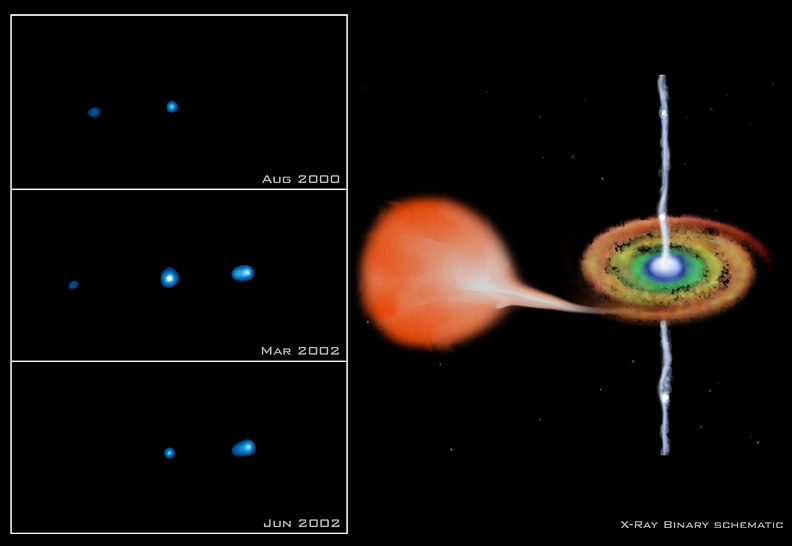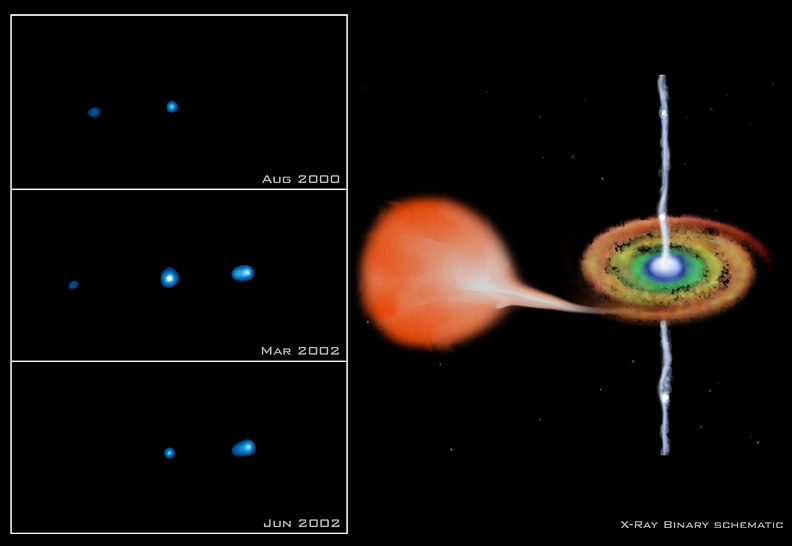
The motion of ultra-fast jets shooting out from a candidate black hole star system have now been documented by observations from the orbiting Chandra X-ray Observatory. In 1998, X-ray source XTE J1550-564 underwent a tremendous outburst. Jets of material sent streaming into space at near light-speed impacted existing gas heating it so much it glowed in X-ray light. The panels on the left of the above image show in X-rays that the hot spots have moved out by more than three light years in the time since the explosion, with the left jet recently fading below detectability. The drawing of the right depicts the binary star system that likely produced the X-ray jets, with a normal red star on the left dumping matter into an accretion disk around the black hole on the right. The jets are thought to be emitted along the spin axis of the black hole.
El movimiento de jets ultrarrápidos que salen disparados de un sistema de candidato agujero negro han sido documentados ahora por observaciones del Observatorio de Rayos X orbital Chandra. En 1998, la fuente de rayos X XTE J1550-564 experimentó un brote tremendamente energético. Jets de materia se dirigieron hacia el espacio a velocidades cercanas a la de la luz, impactando el gas existente y calentándolo tanto que emitía luz en rayos X. Los paneles de la izquierda de la imagen anterior muestran en rayos X que los puntos calientes se han movido más de tres años luz desde el tiempo de la explosión, con el jet izquierdo desvanecida recientemente por debajo de los límites de detección. El dibujo de la derecha representa el sistema de estrellas binarias que probablemente produjo los jets de rayos X, con una estrella roja normal a la izquierda vertiendo materia en un disco de acreción alrededor del agujero negro a la derecha. Se cree que los jets son emitidos a lo largo del eje de rotación del agujero negro.