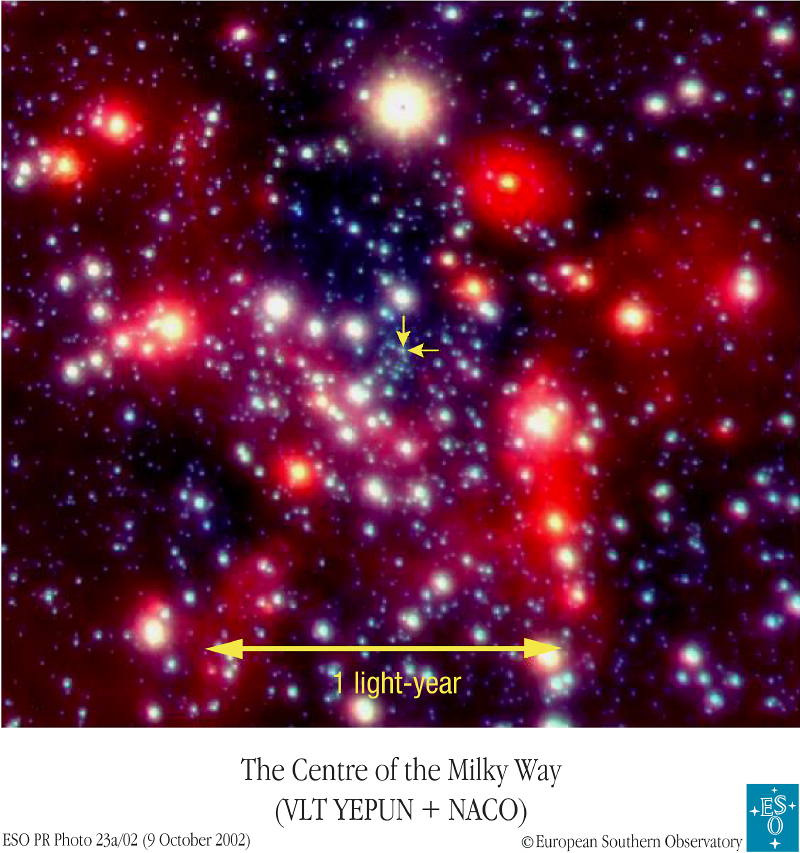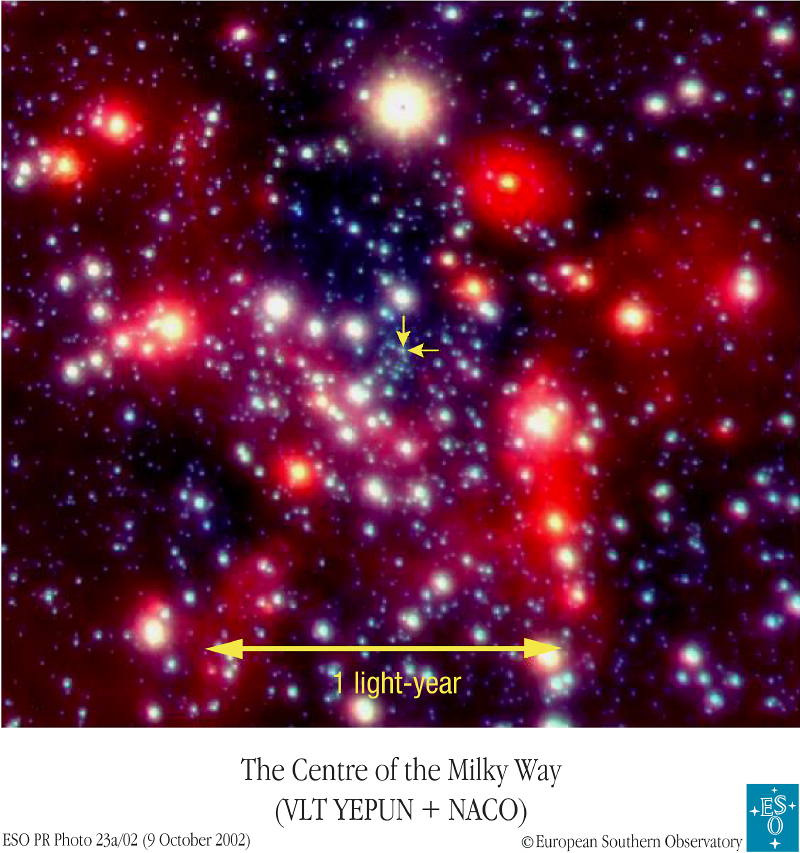
At the center of our Milky Way Galaxy lies a black hole with over 2 million times the mass of the Sun. Once a controversial claim, this astounding conclusion is now virtually inescapable and based on observations of stars orbiting very near the galactic center. Using one of the Paranal Observatory's very large telescopes and the sophisticated infrared camera NACO, astronomers patiently followed the orbit of a particular star, designated S2, as it came within about 17 light-hours of the center of the Milky Way (17 light-hours is only about 3 times the radius of Pluto's orbit). Their results convincingly show that S2 is moving under the influence of the enormous gravity of an unseen object which must be extremely compact -- a supermassive black hole. This deep NACO near-infrared image shows the crowded inner 2 light-years of the Milky Way with the exact position of the galactic center indicated by arrows. NACO's ability to track stars so close to the galactic center can accurately measure the black hole's mass and perhaps even provide an unprecedented test of Einstein's theory of gravity as astronomers watch a star orbit a supermassive black hole.
En el centro de nuestra Galaxia de la Vía Láctea se encuentra un agujero negro con una masa superior a 2 millones de veces la del Sol. Antaño una afirmación controvertida, esta asombrosa conclusión es ahora prácticamente inevitable y se basa en observaciones de estrellas que orbitan muy cerca del centro galáctico. Utilizando uno de los telescopios muy grandes del Observatorio Paranal y la sofisticada cámara infrarroja NACO, los astrónomos siguieron pacientemente la órbita de una estrella particular, designada S2, cuando se acercó a aproximadamente 17 horas-luz del centro de la Vía Láctea (17 horas-luz es solo aproximadamente 3 veces el radio de la órbita de Plutón). Sus resultados demuestran convincentemente que S2 se mueve bajo la influencia de la enorme gravedad de un objeto invisible que debe ser extremadamente compacto: un agujero negro supermasivo. Esta profunda imagen infrarroja cercana de NACO muestra los abarrotados 2 años-luz interiores de la Vía Láctea con la posición exacta del centro galáctico indicada por flechas. La capacidad de NACO para rastrear estrellas tan cerca del centro galáctico puede medir con precisión la masa del agujero negro y quizás incluso proporcionar una prueba sin precedentes de la teoría de la gravedad de Einstein mientras los astrónomos observan una estrella orbitando un agujero negro supermasivo.