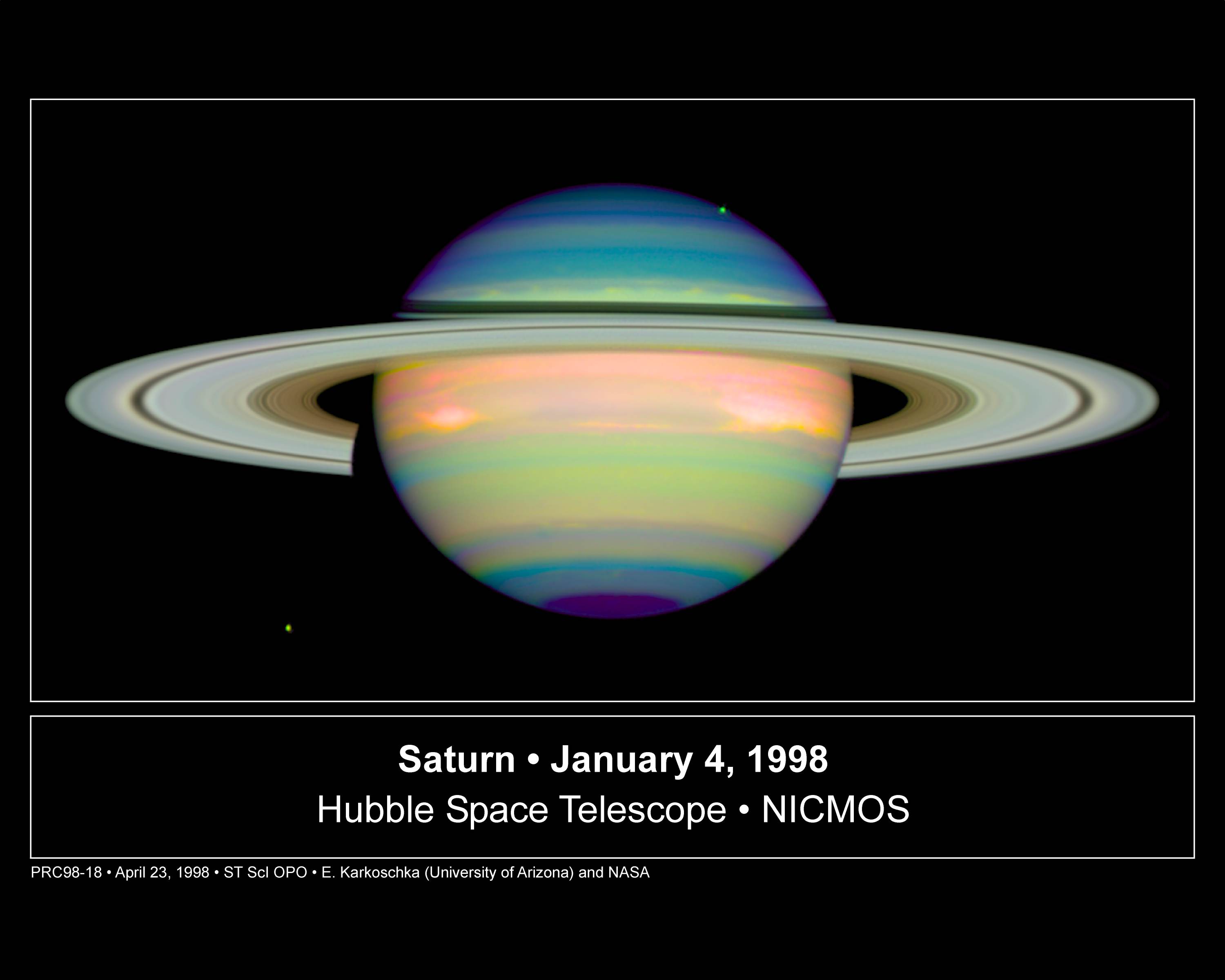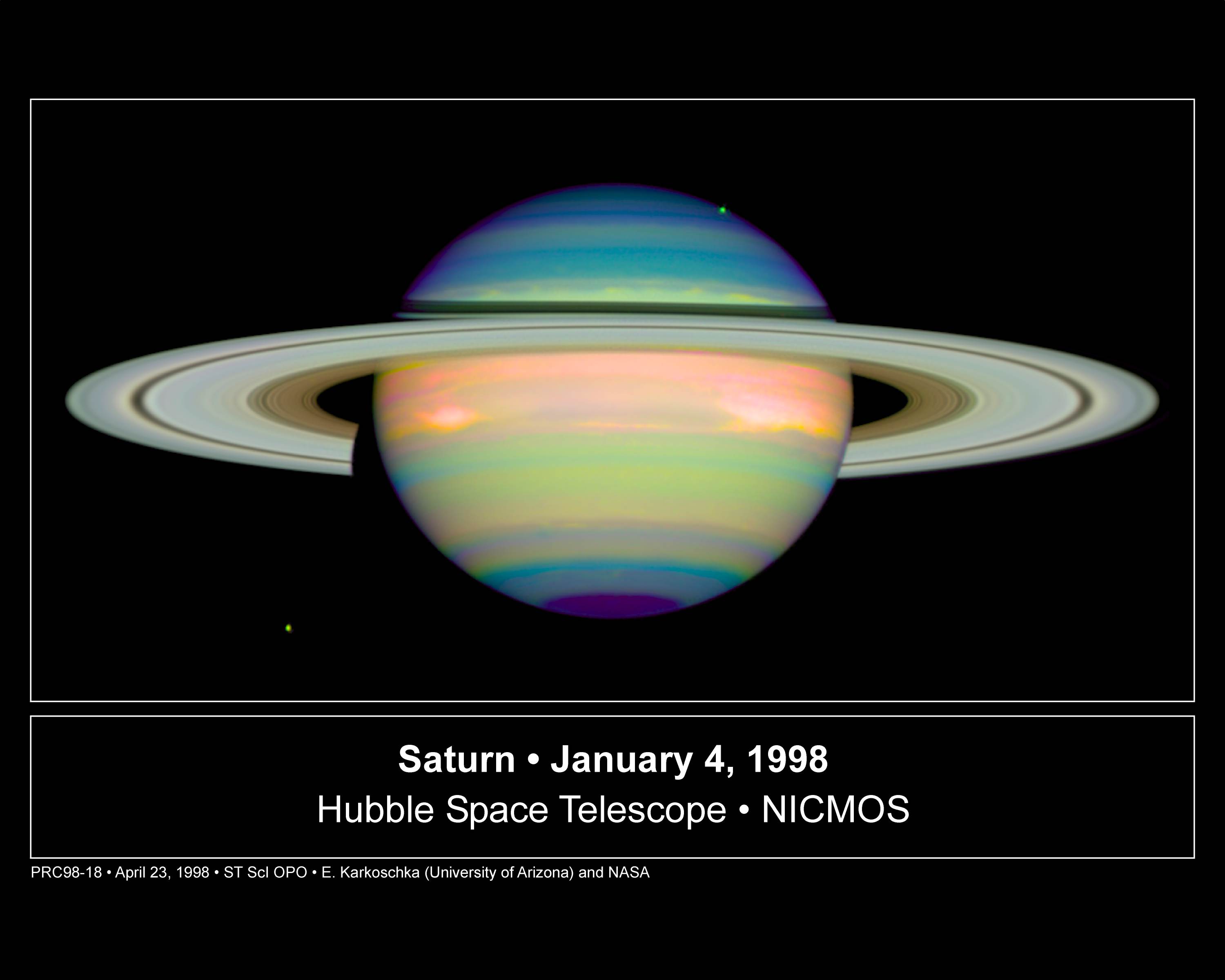
This delightfully detailed false-color image of Saturn was taken in January 1998 by the orbiting Hubble Space Telescope. The picture is a combination of three images from Hubble's NICMOS instrument and shows the lovely ringed planet in reflected infrared sunlight. Different colors indicated varying heights and compositions of cloud layers generally thought to consist of ammonia ice crystals. The eye-catching rings cast a shadow on Saturn's upper hemisphere. The bright stripe seen within the left portion of the shadow is infrared sunlight streaming through the large gap in the rings known as the Cassini Division. Two of Saturn's many moons have also put in an appearance, Tethys just beyond the planet's disk at the upper right, and Dione at the lower left. Presently, Saturn shines brightly in evening skies as a pale yellow "star" near the constellation Orion.
Esta imagen en falsos colores extraordinariamente detallada de Saturno fue capturada en enero de 1998 por el Telescopio Espacial Hubble en órbita. La imagen es una combinación de tres capturas del instrumento NICMOS del Hubble y muestra al hermoso planeta anillado bajo luz solar infrarroja reflejada. Los diferentes colores indican variaciones en las alturas y composiciones de las capas de nubes, que generalmente se consideran constituidas por cristales de hielo de amoníaco. Los llamativos anillos proyectan una sombra en el hemisferio superior de Saturno. La franja brillante visible dentro de la porción izquierda de la sombra es luz solar infrarroja que atraviesa la gran brecha en los anillos conocida como División de Cassini. Dos de las numerosas lunas de Saturno también hacen acto de presencia: Tetis justo más allá del disco del planeta en la parte superior derecha, y Dione en la parte inferior izquierda. En la actualidad, Saturno brilla intensamente en los cielos vespertinos como una "estrella" de color amarillo pálido cerca de la constelación de Orión.