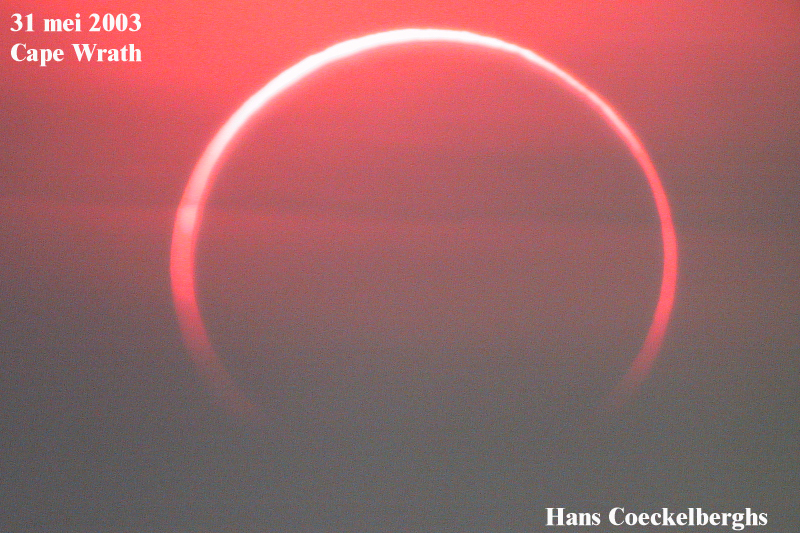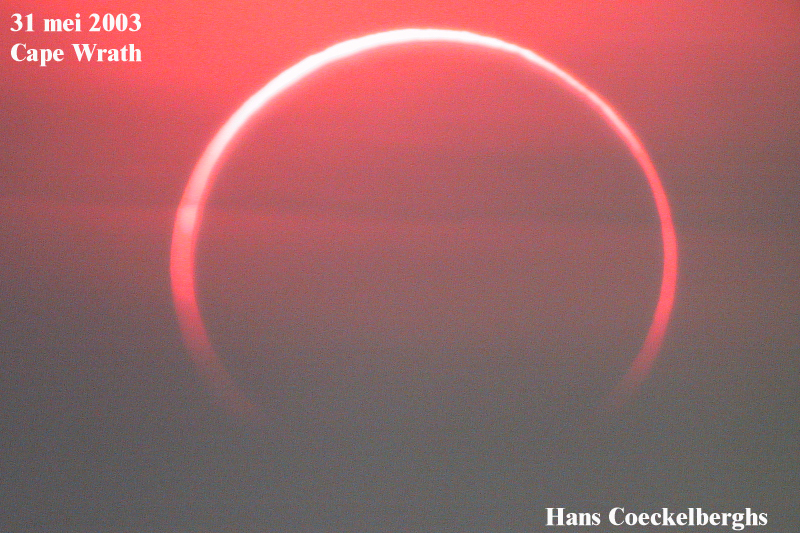
If the Moon's apparent diameter is not quite large enough to cover the Sun during a solar eclipse, an annular eclipse can be the result -- a spectacle of silhouetted Moon surrounded by a solar "ring of fire". Just such a view was possible for observers in the far northern hemisphere as the new Moon slid across the solar disk on May 31st. Still, for astronomical adventurers at Cape Wrath on the northwestern coast of Scotland, the eastern sky was cloudy on eclipse day. But fortunately the Sun became visible a few minutes prior to the annular phase and determined astronomer Hans Coeckelberghs was able to capture this dramatic telescopic image of the eclipsed Sun's ring of fire looming through a reddened, cloud-streaked sky. Not to be outdone by the north, the far southern hemisphere will host the next solar eclipse, with the path of totality racing across Antarctica on November 23rd.
Si el diámetro aparente de la Luna no es lo suficientemente grande para cubrir completamente el Sol durante un eclipse solar, puede ocurrir un eclipse anular, un espectáculo con la Luna en silueta rodeada por un "anillo de fuego" solar. Una vista así fue posible para los observadores del hemisferio norte lejano cuando la Luna nueva se deslizó a través del disco solar el 31 de mayo. Sin embargo, para los aventureros astronómicos en Cabo Wrath, en la costa noroeste de Escocia, el cielo oriental estaba nublado en el día del eclipse. Afortunadamente, el Sol se volvió visible unos minutos antes de la fase anular y el astrónomo entusiasta Hans Coeckelberghs logró capturar esta dramática imagen telescópica del anillo de fuego del Sol eclipsado asomándose a través de un cielo rojizo y surcado de nubes. Sin ser superado por el norte, el hemisferio sur lejano será anfitrión del próximo eclipse solar, con la ruta de totalidad atravesando la Antártida el 23 de noviembre.