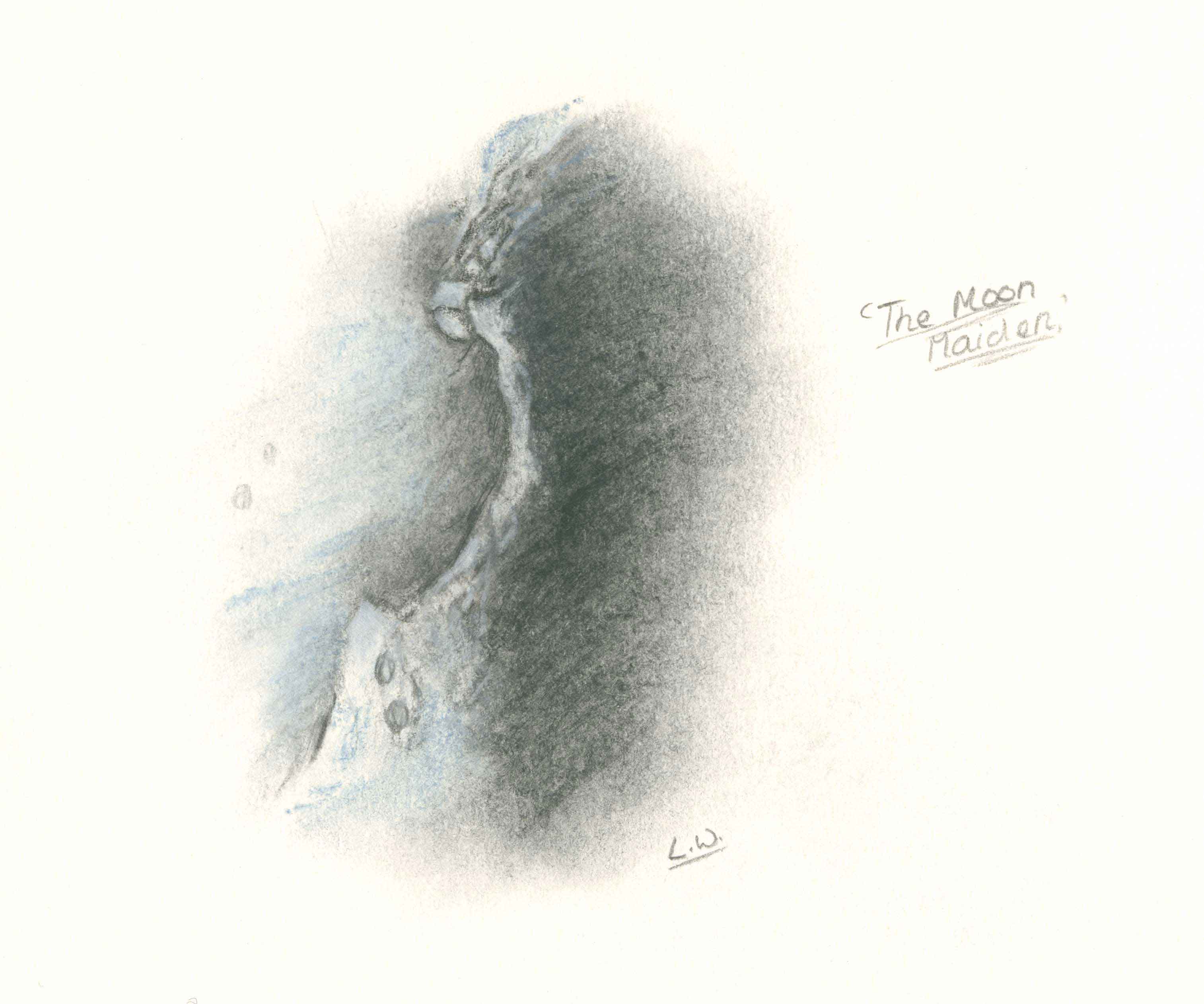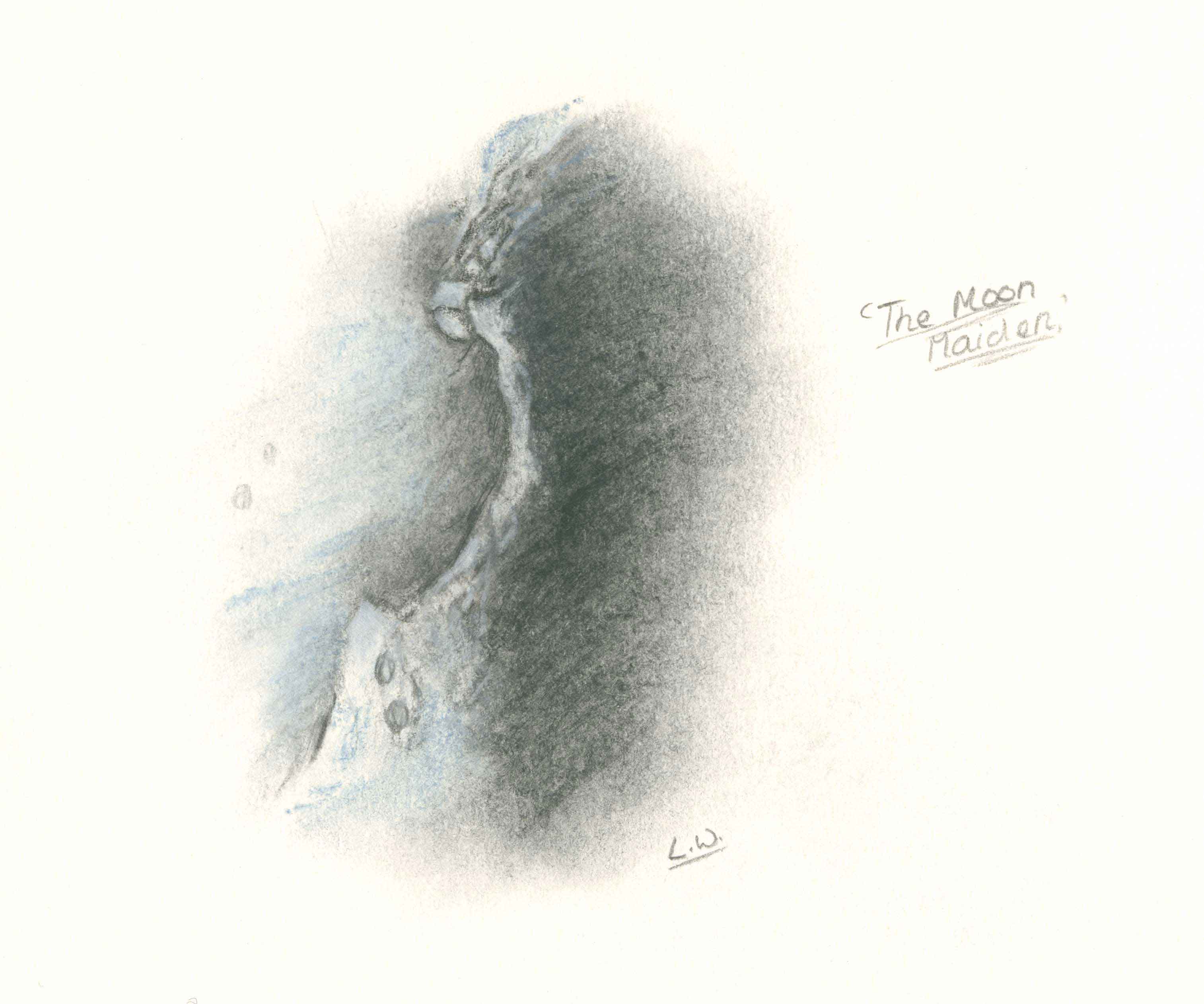
Along the northwestern reaches of the lunar near side, the Sinus Iridum or Bay of Rainbows appropriately lies at the edge of the Moon's smooth, dark Sea of Rains (Mare Imbrium). In this sketch of the lunar surface around the Bay of Rainbows, the sun shines from the left, illuminating the arcing wall of the lava-floored bay. The bay's Cape Heraclides, seen here at the top of the sunlit arc, has been historically depicted as a moon maiden whose hair streams behind her as she gazes sunward across the bay. In the original Moon race - the race to map the Moon - this moon maiden first appeared in telescope-based drawings of the lunar surface by astronomer Giovanni Cassini in 1679. Still gazing across the lunar bay, the moon maiden inspired this drawing by modern day astronomer, Lucy Whitehouse. Done when she was 14, her sketch of the intriguing feature was made from the countryside in northern England, aided by a telescope equipped with a digital imaging eyepiece and a small television screen.
En los confines noroccidentales de la cara visible de la Luna, el Sinus Iridum o Bahía de los Arcoíris se encuentra apropiadamente en el borde del liso y oscuro Mar de las Lluvias (Mare Imbrium). En este bosquejo de la superficie lunar alrededor de la Bahía de los Arcoíris, el sol brilla desde la izquierda, iluminando la pared arqueada del fondo de lava de la bahía. El Cabo Heraclides de la bahía, visible aquí en la parte superior del arco iluminado, ha sido históricamente representado como una doncella lunar cuyo cabello se extiende detrás de ella mientras contempla hacia el sol a través de la bahía. En la carrera lunar original—la carrera por cartografiar la Luna—esta doncella lunar apareció por primera vez en dibujos basados en observaciones telescópicas de la superficie lunar realizados por el astrónomo Giovanni Cassini en 1679. Aún contemplando la bahía lunar, la doncella lunar inspiró este dibujo del astrónoma contemporánea Lucy Whitehouse. Realizado cuando ella tenía 14 años, su bosquejo de esta característica intrigante fue hecho desde el campo en el norte de Inglaterra, con la ayuda de un telescopio equipado con un ocular de imagen digital y una pequeña pantalla de televisión.