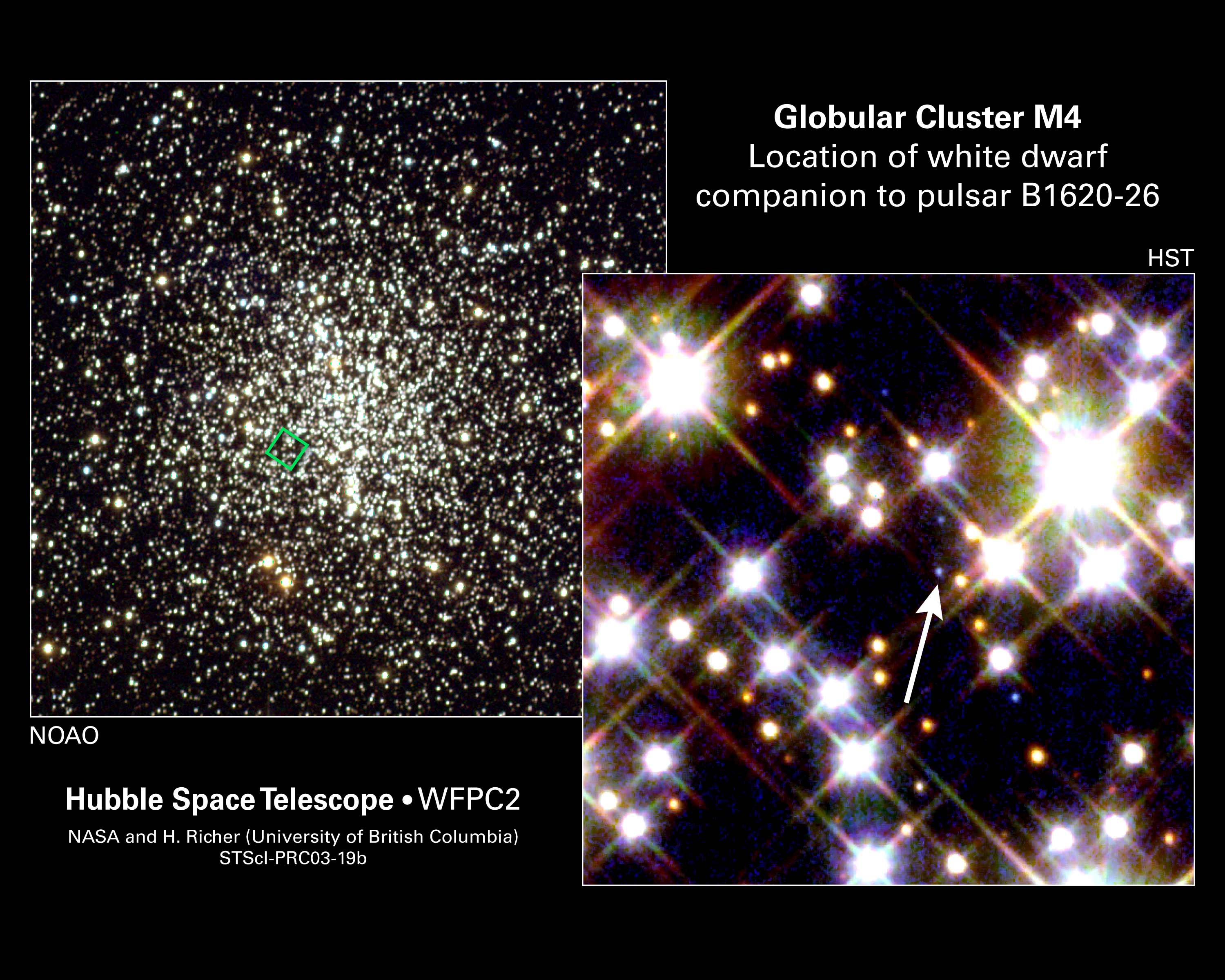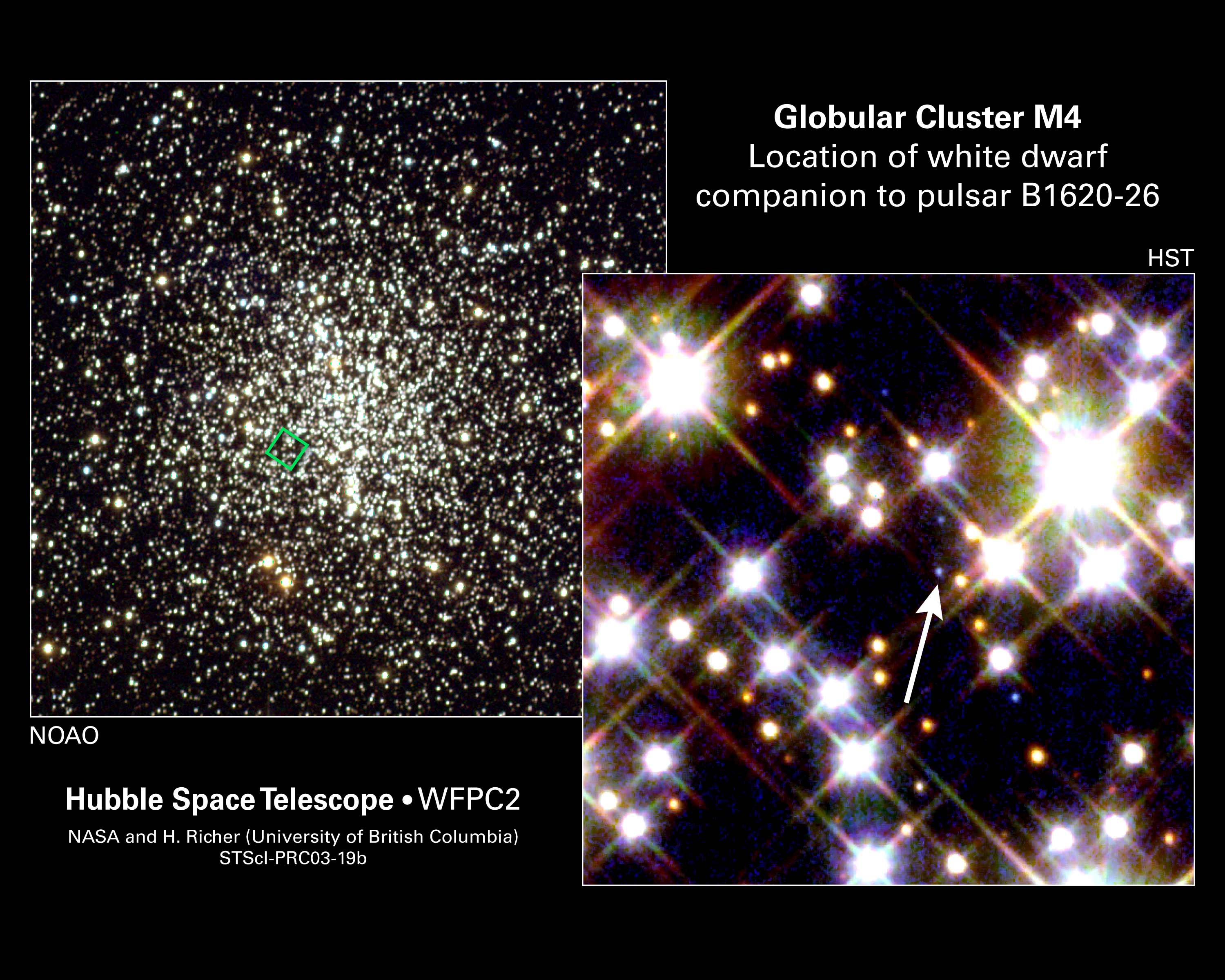
A planet, a white dwarf, and a neutron star orbit each other in the giant globular star cluster M4, some 5,600 light-years away. The most visible member of the trio is the white dwarf star, indicated above in an image from the Hubble Space Telescope, while the neutron star is detected at radio frequencies as a pulsar. A third body was known to be present in the pulsar/white dwarf system and a detailed analysis of the Hubble data has indicated it is indeed a planet with about 2.5 times the mass of Jupiter. In such a system, the planet is likely to be about 13 billion years old. Compared to our solar system's tender 4.5 billion years and other identified planets of nearby stars, this truly ancient world is by far the oldest planet known, almost as old as the Universe itself. Its discovery as part of an evolved cosmic trio suggests that planet formation spans the age of the Universe and that this newly discovered planet is likely only one of many formed in the crowded environs of globular star clusters.
Un planeta, una enana blanca y una estrella de neutrones orbitan mutuamente en el gigantesco cúmulo globular M4, a unos 5.600 años luz de distancia. El miembro más visible del trío es la estrella enana blanca, indicada arriba en una imagen del Telescopio Espacial Hubble, mientras que la estrella de neutrones se detecta en frecuencias de radio como un púlsar. Se sabía que un tercer cuerpo estaba presente en el sistema de púlsar/enana blanca, y un análisis detallado de los datos del Hubble ha indicado que es efectivamente un planeta con una masa aproximadamente 2,5 veces la de Júpiter. En tal sistema, el planeta probablemente tenga unos 13 mil millones de años de antigüedad. Comparado con los tiernos 4.500 millones de años de nuestro sistema solar y otros planetas identificados alrededor de estrellas cercanas, este mundo verdaderamente antiguo es con diferencia el planeta más antiguo conocido, casi tan viejo como el Universo mismo. Su descubrimiento como parte de un trío cósmico evolucionado sugiere que la formación planetaria abarca toda la edad del Universo y que este planeta recién descubierto es probablemente solo uno de muchos formados en los entornos poblados de los cúmulos globulares.