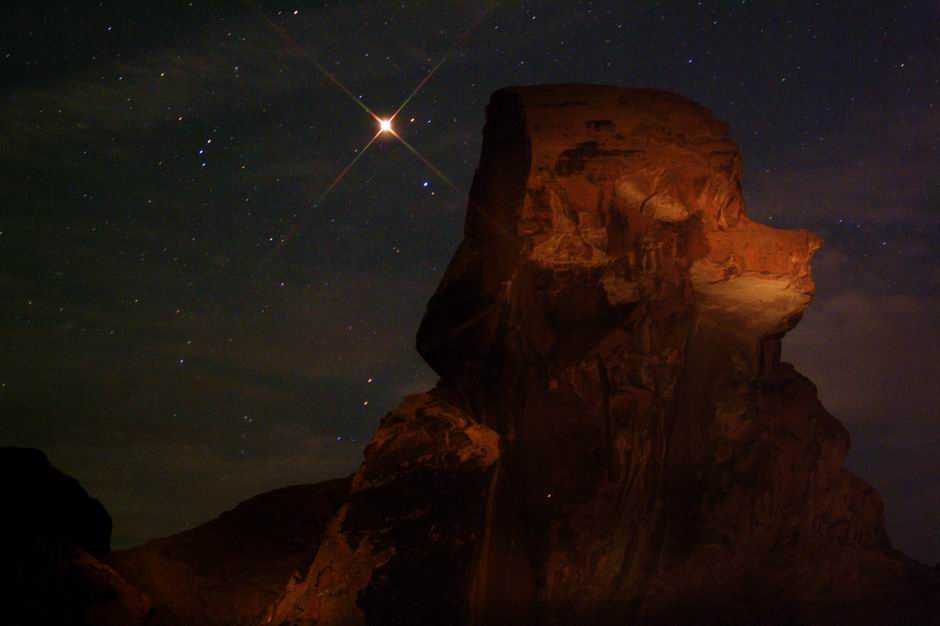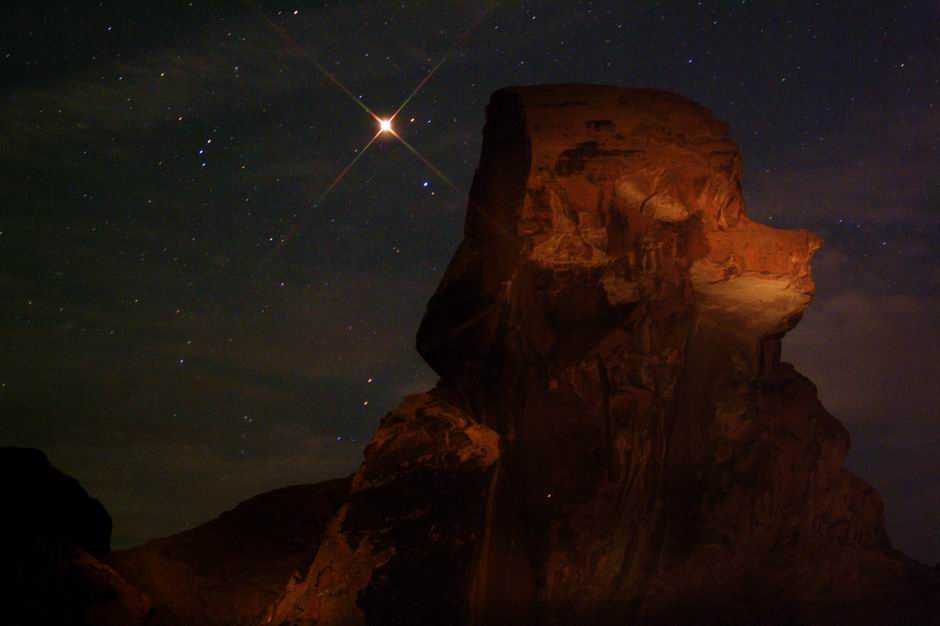
Have you seen Mars lately? As Earth and Mars near their closest approach in nearly 60,000 years on August 27, the red planet has begun to appear dramatically bright and show interesting details through telescopes and binoculars. Although not yet visible at sunset, Mars can be seen rising increasingly earlier in the evening. Once above the horizon, Mars is easy to spot, as it sports a distinct orange-red hue and it is the brightest object in the sky after the Sun, the nearby Moon, and Venus. After Earth overtakes Mars in their respective solar orbits, Mars will be visible right from sunset, although its historic brightness will then begin to fade. Pictured above, Mars was captured rising in the south east next to Poodle Rock in Valley of Fire State Park, Nevada, USA.
¿Ha visto Marte recientemente? Conforme la Tierra y Marte se acercan a su mayor aproximación en casi 60 000 años el 27 de agosto, el planeta rojo ha comenzado a aparecer dramáticamente brillante y mostrar detalles interesantes a través de telescopios y binoculares. Aunque aún no es visible al atardecer, Marte puede verse elevándose cada vez más temprano en la noche. Una vez por encima del horizonte, Marte es fácil de detectar, ya que luce un distintivo tono naranja-rojo y es el objeto más brillante en el cielo después del Sol, la Luna cercana y Venus. Después de que la Tierra adelante a Marte en sus respectivas órbitas solares, Marte será visible desde el atardecer, aunque su brillo histórico comenzará a desvanecerse. En la imagen anterior, Marte fue capturado elevándose en el sureste junto a la Roca Poodle en el Parque Estatal Valley of Fire, Nevada, Estados Unidos.