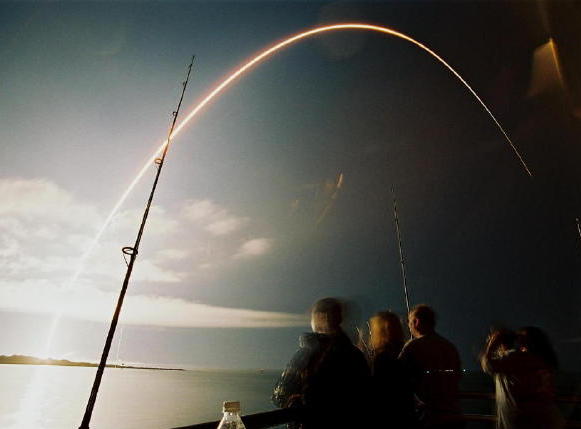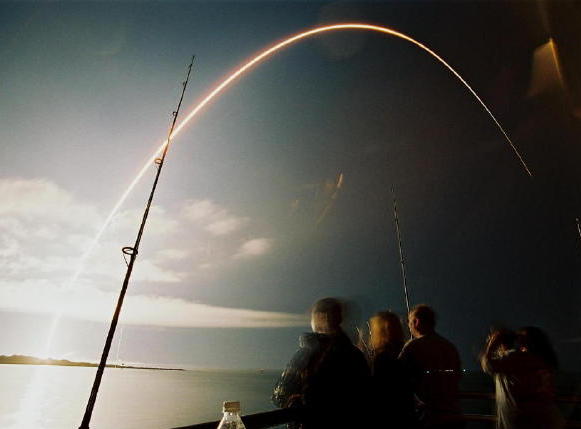
Streaking skyward, a Boeing Delta 2-Heavy rocket carries NASA's Space InfraRed Telescope Facility (SIRTF) aloft during the early morning hours of August 25th. The dramatic scene was recorded in a time exposure from the pier in Jetty Park at the northern end of Cocoa Beach, Florida, about 2.5 miles from the Cape Canaveral launch site. SIRTF (sounds like "sir tiff") will explore the distant Universe in infrared light as the fourth and final satellite observatory in NASA's Great Observatories Program. The three other large astrophysics satellites were designed for higher energies in the electromagnetic spectrum, with the Hubble Space Telescope operating near visible wavelengths, the Compton Gamma Ray Observatory instruments sensitive to gamma rays, and the Chandra Observatory detecting cosmic x-rays. SIRTF has been launched into an Earth-trailing solar orbit to reduce its exposure to infrared radiation from our fair planet. Cooled by an on board supply of liquid helium, SIRTF's infrared detectors will operate at near absolute zero temperatures. Presently, SIRTF's systems are undergoing a 90-day check out.
Trazando un camino hacia el cielo, un cohete Boeing Delta 2-Heavy transporta la Instalación de Telescopio Infrarrojo Espacial (SIRTF) de la NASA durante las primeras horas de la mañana del 25 de agosto. La escena dramática fue capturada en una exposición prolongada desde el muelle en Jetty Park, en el extremo norte de Cocoa Beach, Florida, aproximadamente a 4 kilómetros del sitio de lanzamiento de Cabo Cañaveral. SIRTF (pronunciado "sir tiff") explorará el Universo distante en luz infrarroja como el cuarto y último observatorio satelital del Programa de Grandes Observatorios de la NASA. Los otros tres grandes satélites de astrofísica fueron diseñados para energías más altas en el espectro electromagnético: el Telescopio Espacial Hubble opera cerca de longitudes de onda visibles, los instrumentos del Observatorio Compton de Rayos Gamma son sensibles a rayos gamma, y el Observatorio Chandra detecta rayos X cósmicos. SIRTF ha sido lanzado a una órbita solar de arrastre terrestre para reducir su exposición a la radiación infrarroja de nuestro hermoso planeta. Enfriado por un suministro a bordo de helio líquido, los detectores infrarrojos del SIRTF operarán a temperaturas cercanas al cero absoluto. Actualmente, los sistemas del SIRTF se encuentran en una etapa de verificación de 90 días.