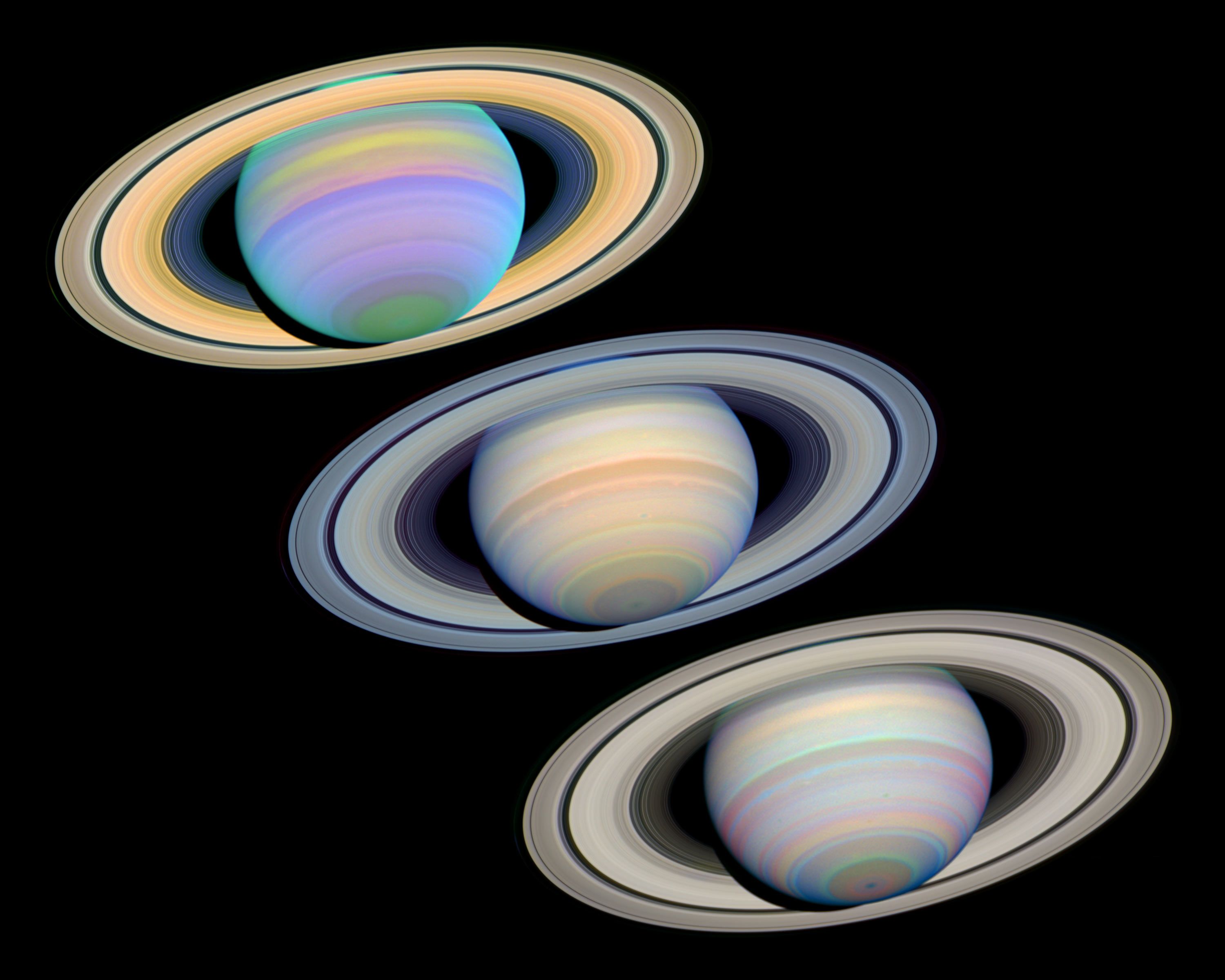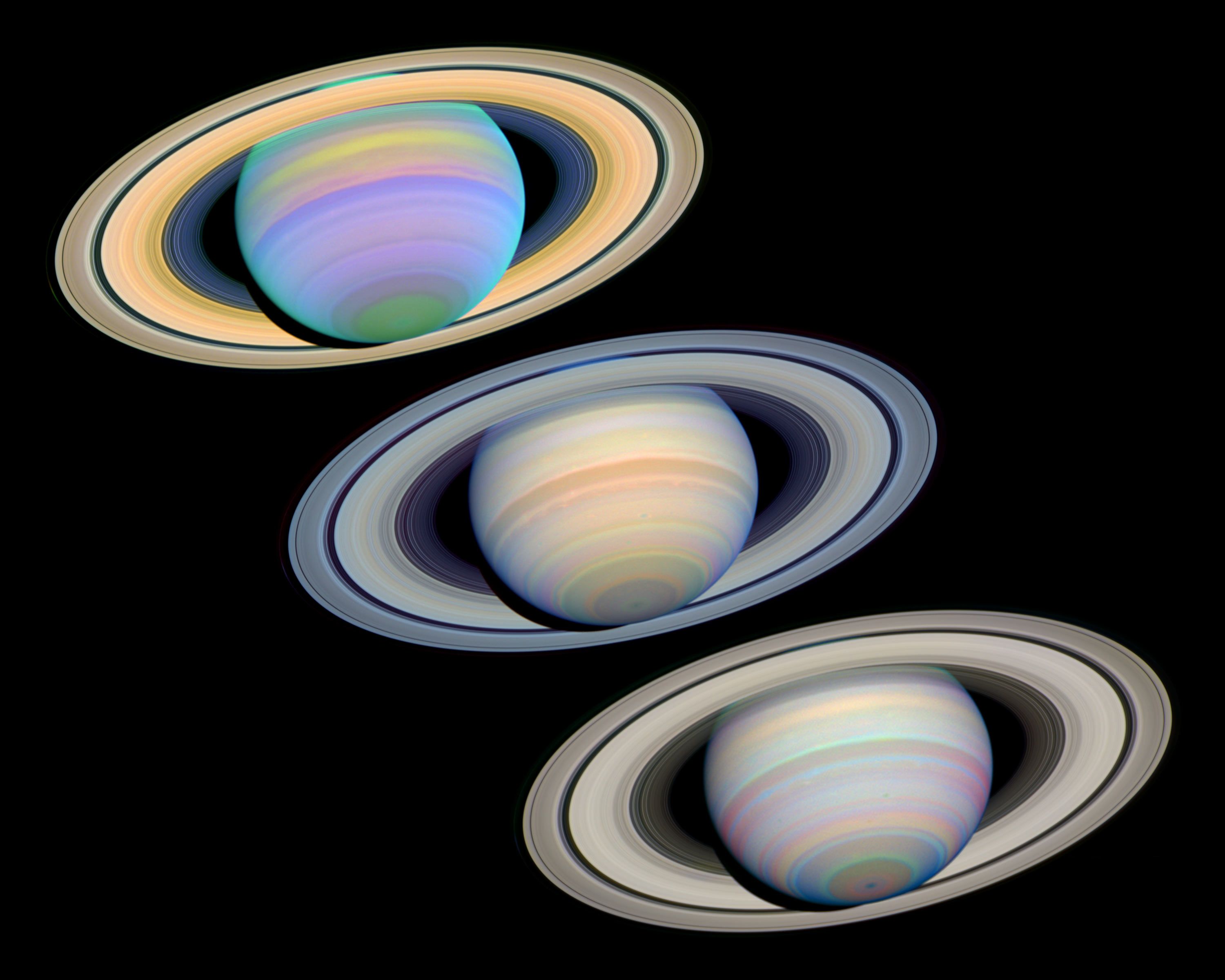
These three views of Saturn were recorded by the Hubble Space Telescope on March 7th of this year, as the southern hemisphere of the solar system's most gorgeous planet reached its maximum 27 degree tilt toward Earth. The images used to construct the false-color pictures were made through a combination of filters covering the electromagnetic spectrum from ultraviolet (top), to visible (middle) and infrared (bottom) wavelengths highlighting different features in the Saturnian atmospheric bands and rings. Well known for its bright ring system and large, mysterious moon Titan, gas giant Saturn is also a planet with a dynamic atmosphere and high-speed winds. In fact, in the 1980s, Voyager spacecraft measured equatorial winds of over 1,000 miles per hour. Giant storm systems, comparable in size to planet Earth itself, have been seen erupting in Saturn's cloud tops.
Estas tres vistas de Saturno fueron registradas por el Telescopio Espacial Hubble el 7 de marzo de este año, cuando el hemisferio sur del planeta más hermoso del sistema solar alcanzó su inclinación máxima de 27 grados hacia la Tierra. Las imágenes utilizadas para construir estas fotografías en falso color fueron capturadas a través de una combinación de filtros que cubren el espectro electromagnético desde la radiación ultravioleta (superior), pasando por la luz visible (centro) hasta las longitudes de onda infrarroja (inferior), resaltando diferentes características en las bandas atmosféricas y los anillos de Saturno. Conocido por su brillante sistema de anillos y su gran luna misteriosa Titán, el gigante gaseoso Saturno es también un planeta con una atmósfera dinámica y vientos de alta velocidad. De hecho, en los años ochenta, las naves espaciales Voyager midieron vientos ecuatoriales superiores a 1,600 kilómetros por hora. Se han observado gigantescos sistemas de tormentas, comparables en tamaño al planeta Tierra, irrumpiendo en las cimas nubosas de Saturno.