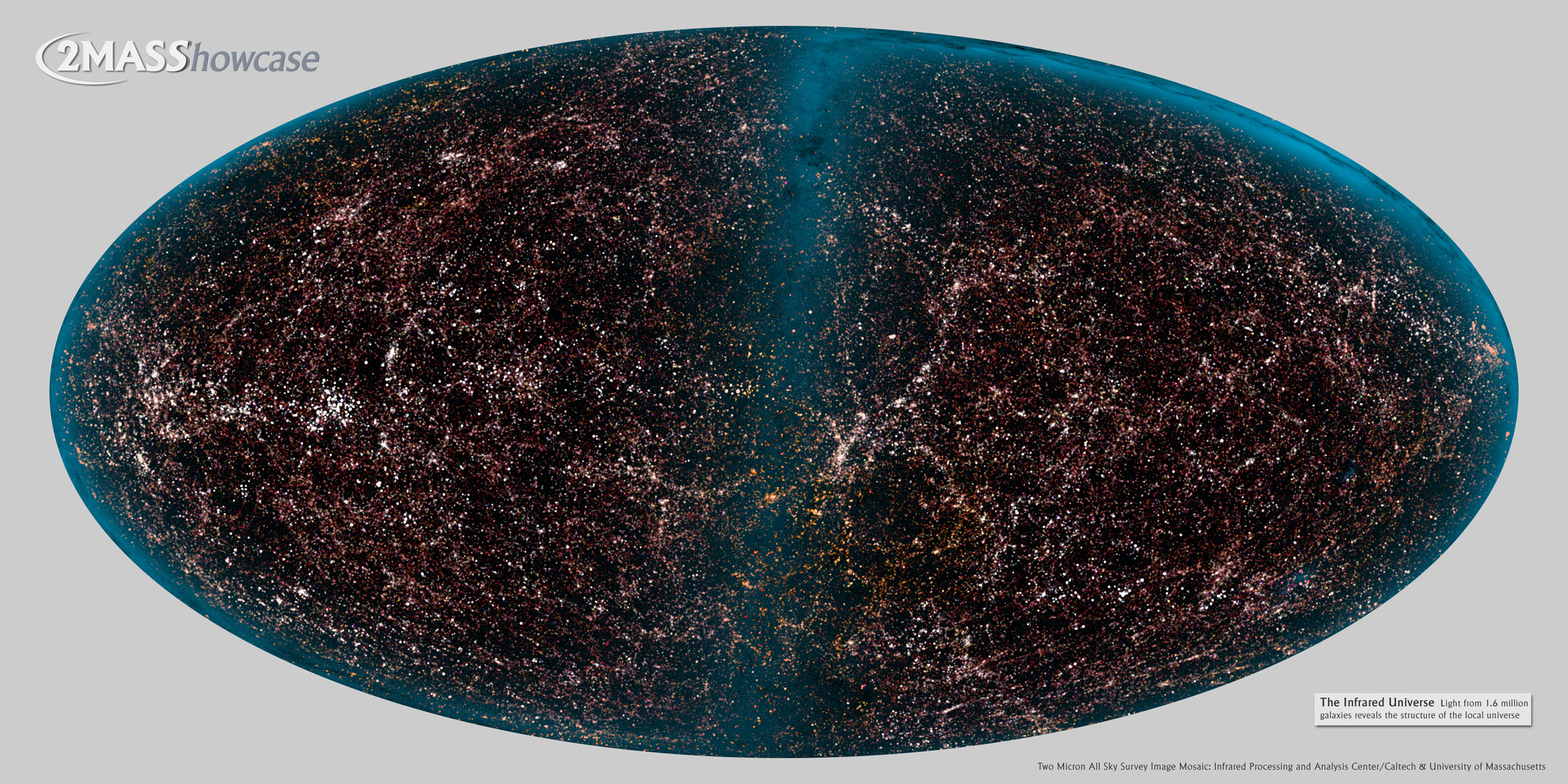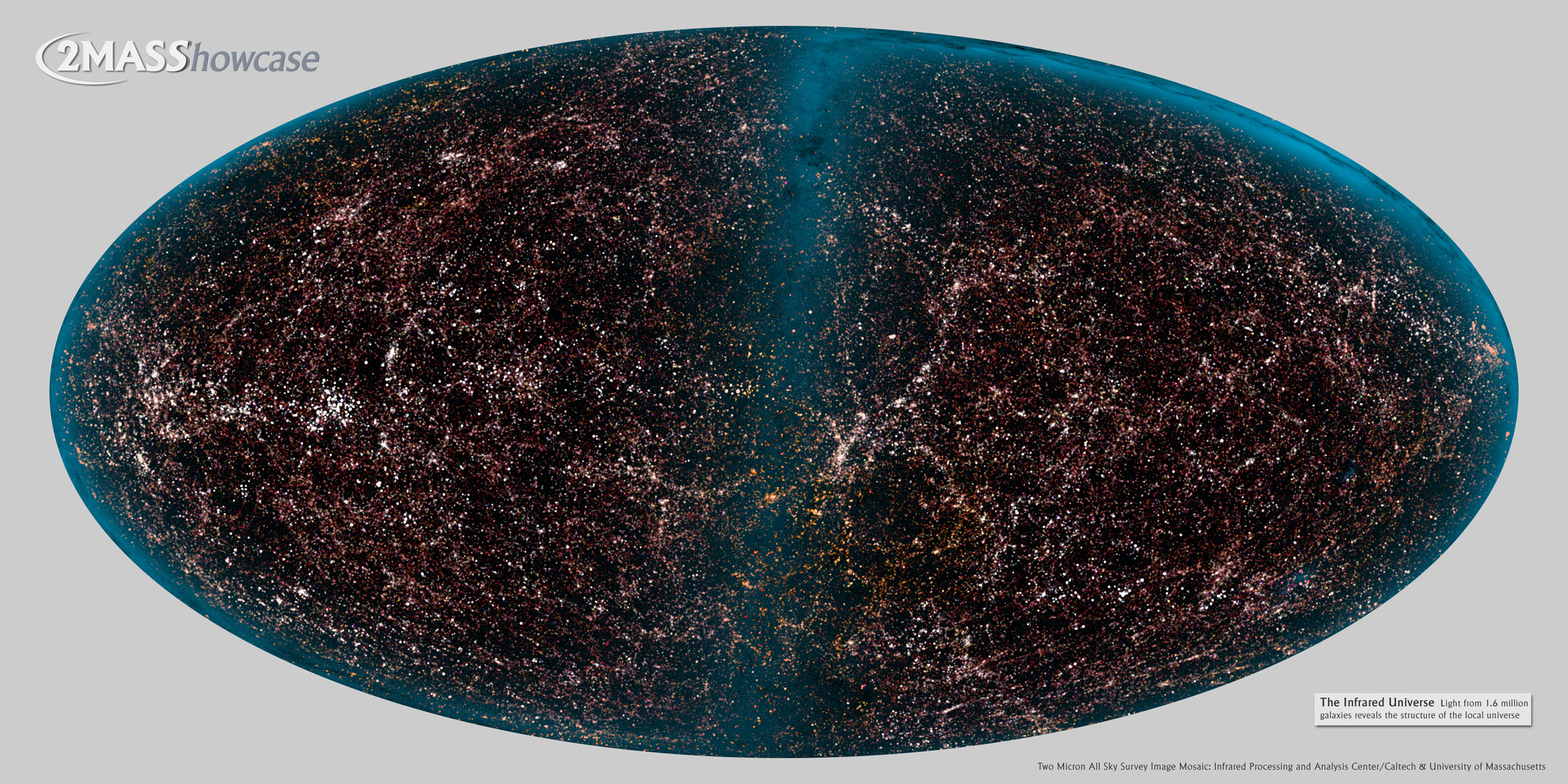
Are the nearest galaxies distributed randomly? A plot of over one million of the brightest "extended sources" detected by the Two Micron All Sky Survey (2MASS) shows that they are not. The vast majority of these infrared extended sources are galaxies. Visible above is an incredible tapestry of structure that provides limits on how the universe formed and evolved. Many galaxies are gravitationally bound together to form clusters, which themselves are loosely bound into superclusters, which in turn are sometimes seen to align over even larger scale structures. In contrast, very bright stars inside our own Milky Way Galaxy cause the vertical blue sash.
¿Se distribuyen aleatoriamente las galaxias más cercanas? Un gráfico de más de un millón de las "fuentes extendidas" más brillantes detectadas por la Encuesta de Todo el Cielo de Dos Micrones (2MASS) muestra que no es así. La gran mayoría de estas fuentes extendidas en infrarrojo son galaxias. Lo visible arriba es un tapiz increíble de estructura que proporciona límites sobre cómo se formó y evolucionó el universo. Muchas galaxias están gravitacionalmente ligadas entre sí para formar cúmulos, que a su vez están débilmente ligados en supercúmulos, que a veces se alinean en estructuras aún de mayor escala. En contraste, las estrellas muy brillantes dentro de nuestra propia Galaxia Vía Láctea producen la banda azul vertical.