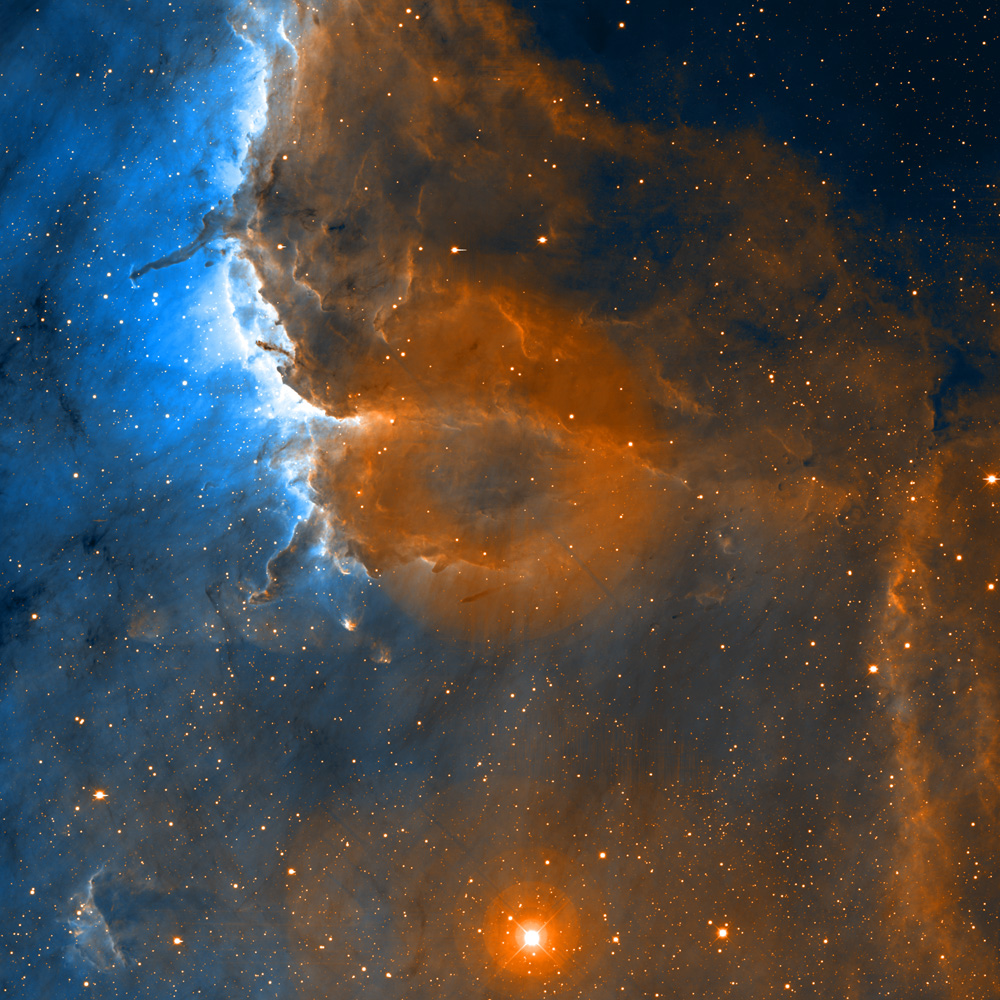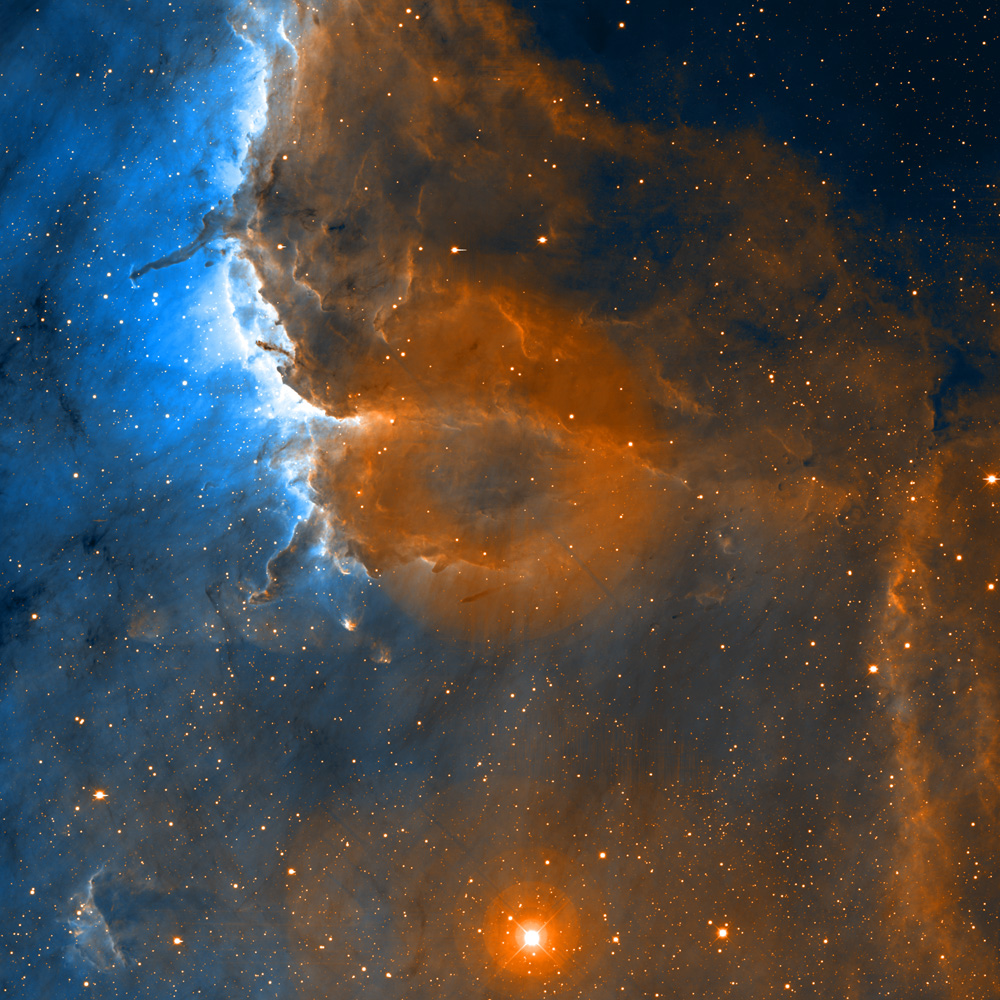
What's happening to the Pelican Nebula? The light from young energetic stars is slowly transforming the Pelican's cold gas to hot gas, with the advancing boundary between the two known as an ionization front. Most of these bright stars lie off the top of the image, but part of the bright ionization front crosses on the upper right. Particularly dense and intricate filaments of cold gas are visible along the front. Millions of years from now this nebula might no longer be known as the Pelican, as the balance and placement of stars and gas will leave something that appears completely different. The above image was taken with the Mayall 4-meter telescope at Kitt Peak National Observatory in Arizona, USA. The large circular artifact below the image center is not real. The nebula, also known as IC 5070, spans about 30 light years and lies about 1800 light years away toward the constellation of Cygnus.
¿Qué está sucediendo en la Nebulosa Pelícano? La luz de jóvenes estrellas energéticas está transformando lentamente el gas frío del Pelícano en gas caliente, siendo el límite avanzado entre ambos conocido como frente de ionización. La mayoría de estas estrellas brillantes se encuentran fuera del borde superior de la imagen, pero parte del frente de ionización brillante cruza en la esquina superior derecha. Filamentos particularmente densos e intrincados de gas frío son visibles a lo largo del frente. Millones de años en el futuro, esta nebulosa podría dejar de ser conocida como el Pelícano, ya que el balance y la posición de las estrellas y el gas dejará algo que parece completamente diferente. La imagen anterior fue tomada con el telescopio Mayall de 4 metros en el Observatorio Nacional de Kitt Peak en Arizona, EE.UU. El gran artefacto circular debajo del centro de la imagen no es real. La nebulosa, también conocida como IC 5070, se extiende aproximadamente 30 años luz y se encuentra a unos 1800 años luz de distancia hacia la constelación del Cisne.