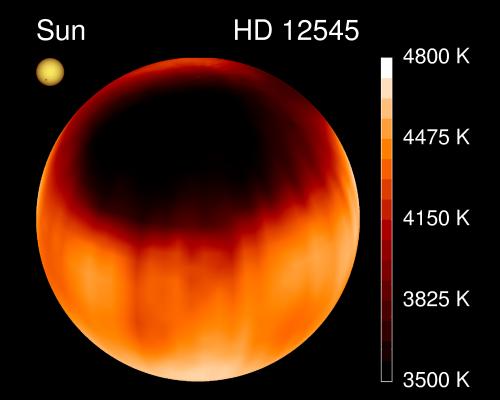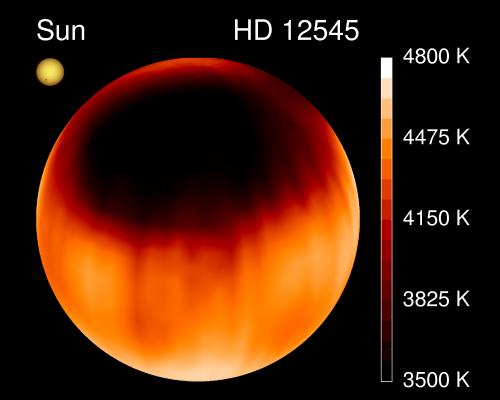
What could cause a star to have such a large spot? Our Sun itself frequently has sunspots, relatively cool dark magnetic depressions that move across its surface. HD 12545, however, exhibits the largest starspots yet observed. Doppler imaging - the use of slight changes in color caused by the rotation of the star - was used to create this false-color image. The vertical bar on the right gives a temperature scale in kelvins. This giant, binary, RS CVn star, also known as XX Trianguli, is visible with binoculars in the constellation of Triangulum. The starspot is thought to be caused by large magnetic fields that inhibit hot matter from flowing to the surface.
¿Qué podría causar que una estrella tenga una mancha tan grande? Nuestro Sol presenta con frecuencia manchas solares, depresiones magnéticas relativamente frías y oscuras que se desplazan sobre su superficie. Sin embargo, HD 12545 exhibe las manchas estelares más grandes jamás observadas. Se utilizó la técnica de imagen Doppler —el uso de ligeros cambios de color causados por la rotación de la estrella— para crear esta imagen en falso color. La barra vertical a la derecha proporciona una escala de temperatura en kelvins. Esta estrella binaria gigante de tipo RS CVn, también conocida como XX Trianguli, es visible con binoculares en la constelación del Triángulo. Se cree que la mancha estelar es causada por grandes campos magnéticos que impiden que la materia caliente fluya hacia la superficie.