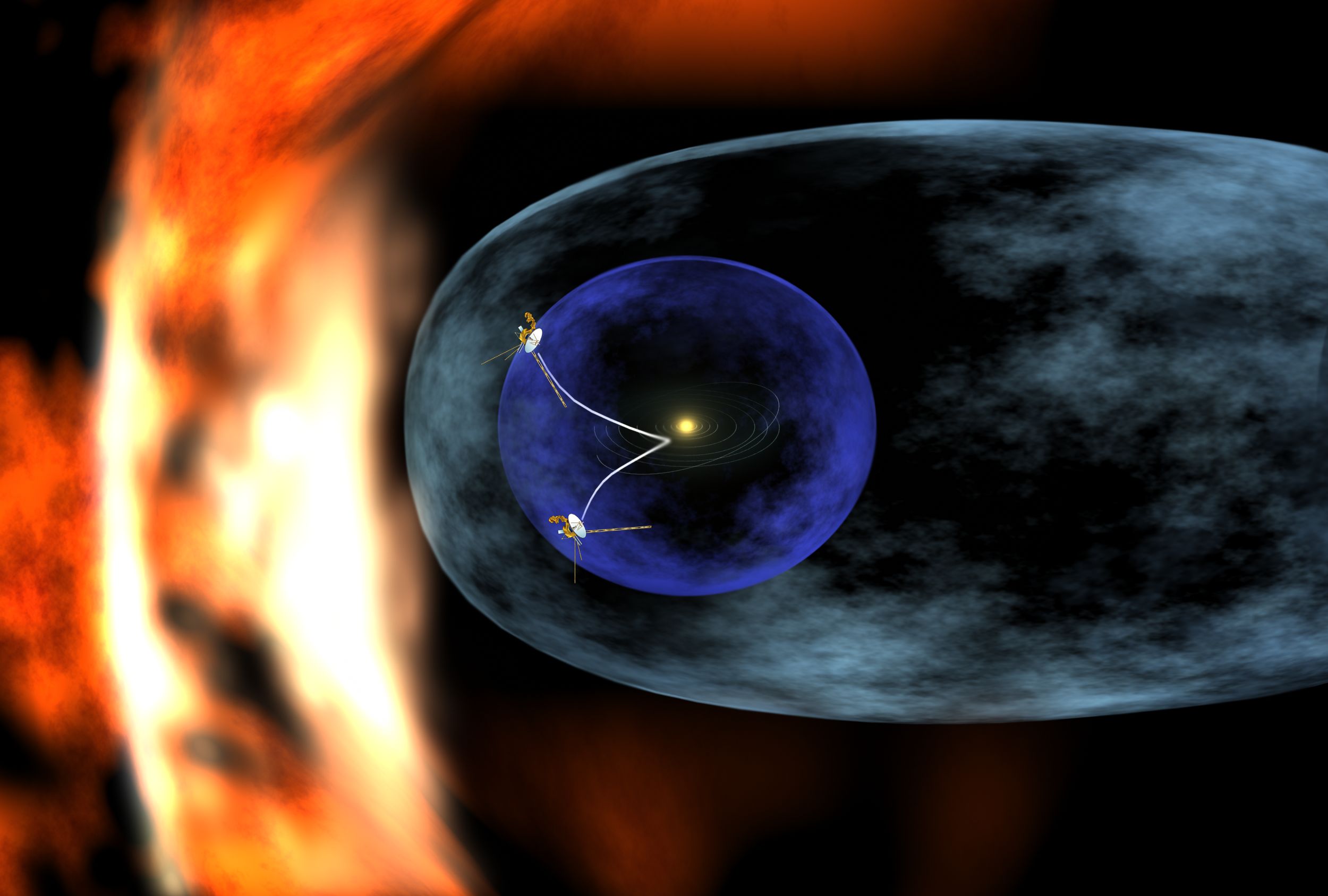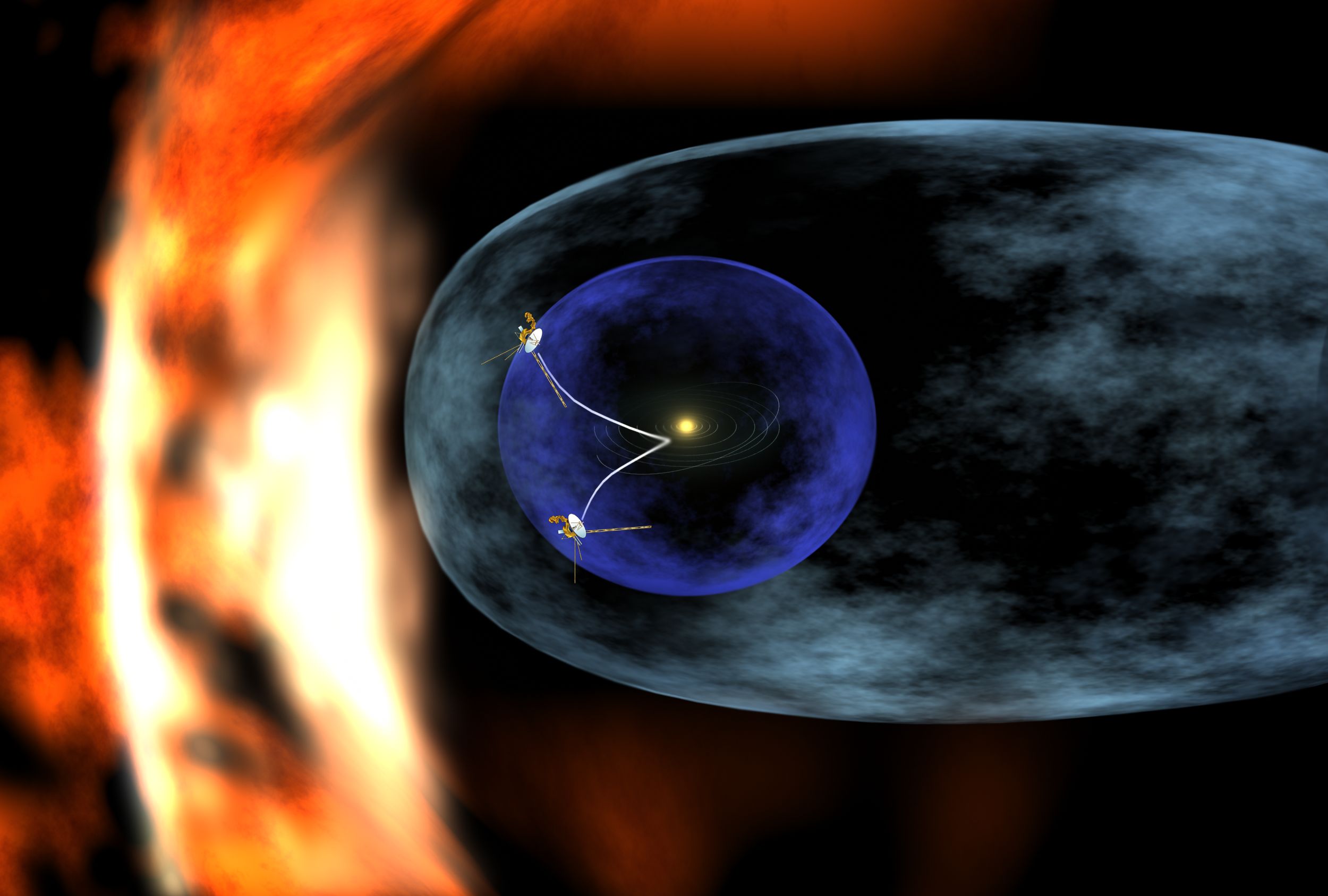
Launched in 1977, Voyager 1 is now about 12 light-hours or 90 astronomical units (AU) from the Sun, making this spacecraft humanity's most distant ambassador to the cosmos. Well beyond the orbits of the outer planets, Voyager 1 is believed to be entering the realm of deep space near the edge of the heliosphere, the region dominated by the solar wind and magnetic field. Causing some debate, new results from instruments still operating have given indications that the spacecraft could finally be encountering a fluctuating boundary known as the solar wind's termination shock. Illustrated above, the bubble-shaped termination shock is produced when the wind from the Sun slows dramatically and piles up as it runs in to the tenuous interstellar gas. Still farther out, beyond the heliopause, solar wind and interstellar gas begin to mix, while the heliosphere's motion through interstellar space creates a bow shock, analogous to a boat moving through water. Estimates are that both Voyager 1 and 2 have enough power and fuel to operate until about the year 2020. The spacecraft continue to coast toward interstellar space at over 3 AU per year.
Lanzada en 1977, la Voyager 1 se encuentra ahora a unos 12 horas luz o 90 unidades astronómicas (UA) del Sol, lo que convierte a esta nave en el embajador más distante de la humanidad hacia el cosmos. Muy más allá de las órbitas de los planetas exteriores, se cree que la Voyager 1 está entrando en el reino del espacio profundo cerca del borde de la heliosfera, la región dominada por el viento solar y el campo magnético. Generando cierto debate, los nuevos resultados de los instrumentos aún operativos han proporcionado indicaciones de que la nave podría estar finalmente encontrando una frontera fluctuante conocida como el choque de terminación del viento solar. Ilustrado arriba, el choque de terminación en forma de burbuja se produce cuando el viento del Sol se ralentiza dramáticamente y se acumula al encontrarse con el gas interestelar tenue. Aún más lejos, más allá de la heliopausa, el viento solar y el gas interestelar comienzan a mezclarse, mientras que el movimiento de la heliosfera a través del espacio interestelar crea un choque de proa, análogo a un barco moviéndose a través del agua. Se estima que tanto la Voyager 1 como la Voyager 2 tienen suficiente energía y combustible para funcionar hasta aproximadamente el año 2020. Las naves espaciales continúan desplazándose hacia el espacio interestelar a más de 3 UA por año.