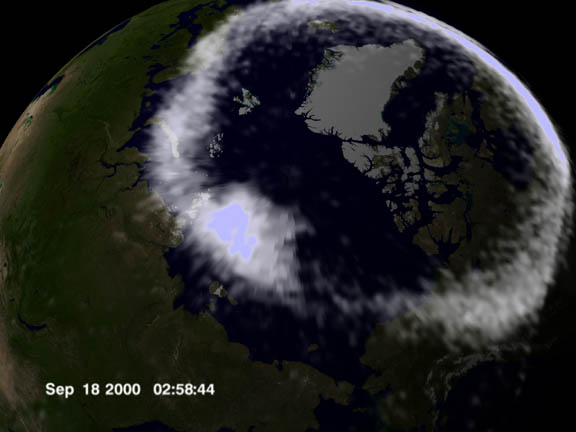
What are auroras made out of? Triggered by solar activity, normal auroras are caused by collisions between fast-moving electrons and the oxygen and nitrogen in Earth's upper atmosphere. The electrons come from the magnetosphere, the region of space controlled by Earth's magnetic field. As the excited oxygen and nitrogen molecules return to their low energy state, they emit light, seen as the auroral glow. Sometimes, however, auroras can be caused by collisions with heavier protons, causing a more energetic display with strong ultraviolet emission. In addition, protons can temporarily capture an electron and emit light for themselves. Such a proton aurora is seen above, recorded by the IMAGE satellite. A special feature is the bright spot near picture center, embedded in a ring of auroral emission around the north magnetic pole of planet Earth. Most solar wind protons never reach the Earth to cause auroras because they are completely deflected away at a great distance by the Earth's magnetic field. The bright spot in the auroral ring indicates a particularly deep crack in the Earth's magnetic field where protons were able to flow along a temporarily connected region between the Sun and the Earth, relatively undeflected, until they impacted the Earth's ionosphere.
¿De qué están hechas las auroras? Desencadenadas por la actividad solar, las auroras normales son causadas por colisiones entre electrones de rápido movimiento y el oxígeno y nitrógeno en la atmósfera superior de la Tierra. Los electrones provienen de la magnetosfera, la región del espacio controlada por el campo magnético terrestre. Cuando las moléculas de oxígeno y nitrógeno excitadas regresan a su estado de baja energía, emiten luz, visible como el brillo auroral. Sin embargo, a veces las auroras pueden ser causadas por colisiones con protones más pesados, causando un despliegue más energético con una fuerte emisión ultravioleta. Además, los protones pueden capturar temporalmente un electrón y emitir luz por sí solos. Tal aurora de protones se ve arriba, registrada por el satélite IMAGE. Una característica especial es el punto brillante cerca del centro de la imagen, incrustado en un anillo de emisión auroral alrededor del polo magnético norte del planeta Tierra. La mayoría de los protones del viento solar nunca alcanzan la Tierra para causar auroras porque son completamente desviados a una gran distancia por el campo magnético terrestre. El punto brillante en el anillo auroral indica una grieta particularmente profunda en el campo magnético terrestre donde los protones pudieron fluir a lo largo de una región temporalmente conectada entre el Sol y la Tierra, relativamente sin desviarse, hasta que impactaron la ionosfera de la Tierra.