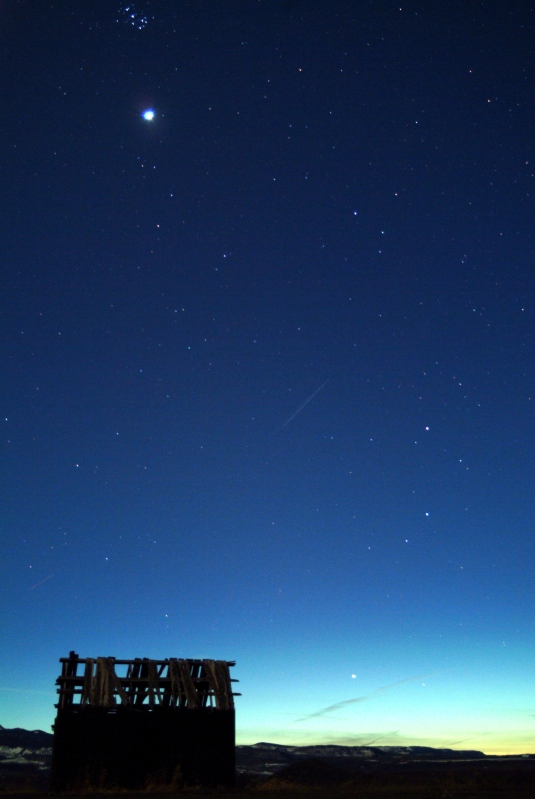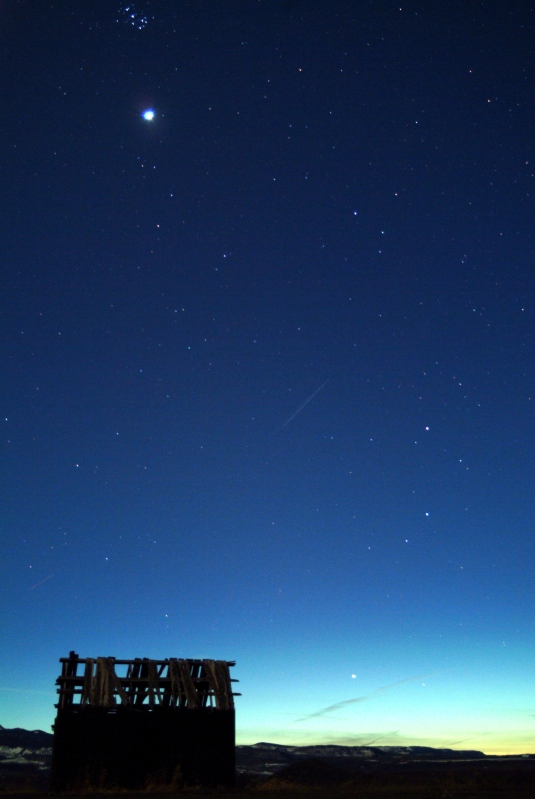
Doing their part in the ongoing dance of the planets, Mercury and Venus both reached their greatest elongation or maximum apparent distance from the Sun only a few days ago, on March 29th. Eager to record their celestial accomplishment, astronomer Jimmy Westlake snapped this view of the two inner most planets shining in western twilight skies above Yampa, Colorado, USA. The picture was taken using a digital camera mounted on a tripod. Mercury is easily the brightest celestial object near the horizon, appearing to the right of the foreground structure and just above a thin cloud silhouetted by fading sunlight. Still, near the top of the picture brilliant Venus dominates the scene as the magnificent evening star. After climbing in western skies throughout the month of March, Venus lies just below the Pleiades star cluster. Tonight and tomorrow night, skygazers can spot Venus at the southern edge of the Pleiades.
En su continuo baile planetario, Mercurio y Venus alcanzaron su máxima elongación o distancia angular máxima del Sol hace apenas unos días, el 29 de marzo. Ansioso por registrar su logro celeste, el astrónomo Jimmy Westlake capturó esta vista de los dos planetas más internos brillando en los crepúsculos occidentales sobre Yampa, Colorado, EE.UU. La fotografía fue tomada usando una cámara digital montada en un trípode. Mercurio es fácilmente el objeto celeste más brillante cerca del horizonte, apareciendo a la derecha de la estructura del primer plano y justo encima de una nube tenue silueteada por la luz solar decreciente. Aun así, cerca de la parte superior de la imagen, Venus brilla magníficamente dominando la escena como la estrella vespertina. Después de ascender en los cielos occidentales durante todo el mes de marzo, Venus se sitúa justo por debajo del cúmulo de las Pléyades. Esta noche y mañana por la noche, los observadores del cielo pueden divisar a Venus en el borde meridional de las Pléyades.