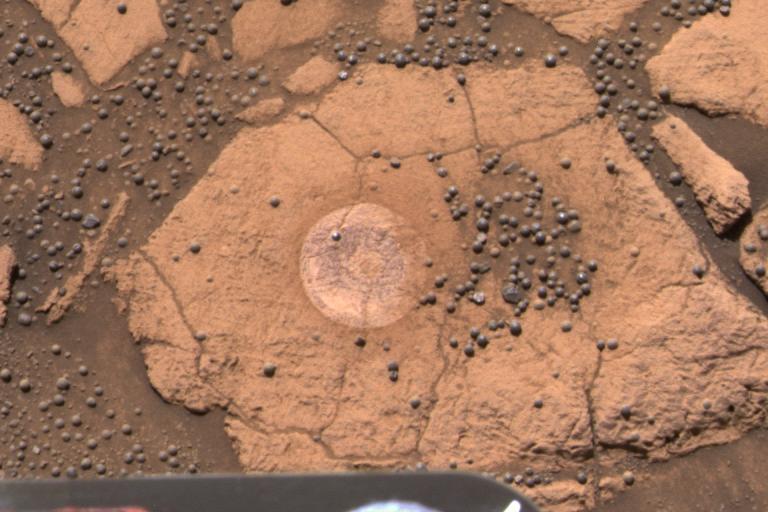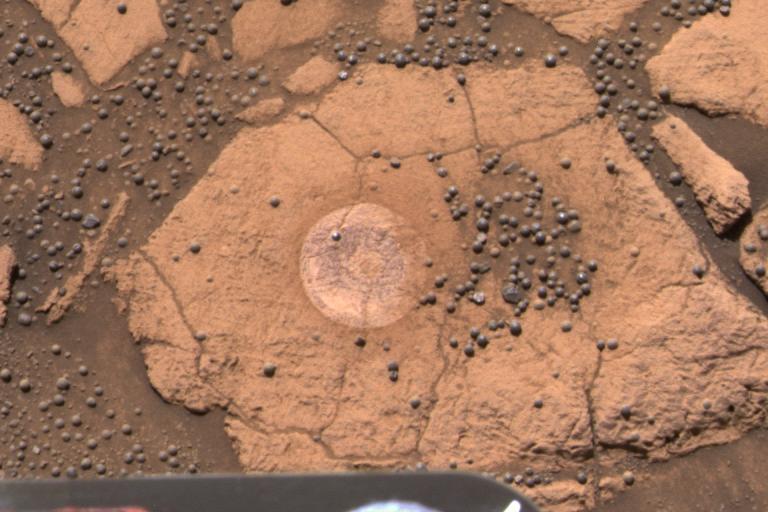
How were these unusual Martian spherules created? Thousands of unusual gray spherules, made of iron and rock but dubbed blueberries, were found embedded in and surrounding rocks near the landing site of the robot Opportunity rover on Mars. To help investigate their origin, Opportunity found a surface dubbed the Berry Bowl with an indentation that was rich in the Martian orbs. The Berry Bowl is pictured above, imaged during rover's 48th Sol on Mars. The average diameter of a blueberry is only about 4 millimeters. By analyzing a circular patch in the rock surface to the left of the densest patch of spherules, Opportunity obtained data showing that the underlying rock has a much different composition than the hematite rich blueberries. This information contributes to the growing consensus is that these small, strange, gray orbs were slowly deposited from a bath of dirty water.
¿Cómo se crearon estas inusuales esferas marcianas? Miles de esferas grises inusuales, hechas de hierro y roca pero llamadas arándanos, fueron encontradas incrustadas en y rodeando rocas cerca del sitio de aterrizaje del rover robótico Opportunity en Marte. Para ayudar a investigar su origen, Opportunity encontró una superficie denominada el Cuenco de Arándanos con una indentación rica en los orbes marcianos. El Cuenco de Arándanos se muestra en la imagen anterior, captada durante el Sol 48 del rover en Marte. El diámetro promedio de un arándano es de solo aproximadamente 4 milímetros. Al analizar un parche circular en la superficie rocosa a la izquierda del parche más denso de esferas, Opportunity obtuvo datos que muestran que la roca subyacente tiene una composición muy diferente a la de los arándanos ricos en hematita. Esta información contribuye al creciente consenso de que estos pequeños y extraños orbes grises fueron depositados lentamente por un baño de agua sucia.