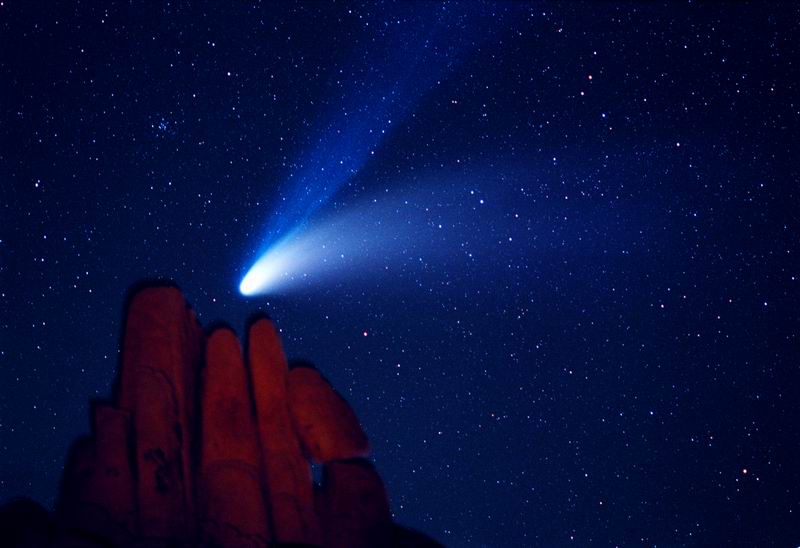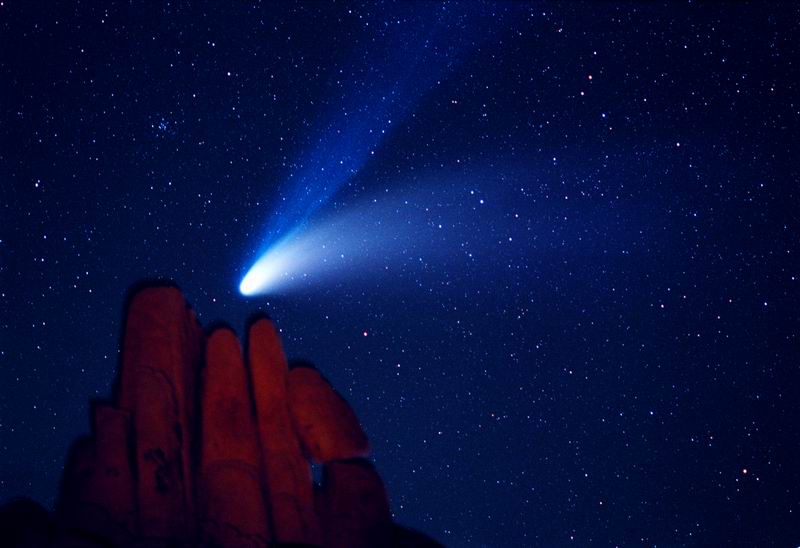
Comet Hale-Bopp, the Great Comet of 1997, was quite a sight. No comets of comparable brightness have graced the skies of Earth since then. During this next month, however, even besides the fleeting Comet Bradfield, two comets have a slight chance of rivaling Hale-Bopp and a good chance of putting on a memorable sky show. Unfortunately, most of the show will be confined to sky gazers in Earth's southern hemisphere. Both comets are already visible to the unaided eye from there. The first, Comet C/2002 T7 (LINEAR), should be at its best before dawn during the first weeks of May from the south. The second, Comet C/2001 Q4 (NEAT), should be visible in early May from all over the Earth. Both comets appear to be approaching the inner Solar System for the first time and so it is very hard to predict how bright each will become. In the above photograph taken 1997 April 6, Comet Hale-Bopp was imaged from the Indian Cove Campground in the Joshua Tree National Forest in California, USA. A flashlight was used to momentarily illuminate foreground rocks during this six minute exposure.
El Cometa Hale-Bopp, el Gran Cometa de 1997, fue espectacular. Ningún cometa de brillo comparable ha adornado los cielos de la Tierra desde entonces. Durante el próximo mes, sin embargo, además del efímero Cometa Bradfield, dos cometas tienen una leve posibilidad de rivalizar con Hale-Bopp y una buena oportunidad de ofrecer un espectáculo memorable en el cielo. Desafortunadamente, la mayor parte del espectáculo se limitará a los observadores del cielo del hemisferio sur de la Tierra. Ambos cometas ya son visibles a simple vista desde allí. El primero, Cometa C/2002 T7 (LINEAR), debería estar en su mejor momento antes del amanecer durante las primeras semanas de mayo desde el sur. El segundo, Cometa C/2001 Q4 (NEAT), debería ser visible a principios de mayo desde toda la Tierra. Ambos cometas parecen estar aproximándose al sistema solar interior por primera vez, por lo que es muy difícil predecir qué tan brillante se volverá cada uno. En la fotografía anterior tomada el 6 de abril de 1997, el Cometa Hale-Bopp fue fotografiado desde el Campamento Indian Cove en el Bosque Nacional Joshua Tree en California, EE.UU. Se utilizó una linterna para iluminar momentáneamente las rocas del primer plano durante esta exposición de seis minutos.