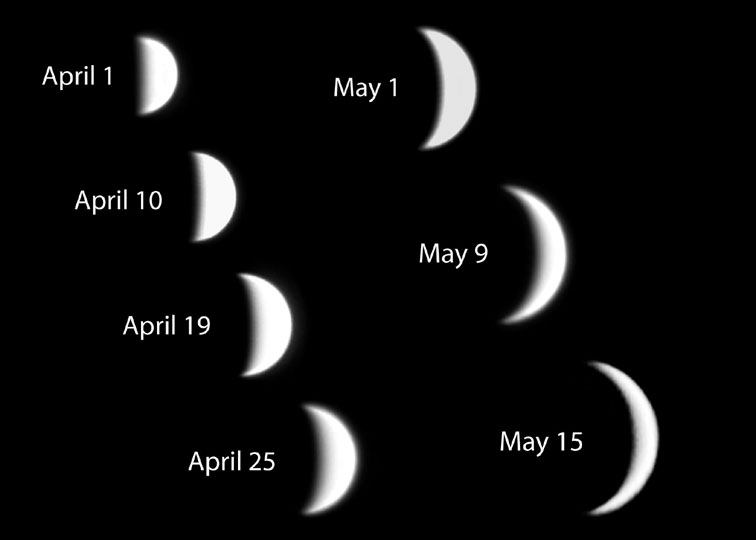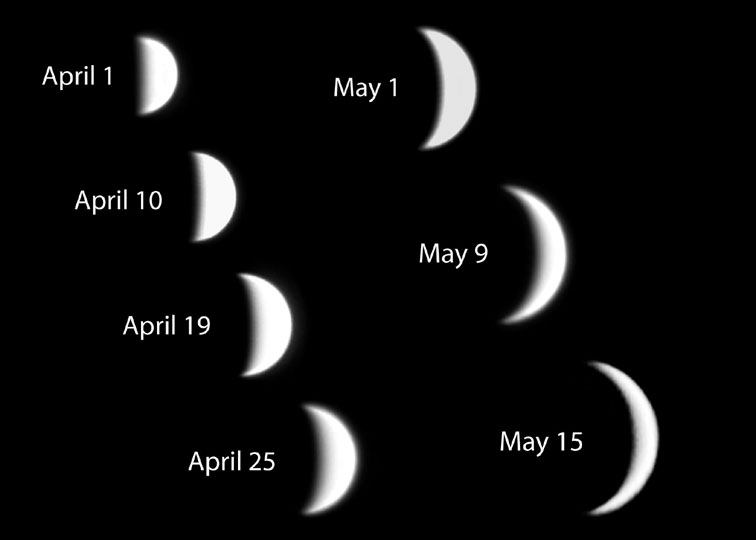
Venus is currently falling out of the western evening sky. Second planet from the Sun and third brightest celestial object after the Sun and Moon, Venus has been appreciated by casual sky gazers as a brilliant beacon above the horizon after sunset. But telescopic images have also revealed its dramatic phases. In fact, this thoughtful composite of telescopic views nicely illustrates the progression of phases and increase in apparent size undergone by Venus over the past few weeks. Gliding along its interior orbit, Venus has been catching up with planet Earth, growing larger as it draws near. At the same time, just as the Moon goes through phases, Venus' visible sunlit hemisphere has presented an increasingly slender, crescent shape. Now sharing the sky with a crescent Moon, on June 8th Venus will actually cross the face of the Sun, the first such transit since 1882.
Venus está desapareciendo actualmente del cielo vespertino occidental. Segundo planeta desde el Sol y tercer objeto celeste más brillante después del Sol y la Luna, Venus ha sido apreciado por los observadores ocasionales del cielo como un faro brillante sobre el horizonte después de la puesta de sol. Sin embargo, las imágenes telescópicas también han revelado sus fases dramáticas. De hecho, este cuidadoso compuesto de vistas telescópicas ilustra bien la progresión de las fases y el aumento del tamaño aparente que ha experimentado Venus durante las últimas semanas. Deslizándose a lo largo de su órbita interior, Venus ha estado alcanzando a la Tierra, haciéndose más grande a medida que se acerca. Al mismo tiempo, así como la Luna atraviesa fases, el hemisferio iluminado visible de Venus ha presentado una forma de creciente cada vez más delgada. Ahora compartiendo el cielo con una Luna creciente, el 8 de junio Venus cruzará la cara del Sol, el primer tránsito de este tipo desde 1882.