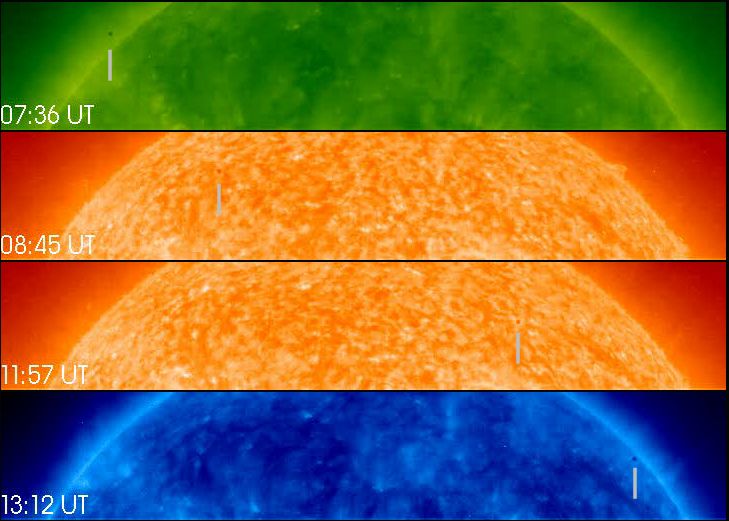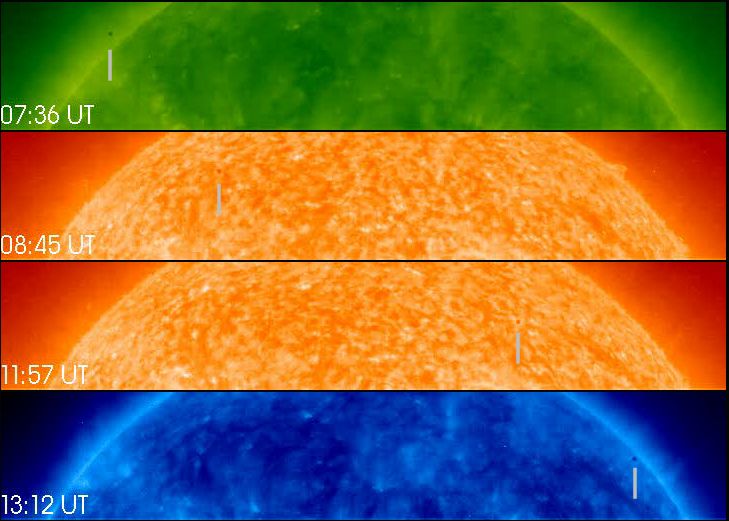
Can you spot the planet? The diminutive disk of Mercury, the solar system's innermost planet, spent about five hours crossing in front of the enormous solar disk on 2003 May 7, as viewed from the general vicinity of planet Earth. The Sun was above the horizon during the entire transit for observers in Europe, Africa, Asia, or Australia, and the horizon was certainly no problem for the sun-staring SOHO spacecraft. Seen as a dark spot, Mercury progresses from left to right (top panel to bottom) in these four images from SOHO's extreme ultraviolet camera. The panels' false-colors correspond to different wavelengths in the extreme ultraviolet which highlight regions above the Sun's visible surface. This was the first of 14 transits of Mercury which will occur during the 21st century, but the next similar event will be a much more rare transit of Venus this coming Tuesday. Need help spotting Mercury? Just click on the picture. News flash: Venus to cross the Sun on Tuesday
¿Puedes localizar el planeta? El diminuto disco de Mercurio, el planeta más interno del sistema solar, pasó frente al enorme disco solar durante aproximadamente cinco horas el 7 de mayo de 2003, tal como se observó desde la región general del planeta Tierra. El Sol estuvo sobre el horizonte durante todo el tránsito para los observadores en Europa, África, Asia u Oceanía, y el horizonte ciertamente no fue un problema para la nave espacial SOHO que observa constantemente al Sol. Visto como un punto oscuro, Mercurio progresa de izquierda a derecha (panel superior al inferior) en estas cuatro imágenes de la cámara de ultravioleta extremo de SOHO. Los falsos colores de los paneles corresponden a diferentes longitudes de onda en el ultravioleta extremo que destacan regiones por encima de la superficie visible del Sol. Este fue el primero de 14 tránsitos de Mercurio que ocurrirán durante el siglo XXI, pero el próximo evento similar será un tránsito mucho más raro de Venus el próximo martes.