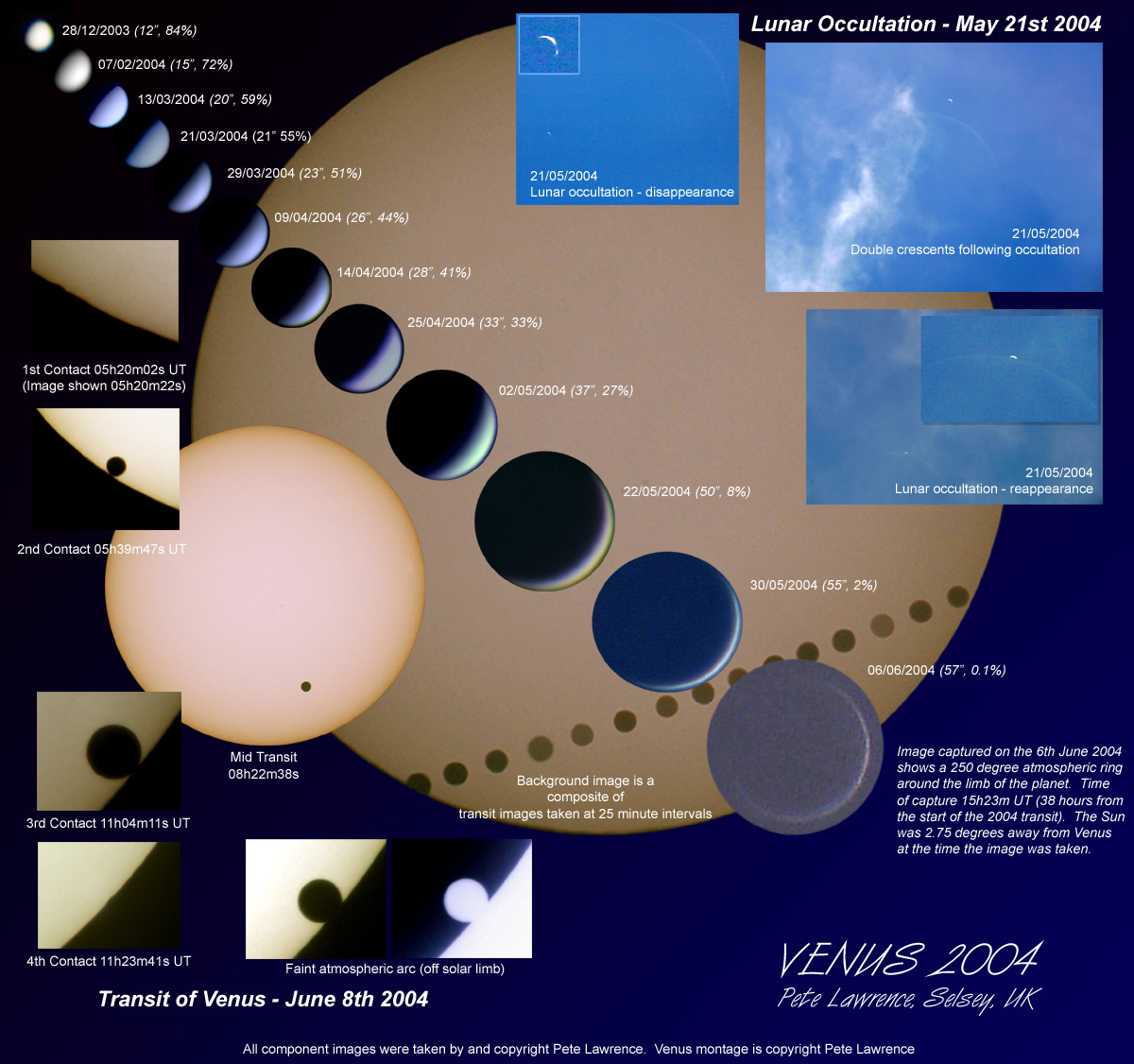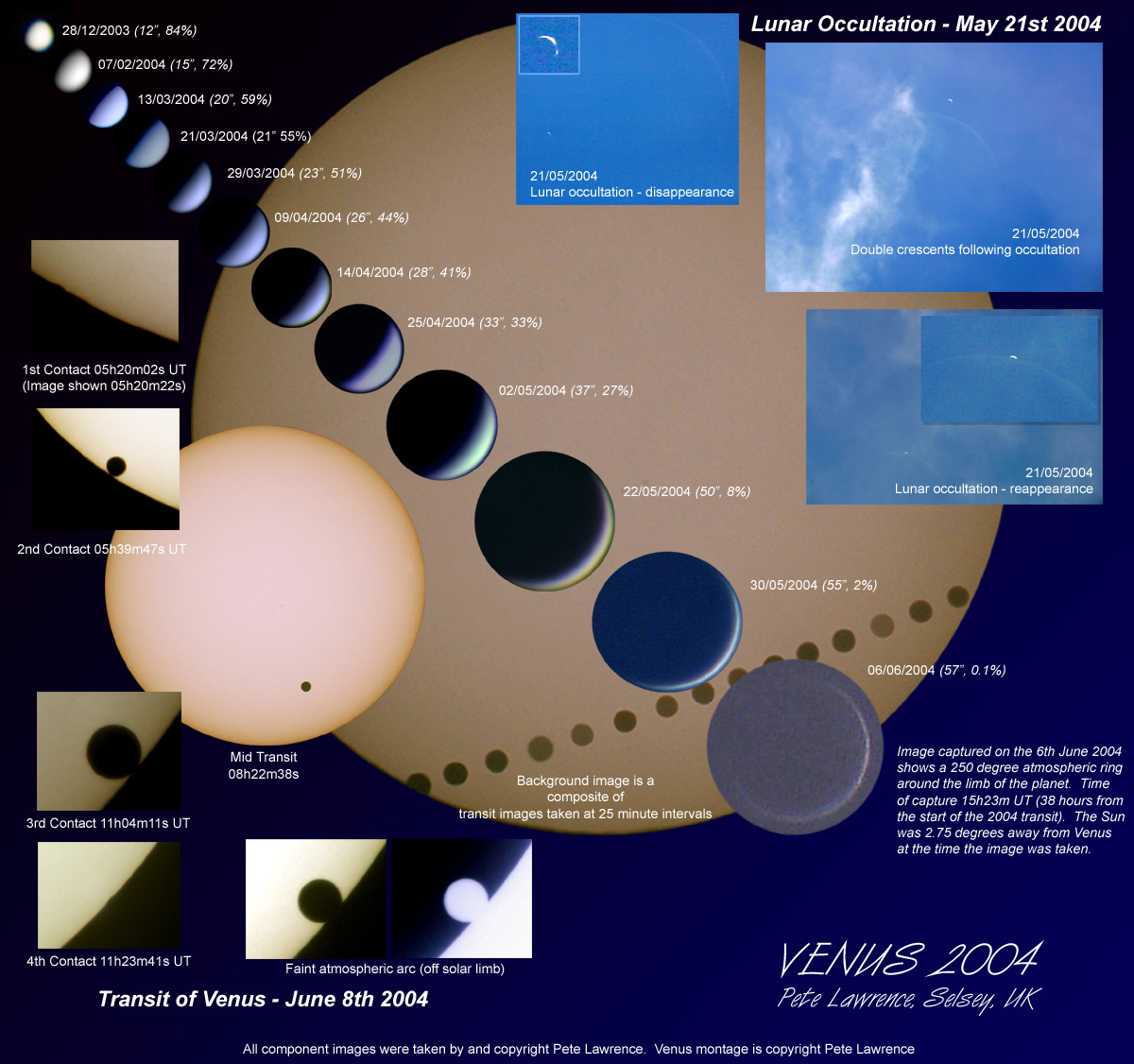
An unusual type of solar eclipse occurred last week. Usually it is the Earth's Moon that eclipses the Sun. Last week, for the first time in over 100 years, the planet Venus took a turn. Like a solar eclipse by the Moon, the phase of Venus became a continually thinner crescent as Venus became increasingly better aligned with the Sun. Eventually the alignment became perfect and the phase of Venus dropped to zero. The dark spot of Venus crossed our parent star. The situation could technically be labeled a Venusian annular eclipse with an extraordinarily large ring of fire. From above the thick cloud tops of Venus, the Earth appeared in its fullest phase, brighter in the Venusian sky than even Mars appeared from Earth last August. Hours later, as Venus continued in its orbit, a slight crescent phase appeared again. The next Venusian solar eclipse will occur in 2012.
Ocurrió un tipo inusual de eclipse solar la semana pasada. Normalmente es la Luna de la Tierra la que eclipsa al Sol. La semana pasada, por primera vez en más de 100 años, el planeta Venus tuvo su turno. Como un eclipse solar causado por la Luna, la fase de Venus se convirtió en un creciente continuamente más delgado conforme Venus se alineó cada vez mejor con el Sol. Eventualmente la alineación se hizo perfecta y la fase de Venus se redujo a cero. La mancha oscura de Venus cruzó nuestra estrella madre. La situación técnicamente podría etiquetarse como un eclipse solar anular venusino con un anillo de fuego extraordinariamente grande. Desde arriba de las densas capas nubosas de Venus, la Tierra apareció en su fase más llena, más brillante en el cielo venusino que incluso lo que Marte apareció desde la Tierra el pasado agosto. Horas después, conforme Venus continuó en su órbita, una ligera fase creciente volvió a aparecer. El próximo eclipse solar venusino ocurrirá en 2012.