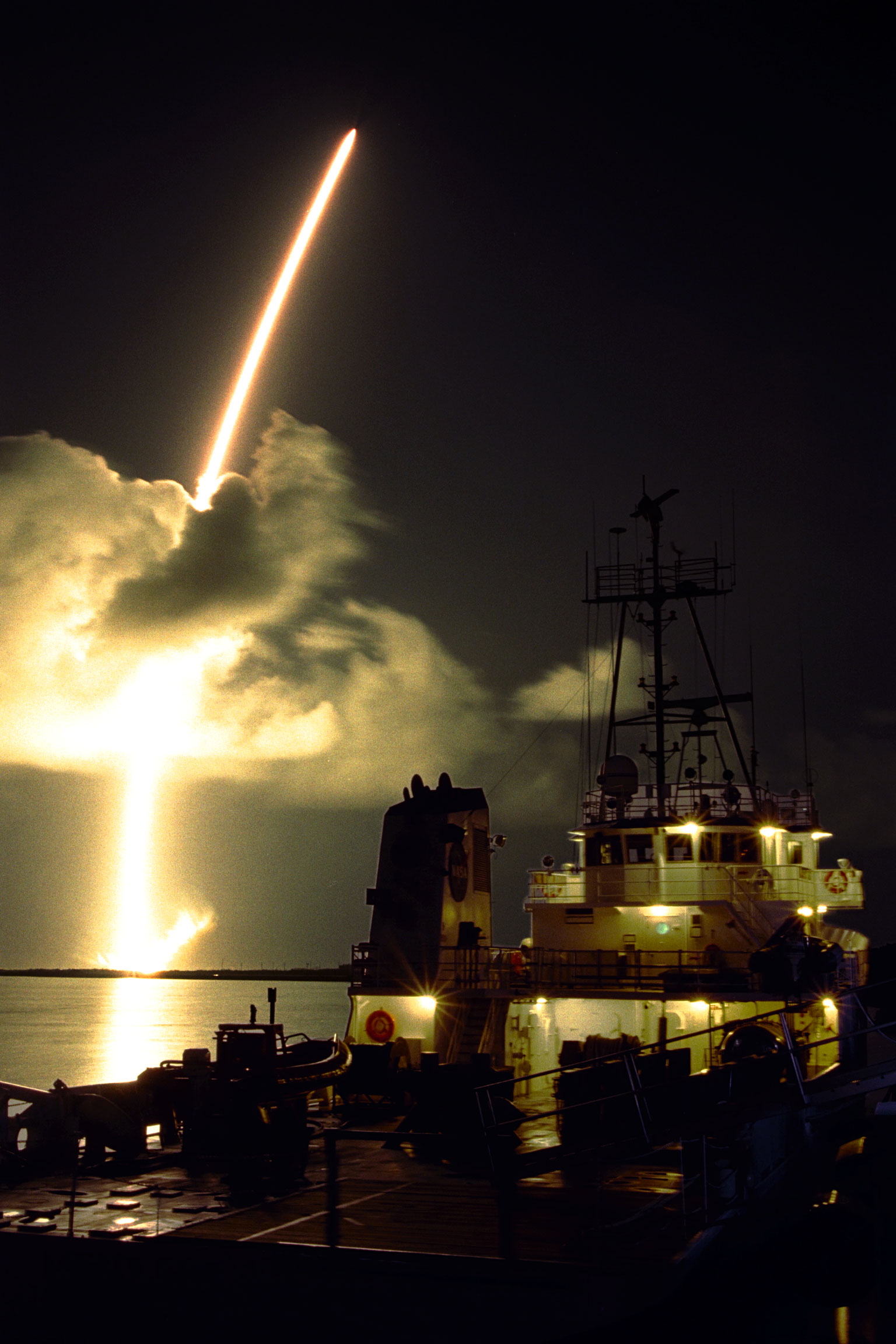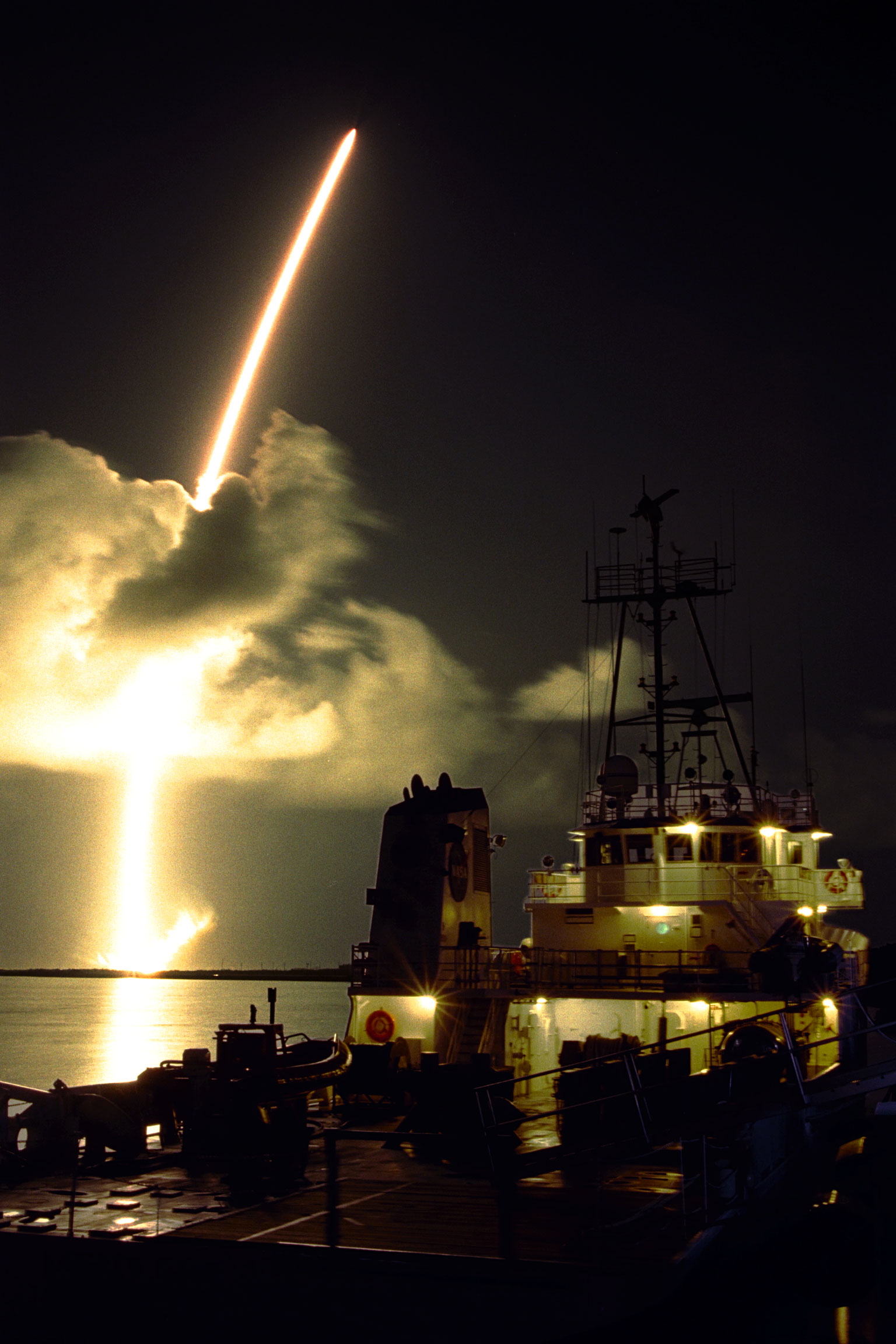
Saturn Orbiter Cassini with Titan Probe Huygens attached rocketed into early morning skies on October 15, 1997. The mighty Titan 4B Centaur rocket is seen here across the water, arcing away from Launch Complex 40 at Cape Canaveral Air Station. Cassini, a sophisticated robot spacecraft was actually headed toward inner planet Venus, the first way point in its 7 year, 2.2 billion mile interplanetary journey to Saturn. In fact, Cassini swung by Venus during April 1998 and June 1999, Earth in August 1999, and Jupiter in December 2000. During each of these "gravity assist" encounters the six ton spacecraft picked up speed, reaching Saturn only three days ago. Cassini is now orbiting the ringed gas giant, with the Huygens Probe scheduled to separate from the spacecraft in December. The probe's descent to the surface of Saturn's large moon Titan will be the most distant landing ever attempted.
El orbitador de Saturno Cassini con la sonda Huygens acoplada despegó hacia los cielos de la madrugada del 15 de octubre de 1997. El poderoso cohete Titán 4B Centauro se ve aquí atravesando el agua, arqueándose alejándose del Complejo de Lanzamiento 40 en la Estación de la Fuerza Aérea de Cabo Cañaveral. Cassini, una sofisticada sonda robótica, en realidad estaba dirigida hacia el planeta interior Venus, el primer punto de referencia en su viaje interplanetario de 7 años y 2.200 millones de millas hacia Saturno. De hecho, Cassini pasó junto a Venus durante abril de 1998 y junio de 1999, a la Tierra en agosto de 1999, y a Júpiter en diciembre de 2000. Durante cada uno de estos encuentros de "asistencia gravitatoria", la nave espacial de seis toneladas ganó velocidad, llegando a Saturno hace solo tres días. Cassini ahora está orbitando al gigante gaseoso anillado, con la sonda Huygens programada para separarse de la nave espacial en diciembre. El descenso de la sonda a la superficie de Titán, la gran luna de Saturno, será el aterrizaje más distante jamás intentado.