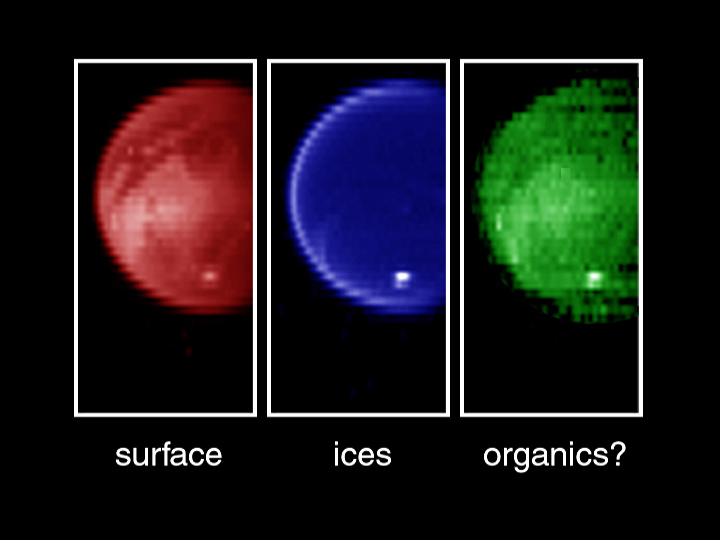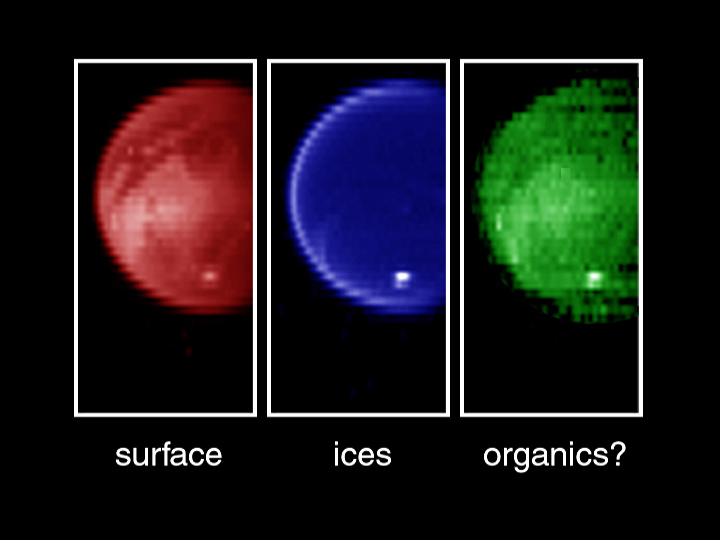
Could the building blocks of life exist under the smog of Titan? What is creating all of the methane? To help answer these questions, the largest and most mysterious moon of Saturn got a quick first look from the Cassini robot spacecraft soon after entering orbit around the giant planet last week. Although thick atmospheric smog prevented detailed surface images in visible light, infrared light was able to provide interesting clues to the nature of Titan's surface. The above images show Titan in three different colors of infrared light, with the most energetic on the left. The leftmost image is the most detailed but shows surface features that are not yet well understood. The smoothness of the middle image is consistent with a large frozen ocean of water ice containing simple hydrocarbons. The darker regions on the rightmost image might indicate areas relatively rich in hydrocarbons. The white spot visible near the South Pole is hypothesized to be a persistent cloud of large particles containing methane. A better understanding of the mysterious surface of Titan will hopefully be forthcoming as scientists study these images and those from a planned 45 flybys over the next four years. In January, Cassini is scheduled to drop the Huygens probe onto Titan's surface.
¿Podrían existir los componentes básicos de la vida bajo la bruma de Titán? ¿Qué está generando todo ese metano? Para ayudar a responder estas preguntas, la luna más grande y misteriosa de Saturno recibió una primera observación rápida de la sonda robótica Cassini poco después de entrar en órbita alrededor del gigante planetario la semana pasada. Aunque la densa bruma atmosférica impidió obtener imágenes detalladas de la superficie en luz visible, la luz infrarroja pudo proporcionar pistas interesantes sobre la naturaleza de la superficie de Titán. Las imágenes anteriores muestran a Titán en tres colores diferentes de luz infrarroja, siendo la más energética la de la izquierda. La imagen más a la izquierda es la más detallada, pero muestra características superficiales que aún no se comprenden bien. La suavidad de la imagen central es consistente con un gran océano congelado de hielo de agua que contiene hidrocarburos simples. Las regiones más oscuras en la imagen más a la derecha podrían indicar áreas relativamente ricas en hidrocarburos. La mancha blanca visible cerca del Polo Sur se hipotetiza que es una nube persistente de partículas grandes que contiene metano. Se espera que una mejor comprensión de la superficie misteriosa de Titán se produzca pronto a medida que los científicos estudien estas imágenes y las de los 45 sobrevuelos planeados durante los próximos cuatro años. En enero, Cassini está programada para depositar la sonda Huygens en la superficie de Titán.