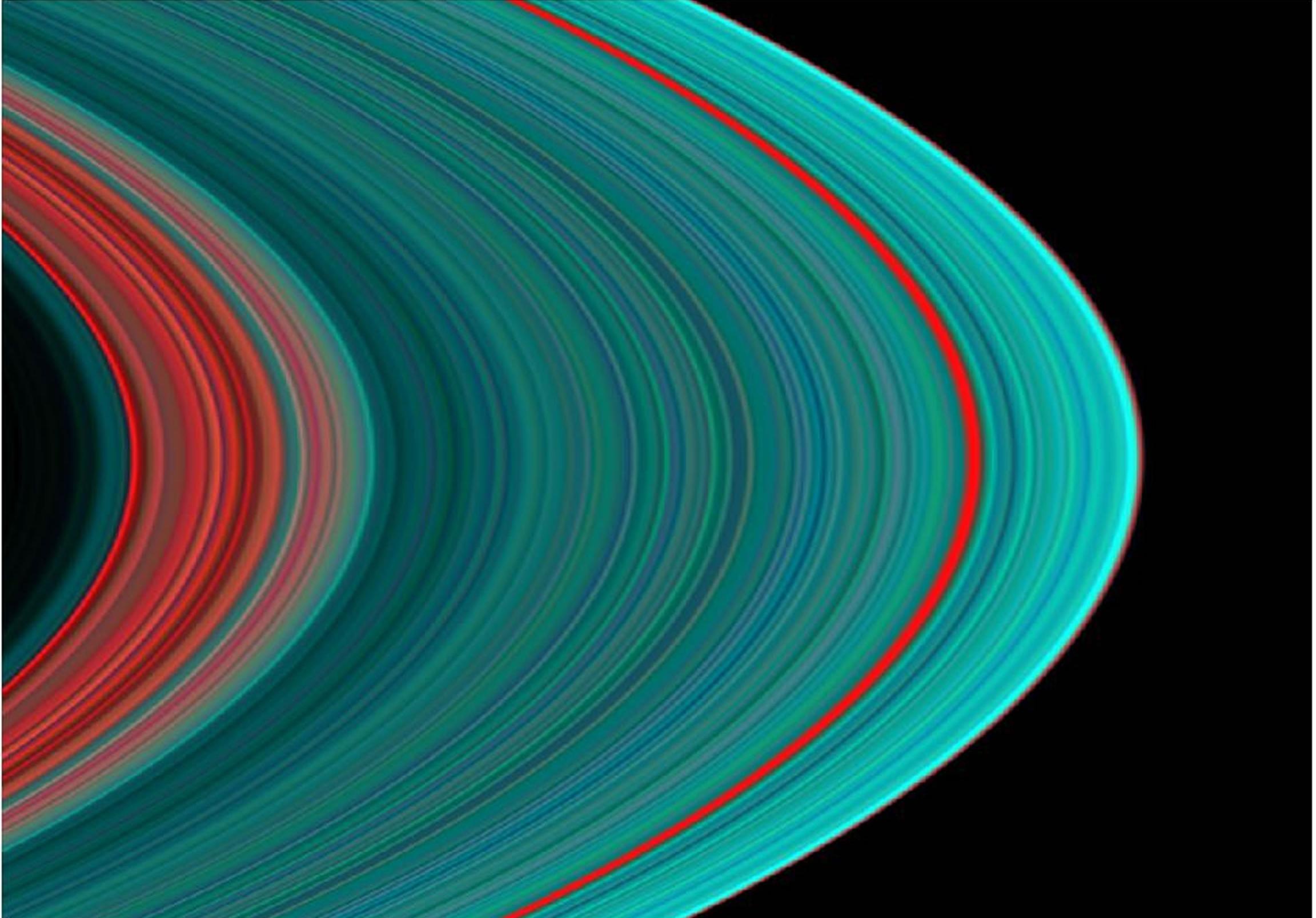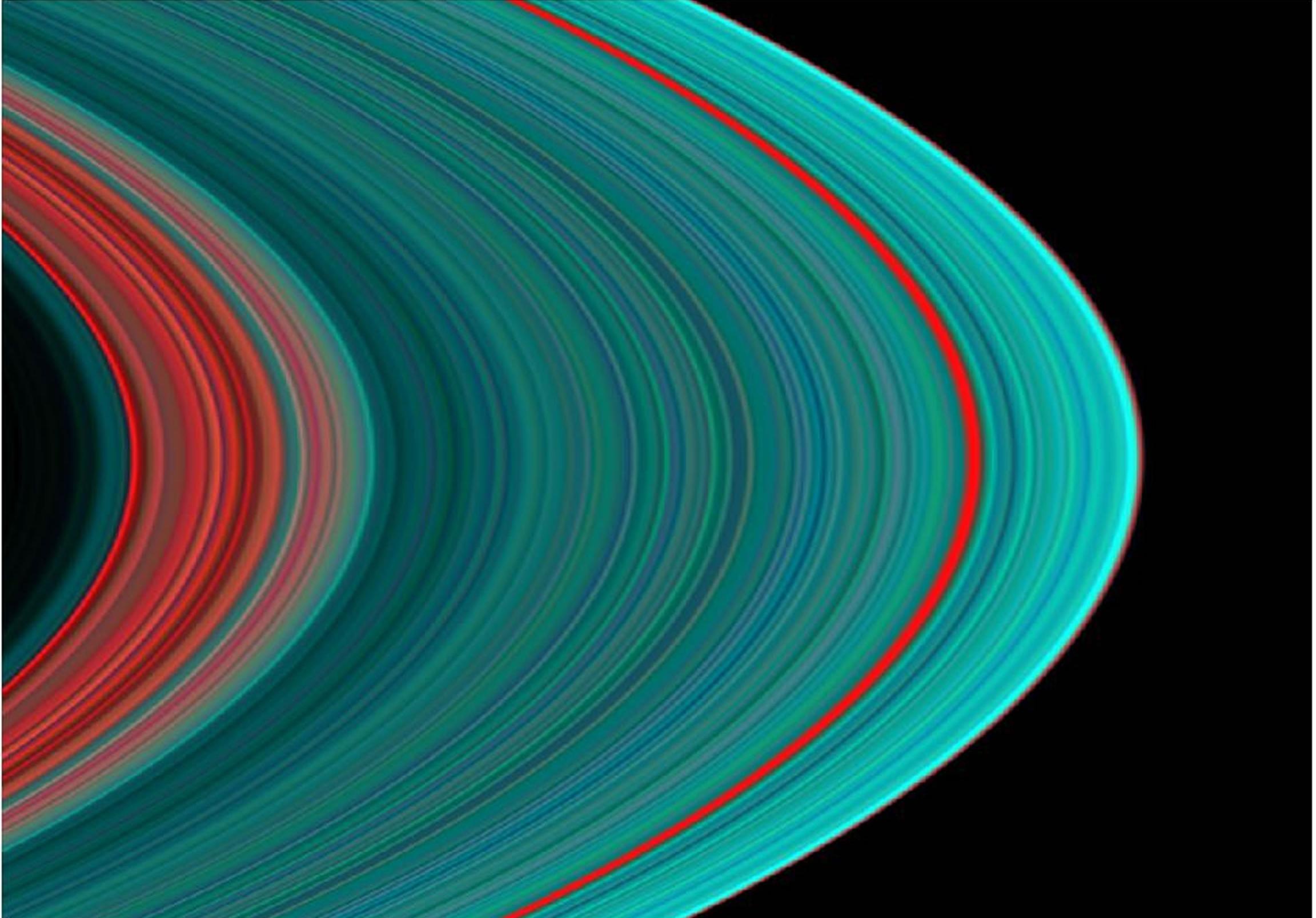
What are Saturn's rings made of? In an effort to find out, the robot spacecraft Cassini that entered orbit around Saturn two weeks ago took several detailed images of the area surrounding Saturn's large A ring in ultraviolet light. In the above image, the bluer an area appears, the richer it is in water ice. Conversely, the redder an area appears, the richer it is in some sort of dirt. This and other images show that inner rings have more dirt than outer rings. Specifically, as shown above, the thin rings in the Cassini Division on the left have relatively high dirt content compared to the outer parts of Saturn's A ring, shown on the right. This dirt/ice trend could be a big clue to the ring's origin. The thin red band in the otherwise blue A ring is the Encke Gap. The exact composition of dirt remains unknown.
¿De qué están compuestos los anillos de Saturno? Con el propósito de averiguarlo, la nave robótica Cassini, que entró en órbita alrededor de Saturno hace dos semanas, tomó varias imágenes detalladas de la región que rodea el gran anillo A de Saturno en luz ultravioleta. En la imagen anterior, cuanto más azul parece un área, más rica es en hielo de agua. Inversamente, cuanto más roja parece un área, más rica es en algún tipo de polvo. Esta y otras imágenes muestran que los anillos interiores tienen más polvo que los anillos exteriores. Específicamente, como se muestra arriba, los anillos delgados en la División de Cassini a la izquierda tienen un contenido de polvo relativamente alto comparado con las partes exteriores del anillo A de Saturno, mostradas a la derecha. Esta tendencia polvo/hielo podría ser una pista importante sobre el origen de los anillos. La banda roja delgada en el anillo A de otro modo azul es la Brecha de Encke. La composición exacta del polvo permanece desconocida.