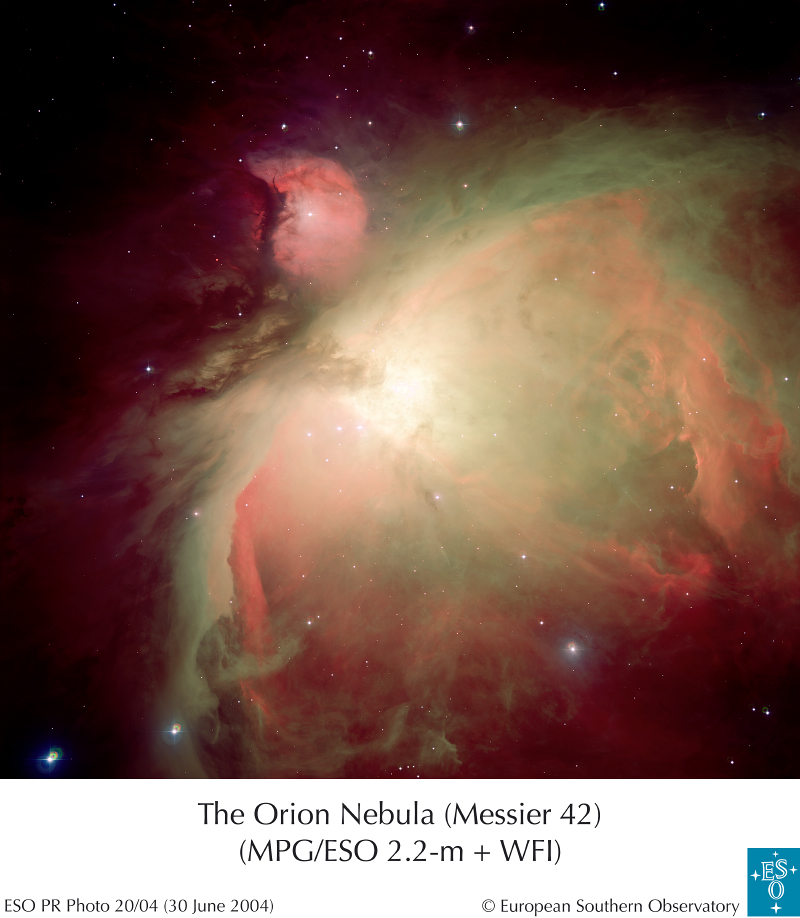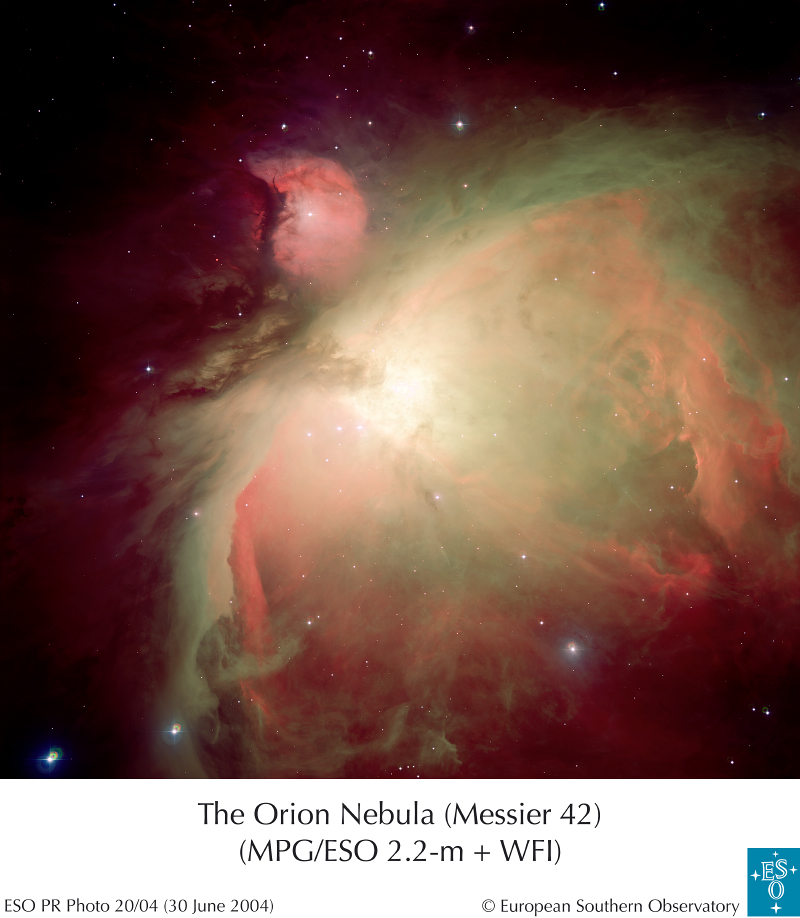
The Great Nebula in Orion, an immense, nearby starbirth region, is arguably the most famous of all astronomical nebulae. The Orion Nebula, also known as M42, is shown above through ultraviolet and blue filters augmented with three exact colors specifically emitted by hydrogen, oxygen, and sulfur. In addition to housing a bright open cluster of stars known as the Trapezium, the Orion Nebula contains many stellar nurseries. These nurseries contain glowing gas, hot young stars, proplyds, and stellar jets spewing material at high speeds. Many of the filamentary structures visible in this image are actually shock waves - fronts where fast moving material encounters slow moving gas. The Orion Nebula spans about 40 light years and is located about 1500 light years away in the same spiral arm of our Galaxy as the Sun.
La Gran Nebulosa de Orión, una inmensa región cercana de formación estelar, es posiblemente la más famosa de todas las nebulosas astronómicas. La Nebulosa de Orión, también conocida como M42, se muestra arriba a través de filtros ultravioleta y azul aumentados con tres colores exactos específicamente emitidos por hidrógeno, oxígeno y azufre. Además de albergar un brillante cúmulo abierto de estrellas conocido como el Trapecio, la Nebulosa de Orión contiene muchos viveros estelares. Estos viveros contienen gas luminoso, jóvenes estrellas calientes, proplyds y chorros estelares que expulsan material a altas velocidades. Muchas de las estructuras filamentosas visibles en esta imagen son en realidad ondas de choque, frentes donde material que se mueve rápidamente encuentra gas que se mueve lentamente. La Nebulosa de Orión se extiende aproximadamente 40 años luz y está ubicada a unos 1500 años luz de distancia en el mismo brazo espiral de nuestra Galaxia que el Sol.