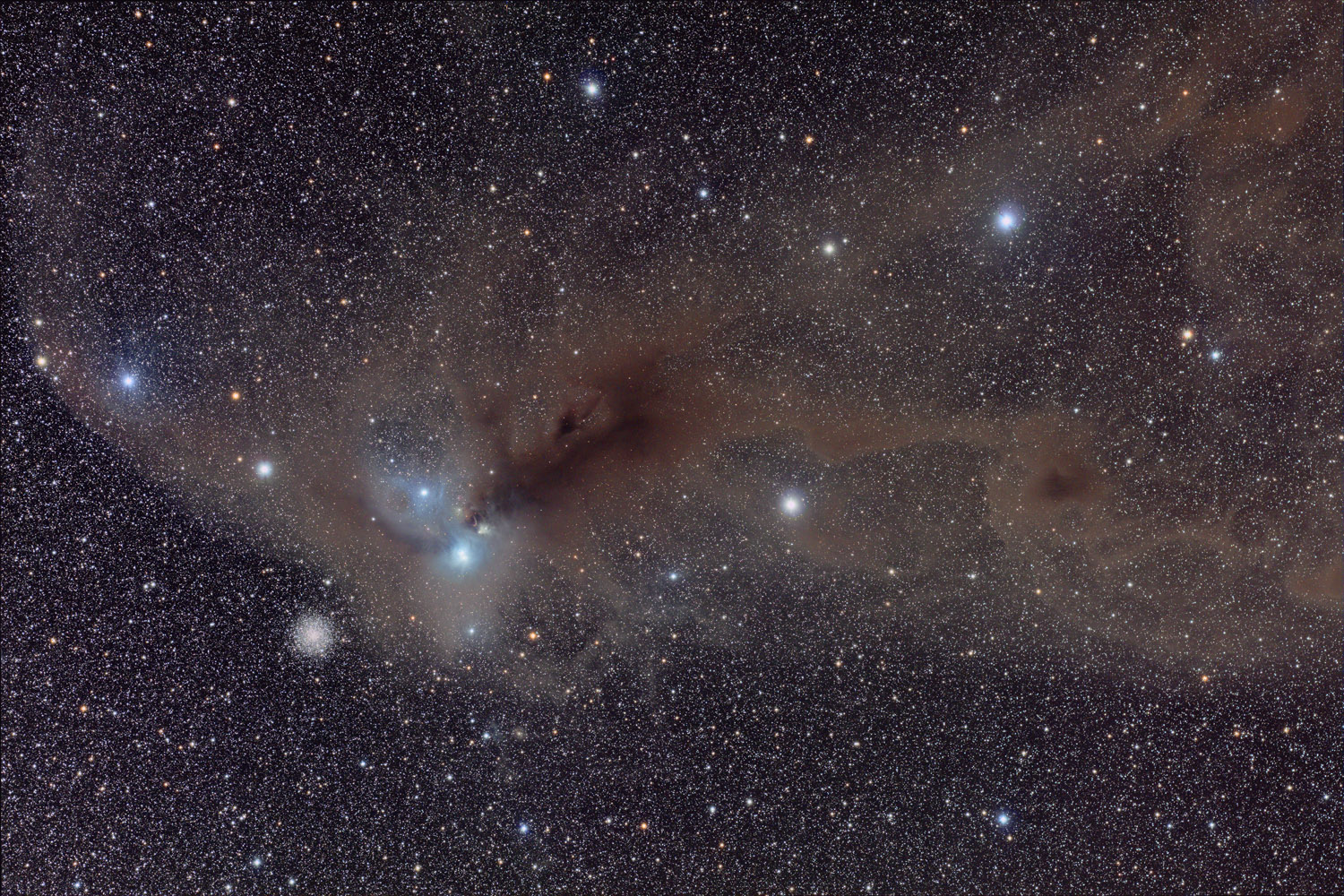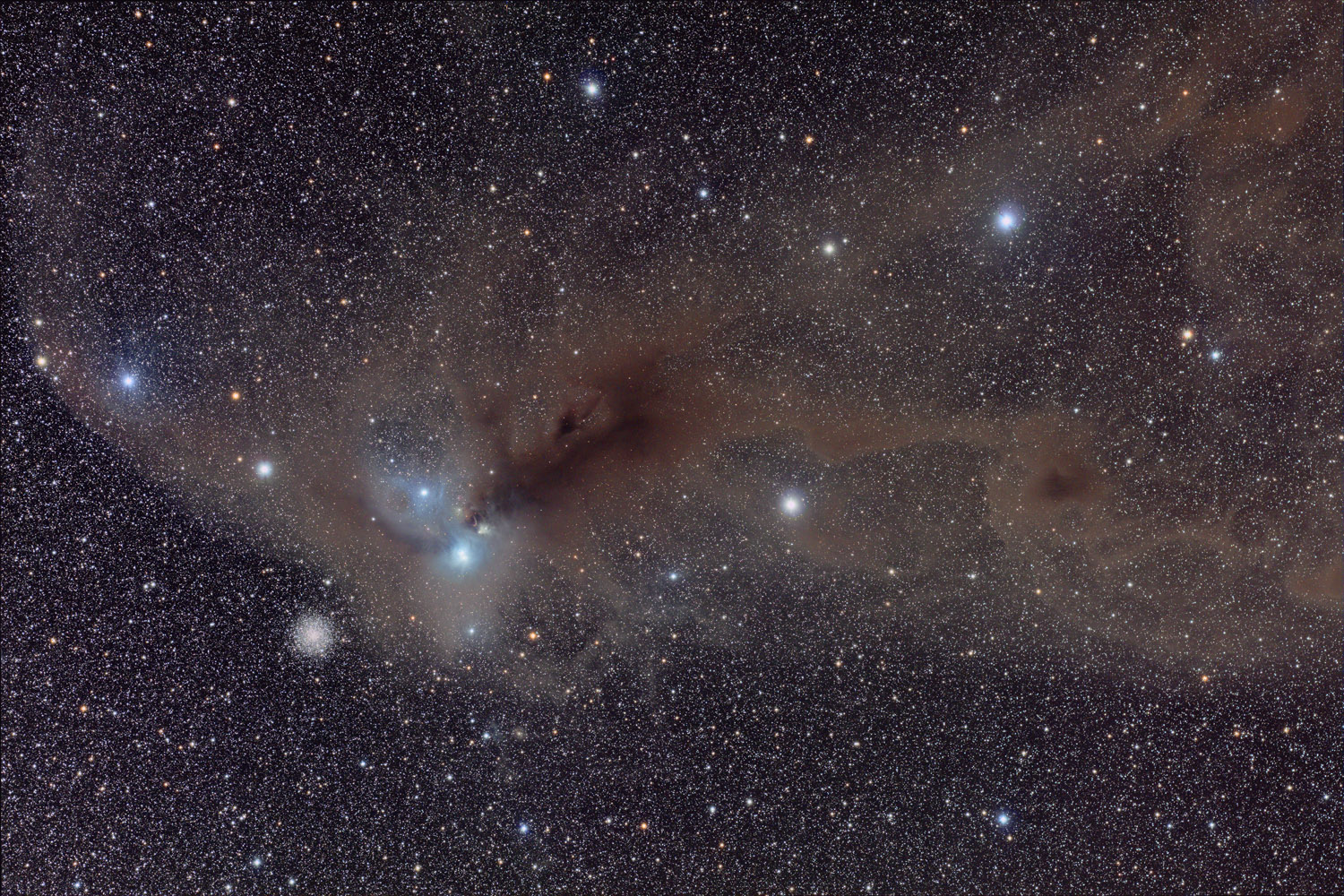
A cosmic dust cloud sprawls across a rich field of stars in this gorgeous wide field telescopic vista looking toward Corona Australis, the Southern Crown. Probably less than 500 light-years away and effectively blocking light from more distant, background stars in the Milky Way, the densest part of the dust cloud is about 8 light-years long. At its tip (lower left) is a series of lovely blue nebulae cataloged as NGC 6726, 6727, 6729, and IC 4812. Their characteristic blue color is produced as light from hot stars is reflected by the cosmic dust. The tiny but intriguing yellowish arc visible near the blue nebulae marks young variable star R Coronae Australis. Magnificent globular star cluster NGC 6723 is seen here below and left of the nebulae. While NGC 6723 appears to be just outside Corona Australis in the constellation Sagittarius, it actually lies nearly 30,000 light-years away, far beyond the Corona Australis dust cloud.
Una nube de polvo cósmico se extiende a través de un rico campo de estrellas en esta magnífica vista de gran angular obtenida con telescopio, dirigida hacia Corona Australis, la Corona Austral. Probablemente a menos de 500 años luz de distancia y bloqueando efectivamente la luz de estrellas más distantes y de fondo en la Vía Láctea, la parte más densa de la nube de polvo tiene aproximadamente 8 años luz de largo. En su extremo (abajo a la izquierda) se encuentra una serie de encantadoras nebulosas azules catalogadas como NGC 6726, 6727, 6729 e IC 4812. Su color azul característico se produce cuando la luz de estrellas calientes es reflejada por el polvo cósmico. El diminuto pero intrigante arco amarillento visible cerca de las nebulosas azules marca la joven estrella variable R Coronae Australis. El magnífico cúmulo globular NGC 6723 se ve aquí debajo y a la izquierda de las nebulosas. Aunque NGC 6723 parece estar justo fuera de Corona Australis en la constelación Sagitario, en realidad se encuentra a casi 30 000 años luz de distancia, mucho más allá de la nube de polvo de Corona Australis.