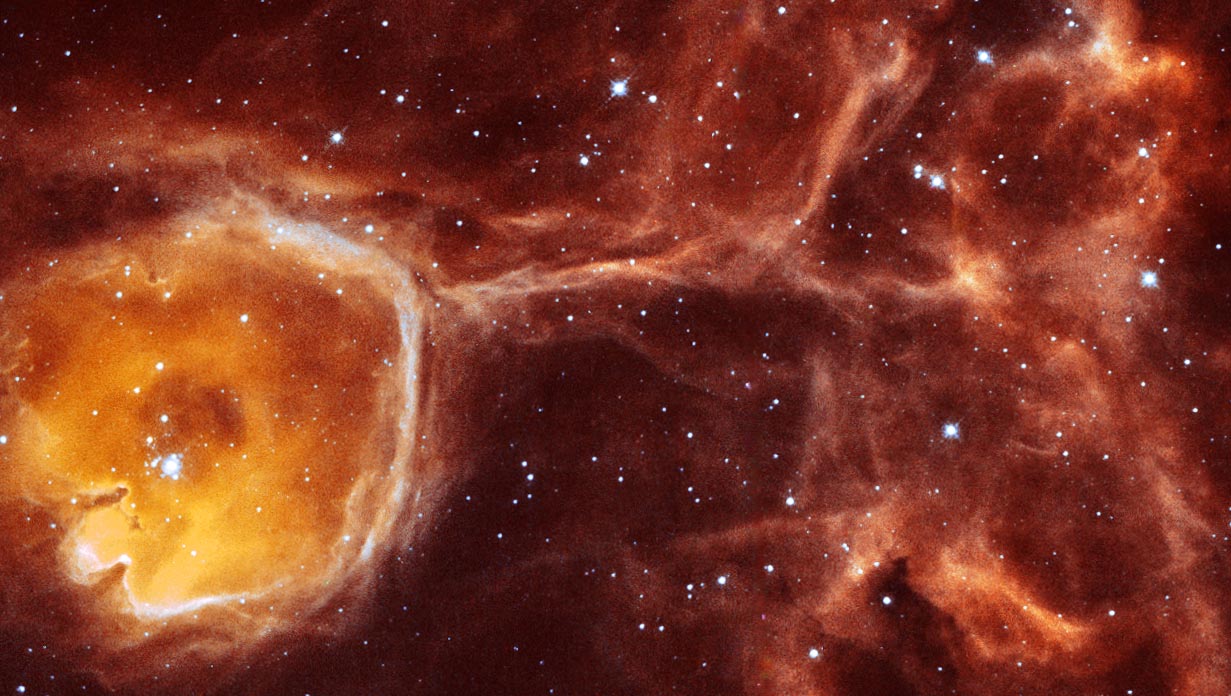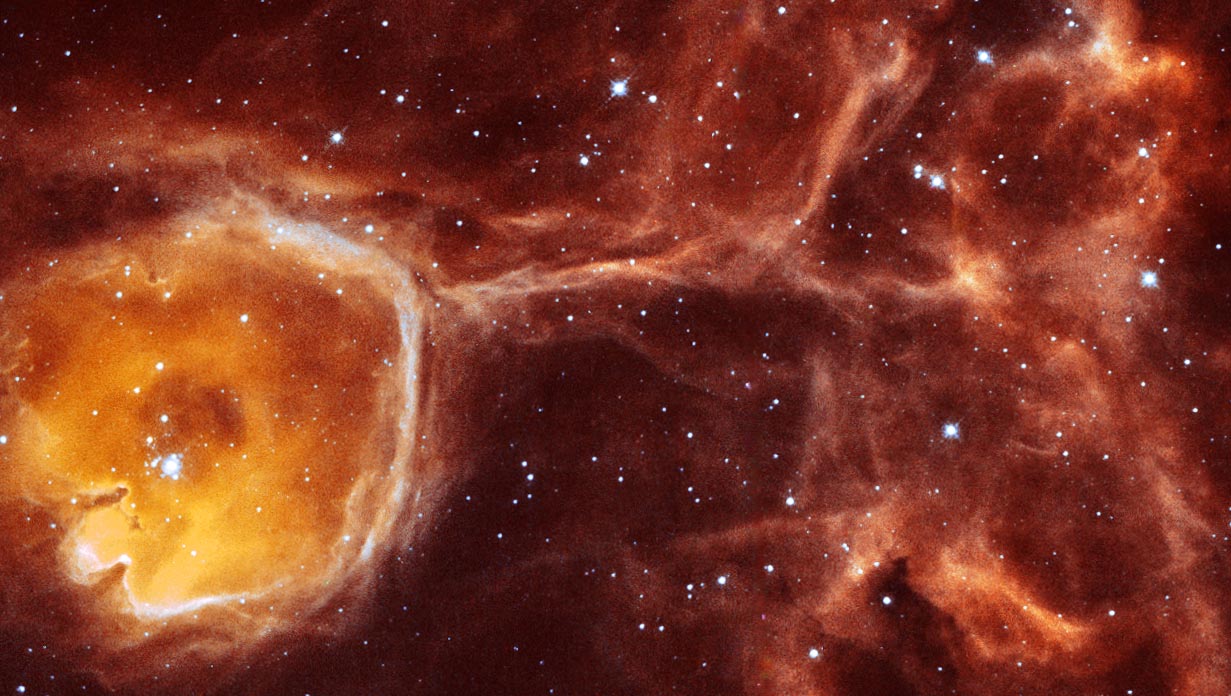
A fast and powerful wind from a hot young star has created this stunning bubble-shaped nebula poised on the end of a bright filament of hydrogen gas. Cataloged as N44F, the cosmic windblown bubble is seen at the left of this Hubble Space Telescope image. N44F lies along the northern outskirts of the N44 complex of emission nebulae in the Large Magellanic Cloud, a mere 160,000 light-years away. The bright, blue, hot star itself is just below the center of the bubble. Peering into the bubble's interior, the Hubble image reveals dramatic structures, including pillars of dust, aligned toward N44F's hot central star. Reminiscent of dust pillars in stellar nurseries within our Milky Way galaxy, they likely contain young stars at their tips. Expanding into the surrounding gas and dust at about 12 kilometers per second, N44F is around 35 light-years across.
Un viento rápido y poderoso emanado de una joven estrella caliente ha creado esta impresionante nebulosa en forma de burbuja ubicada en el extremo de un brillante filamento de gas de hidrógeno. Catalogada como N44F, la burbuja cósmica arrastrada por el viento se observa a la izquierda de esta imagen del Telescopio Espacial Hubble. N44F se encuentra en los límites septentrionales del complejo N44 de nebulosas de emisión en la Gran Nube de Magallanes, a tan solo 160,000 años luz de distancia. La brillante, azul y caliente estrella se encuentra justo debajo del centro de la burbuja. Al observar el interior de la burbuja, la imagen del Hubble revela estructuras espectaculares, incluyendo pilares de polvo alineados hacia la estrella central caliente de N44F. Similares a los pilares de polvo en guarderías estelares dentro de nuestra galaxia la Vía Láctea, probablemente contienen estrellas jóvenes en sus extremos. Expandiéndose hacia el gas y polvo circundante a aproximadamente 12 kilómetros por segundo, N44F tiene un diámetro de alrededor de 35 años luz.