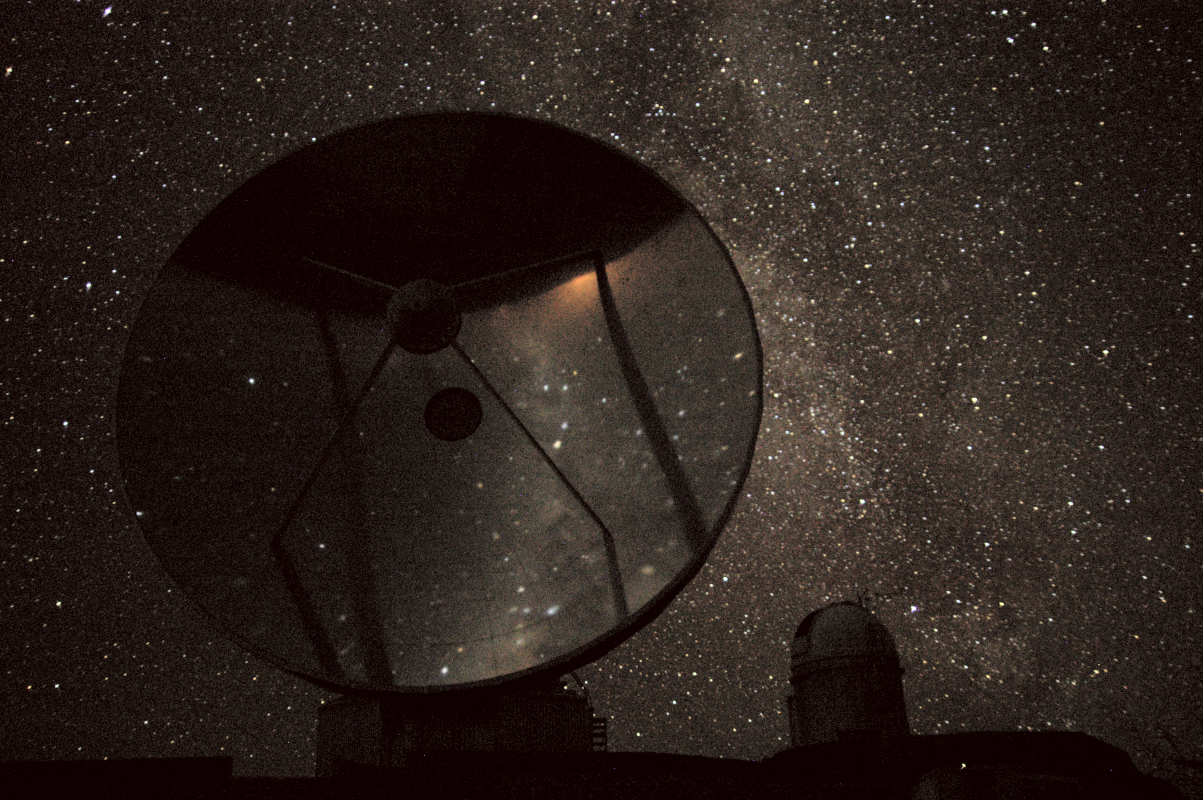
On clear, moonless nights, the stars still come out with a vengance above the high-altitude La Silla astronomical observatory. Taking advantage of a recent visit to this first European Southern Observatory (ESO) site constructed on a mountain top in Chile, ESO software engineer Nico Housen recorded this stunning sky view. Difficult to see from light polluted areas, faint stars and dark dust clouds along the plane of our Milky Way Galaxy arc across the gorgeous photo. In the foreground lies the highly polished 15-meter diameter dish antenna of the Swedish-ESO Submillimeter Telescope (now decommissioned). Beyond it, silhouetted by starlight, is the dome of one of La Silla's large optical instruments, a 3.6 meter telescope. Dramatically reflected in the focusing, mirror-like surface of the dish, the vista behind the photographer appears inverted, with the dark horizon hanging above the Milky Way and the starry night.
En noches claras y sin luna, las estrellas siguen brillando con toda su intensidad sobre el observatorio astronómico de gran altitud La Silla. Aprovechando una visita reciente a este primer sitio del Observatorio Europeo Austral (ESO) construido en la cima de una montaña en Chile, el ingeniero de software del ESO Nico Housen registró esta impresionante vista del cielo. Difíciles de ver desde áreas contaminadas por luz, las estrellas débiles y las nubes de polvo oscuro a lo largo del plano de nuestra Galaxia de la Vía Láctea se extienden en forma de arco a través de la fotografía magnífica. En primer plano se encuentra la antena parabólica de 15 metros de diámetro, altamente pulida, del Telescopio Submilimétrico Sueco-ESO (ahora desmantelado). Más allá, silueteada por la luz de las estrellas, está la cúpula de uno de los grandes instrumentos ópticos de La Silla, un telescopio de 3,6 metros. Dramáticamente reflejada en la superficie reflectante enfocada del plato, la vista detrás del fotógrafo aparece invertida, con el horizonte oscuro colgando sobre la Vía Láctea y la noche estrellada.