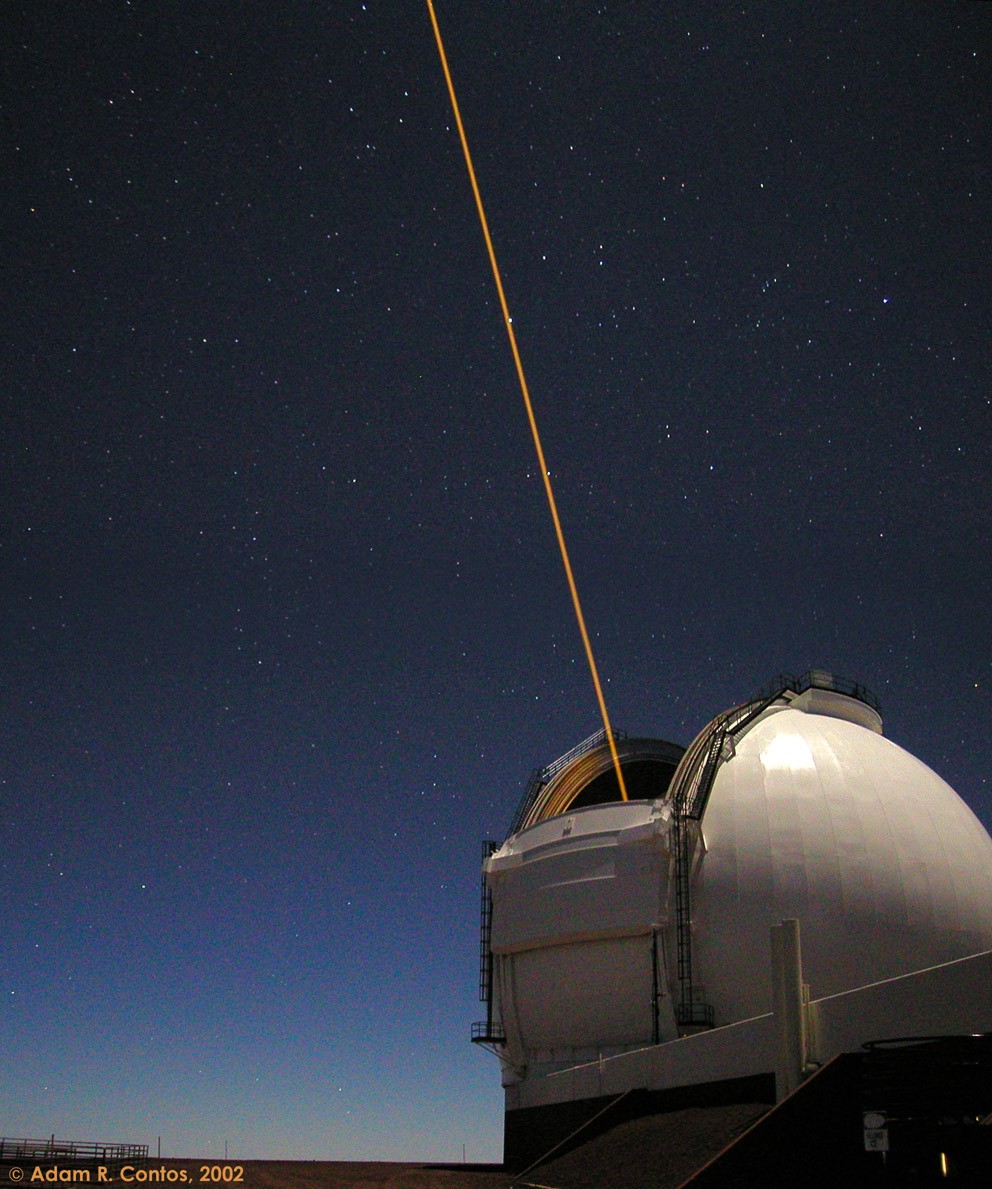
What do you get when you combine one of the world's most powerful telescopes with a powerful laser? An artificial star. Monitoring fluctuations in brightness of a genuine bright star can indicate how the Earth's atmosphere is changing, but many times no bright star exists in the direction where atmospheric information is needed. Therefore, astronomers have developed the ability to create an artificial star where they need it -- with a laser. Subsequent observations of the artificial laser guide star can reveal information so detailed about the blurring effects of the Earth's atmosphere that much of this blurring can be removed by rapidly flexing the mirror. Such adaptive optic techniques allow high-resolution ground-based observations of real stars, planets, nebulae, and the early universe. Above, a laser beam shoots out of the Keck II 10-meter telescope on Mauna Kea in Hawaii in 2002, creating an artificial star.
¿Qué se obtiene cuando se combina uno de los telescopios más potentes del mundo con un láser poderoso? Una estrella artificial. Monitorear las fluctuaciones en el brillo de una estrella genuinamente brillante puede indicar cómo está cambiando la atmósfera de la Tierra, pero muchas veces no existe una estrella brillante en la dirección donde se necesita información atmosférica. Por lo tanto, los astrónomos han desarrollado la capacidad de crear una estrella artificial donde la necesitan, utilizando un láser. Las observaciones posteriores de la estrella guía láser artificial pueden revelar información tan detallada sobre los efectos de desenfoque de la atmósfera terrestre que gran parte de este desenfoque puede eliminarse flexionando rápidamente el espejo. Tales técnicas de óptica adaptativa permiten observaciones de alta resolución desde tierra de estrellas reales, planetas, nebulosas y el universo primitivo. En la imagen superior, un haz láser sale del telescopio Keck II de 10 metros en Mauna Kea, Hawái, en 2002, creando una estrella artificial.