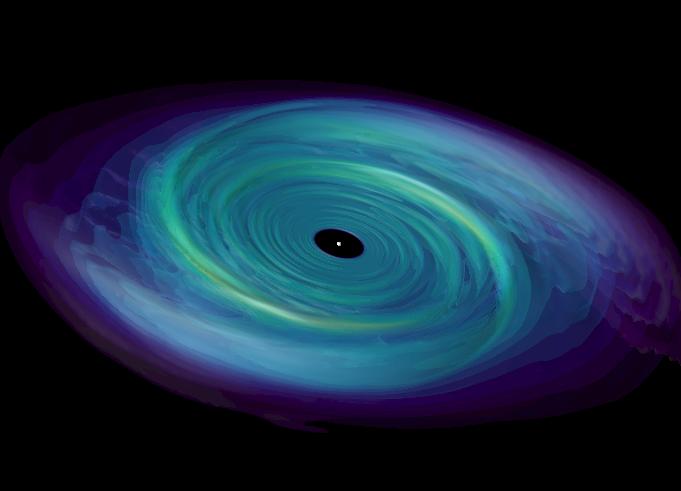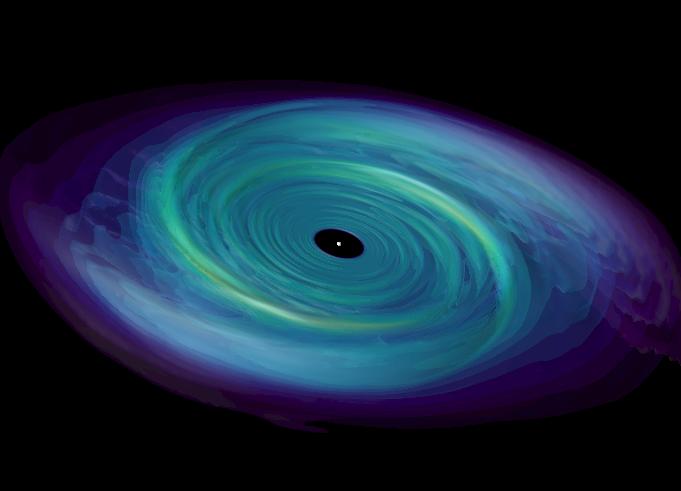
Don't be fooled by the familiar pattern. The graceful spiral structure seen in this computer visualization does not portray winding spiral arms in a distant galaxy of stars. Instead, the graphic shows spiral shock waves in a three dimensional simulation of an accretion disk -- material swirling onto a compact central object that could represent a white dwarf star, neutron star, or black hole. Such accretion disks power bright x-ray sources within our own galaxy. They form in binary star systems which consist of a donor star (not shown above), supplying the accreting material, and a compact object whose strong gravity ultimately draws the material towards its surface. For known x-ray binary systems the size of the accretion disk itself might fall somewhere between the diameter of the Sun (about 1,400,000 kilometers) and the diameter of the Moon's orbit (800,000 kilometers). One interesting result of the virtual reality astrophysics illustrated here is that the simulated disk develops instabilities which tend to smear out the pronounced spiral shocks.
No se deje engañar por el patrón familiar. La elegante estructura espiral que se ve en esta visualización computacional no retrata brazos espirales sinuosos en una galaxia distante de estrellas. En cambio, el gráfico muestra ondas de choque espirales en una simulación tridimensional de un disco de acreción —materia que se arremolina hacia un objeto central compacto que podría representar una enana blanca, una estrella de neutrones o un agujero negro. Tales discos de acreción alimentan fuentes brillantes de rayos X dentro de nuestra propia galaxia. Se forman en sistemas binarios de estrellas que consisten en una estrella donante (no mostrada arriba) que suministra el material acretado, y un objeto compacto cuya gravedad intensa en última instancia atrae la materia hacia su superficie. Para los sistemas binarios de rayos X conocidos, el tamaño del disco de acreción mismo podría caer en algún lugar entre el diámetro del Sol (aproximadamente 1.400.000 kilómetros) y el diámetro de la órbita lunar (800.000 kilómetros). Un resultado interesante de la astrofísica de realidad virtual ilustrada aquí es que el disco simulado desarrolla inestabilidades que tienden a difuminar las ondas de choque espirales pronunciadas.