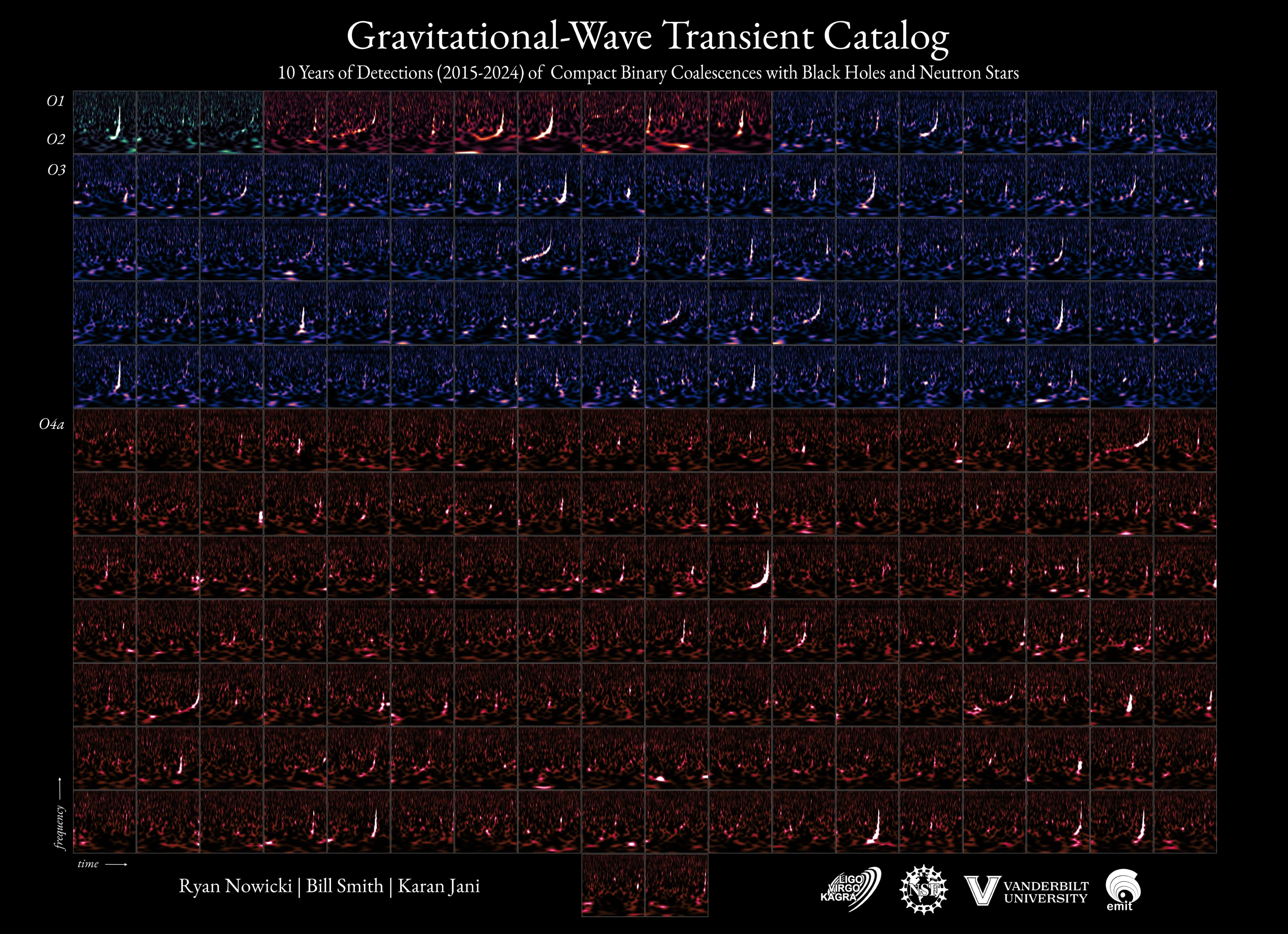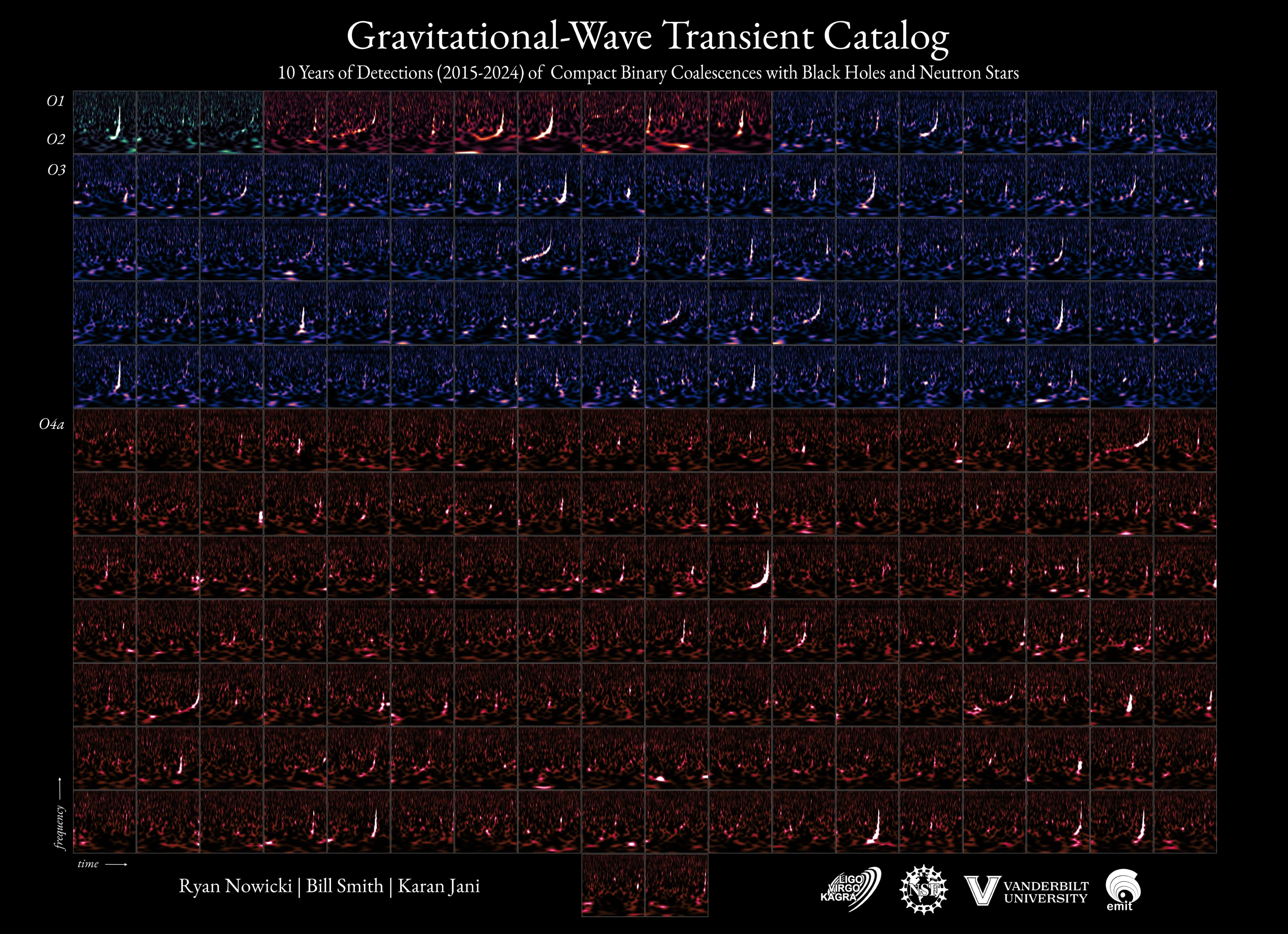
What is the sound of two black holes merging in deep space? Sound waves don't propagate in vacuum, but gravitational waves do. In 2015 we were able to "hear" them for the first time and confirm one of Albert Einstein's theoretical predictions. Each square on the grid of the featured image represents one of the gravitational wave detections announced so far by the LIGO-VIRGO-KAGRA Collaboration. These plots show how the binary pair accelerates in their orbit around each other towards merger: the rising frequency effect is called a "chirp". Although there are significantly more neutron stars than black holes, most of the detections are binary black hole mergers. That happens because black holes are heavier and their signals are louder and can be seen farther away, resulting in more detections. These events are rare, and we don't expect to see one close by in our Galaxy any time soon. But they are happening continuously throughout the cosmos.
¿Cuál es el sonido de dos agujeros negros fusionándose en el espacio profundo? Las ondas sonoras no se propagan en el vacío, pero las ondas gravitacionales sí. En 2015 pudimos "escucharlas" por primera vez y confirmar una de las predicciones teóricas de Albert Einstein. Cada cuadrado en la cuadrícula de la imagen destacada representa una de las detecciones de ondas gravitacionales anunciadas hasta ahora por la Colaboración LIGO-VIRGO-KAGRA. Estos gráficos muestran cómo el par binario se acelera en su órbita mutua hacia la fusión: el efecto de frecuencia ascendente se denomina "chirrido" (chirp). Aunque hay significativamente más estrellas de neutrones que agujeros negros, la mayoría de las detecciones corresponden a fusiones de agujeros negros binarios. Esto ocurre porque los agujeros negros son más masivos, sus señales son más intensas y pueden detectarse a mayor distancia, lo que resulta en un mayor número de detecciones. Estos eventos son poco frecuentes y no se espera observar uno cercano en nuestra Galaxia en un futuro próximo. Sin embargo, ocurren de manera continua a lo largo y ancho del cosmos.