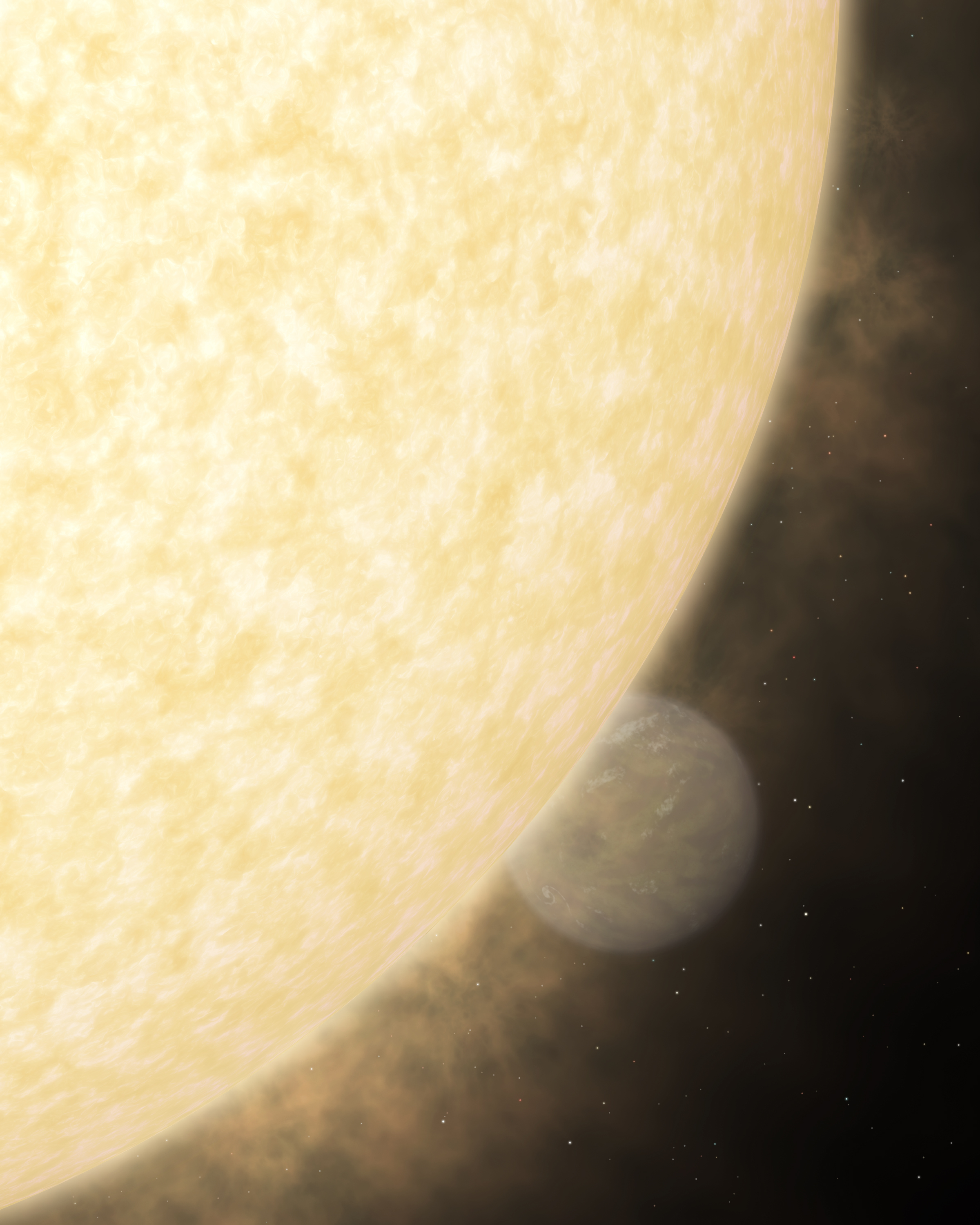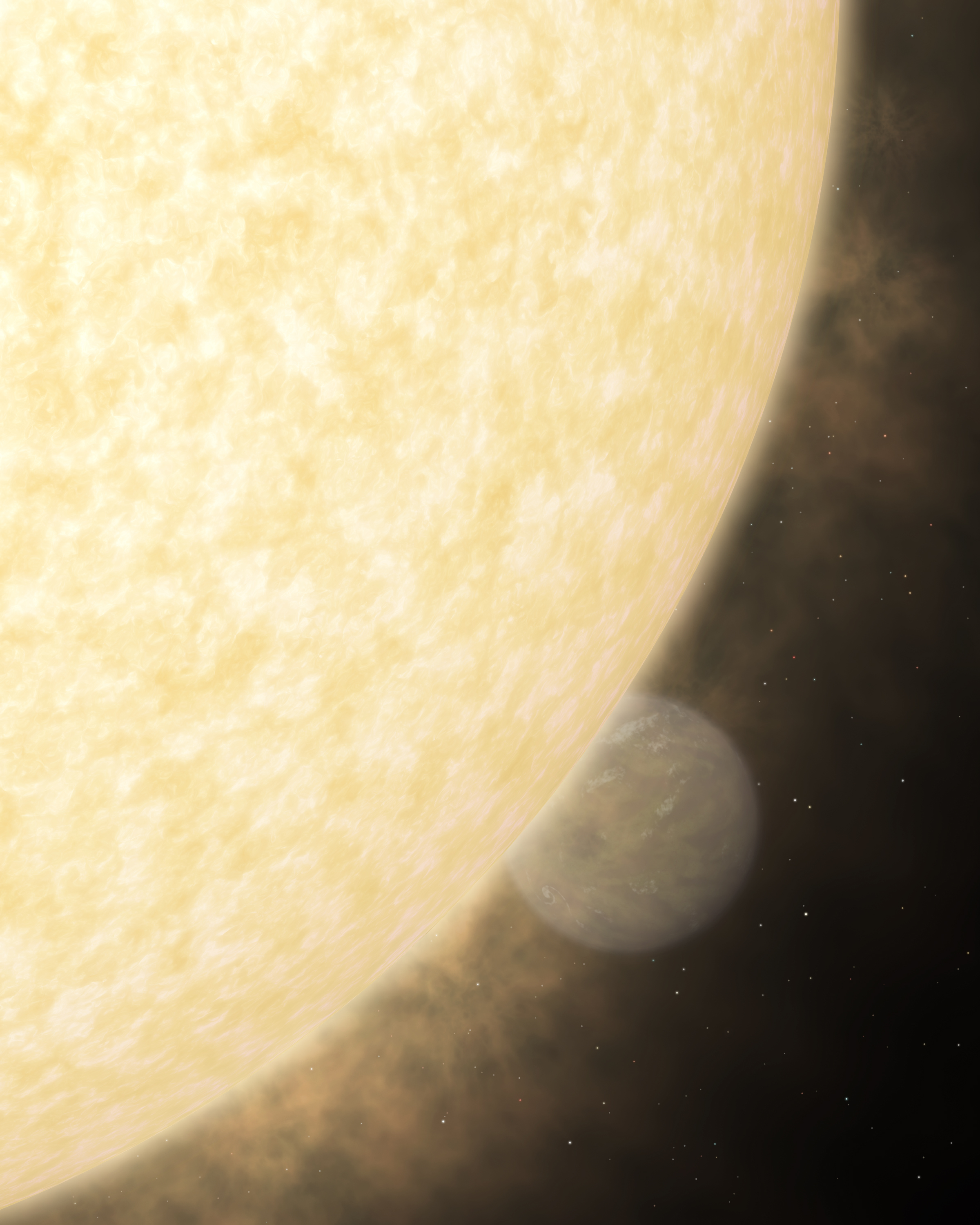
Light emitted by a planet far beyond our Solar System has been identified for the first time. The planet, illustrated in the above drawing, had its light detected by comparing the brightness of only the parent star, when the planet was behind the star, to the light emitted when both the planet and its parent star were visible. The Earth-trailing Spitzer Space Telescope made the observation in infrared light, where the intrinsic glow of the planet outshines the light it reflects from its central star. The direct observation of light allowed a measurement of both the temperature and size of the planet: HD 209458b. Planet HD 209458b was confirmed to be larger than expected for its mass and on an orbit around its parent star that was unexpectedly close to a circle.
Se ha identificado por primera vez la luz emitida por un planeta ubicado más allá de nuestro Sistema Solar. El planeta, ilustrado en el dibujo anterior, tuvo su luz detectada comparando el brillo únicamente de la estrella madre cuando el planeta estaba detrás de la estrella, con la luz emitida cuando tanto el planeta como su estrella madre eran visibles. El Telescopio Espacial Spitzer, situado detrás de la Tierra, realizó la observación en luz infrarroja, donde el brillo intrínseco del planeta supera la luz que refleja desde su estrella central. La observación directa de la luz permitió medir tanto la temperatura como el tamaño del planeta: HD 209458b. Se confirmó que el planeta HD 209458b es más grande de lo esperado para su masa y orbita su estrella madre en una órbita inesperadamente circular.