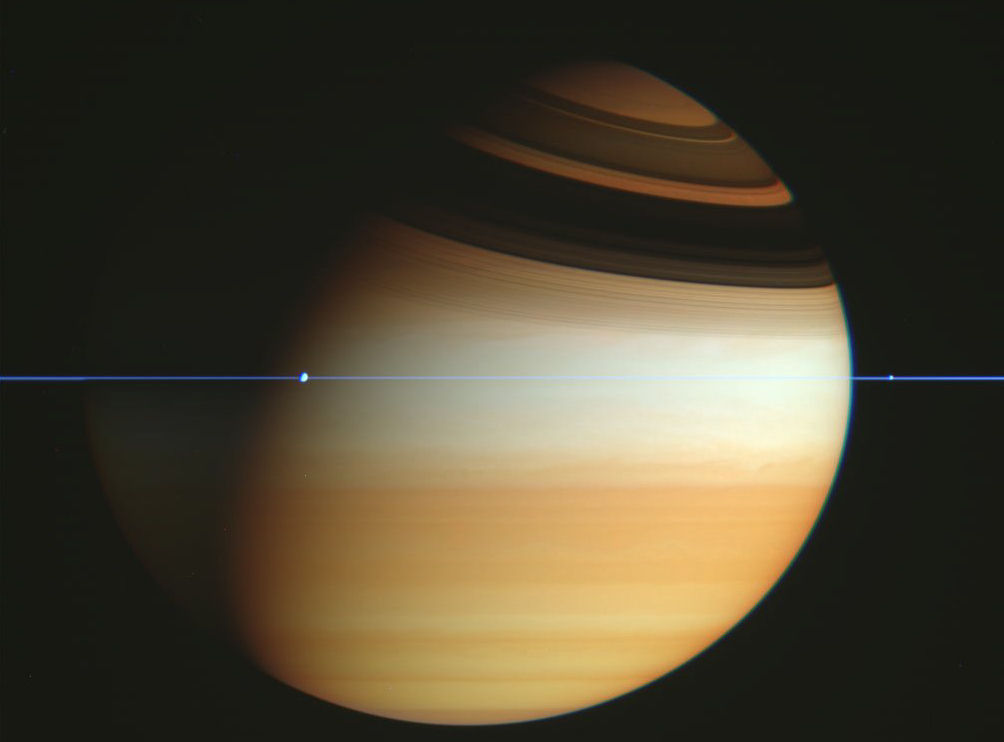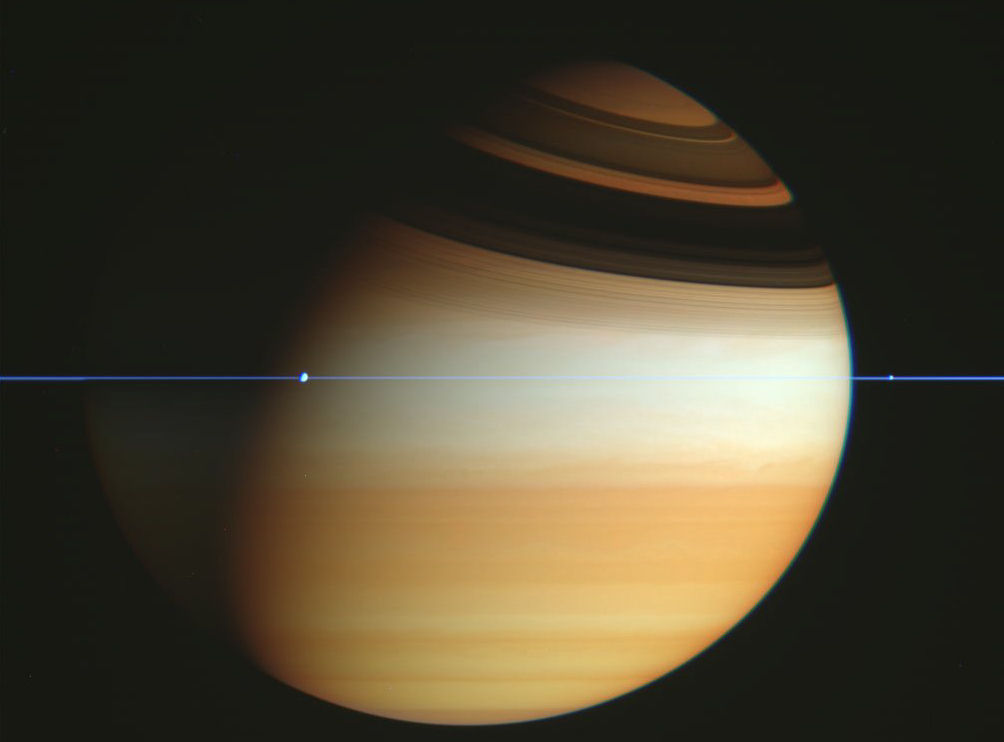
If this is Saturn, where are the rings? When Saturn's "appendages" disappeared in 1612, Galileo did not understand why. Later that century, it became understood that Saturn's unusual protrusions were rings and that when the Earth crosses the ring plane, the edge-on rings will appear to disappear. This is because Saturn's rings are confined to a plane many times thinner, in proportion, than a razor blade. In modern times, the robot Cassini spacecraft orbiting Saturn now also crosses Saturn's ring plane. A series of plane crossing images from late February was dug out of the vast online Cassini raw image archive by interested Spanish amateur Fernando Garcia Navarro. Pictured above, digitally cropped and set in representative colors, is the striking result. Saturn's thin ring plane appears in blue, bands and clouds in Saturn's upper atmosphere appear in gold, and dark shadows of the rings curve across the top of the gas giant planet. Moons appear as bumps in the rings.
Si esto es Saturno, ¿dónde están los anillos? Cuando los "apéndices" de Saturno desaparecieron en 1612, Galileo no comprendía por qué. Más adelante en ese siglo, se llegó a entender que las inusuales protuberancias de Saturno eran anillos y que cuando la Tierra cruza el plano de los anillos, estos anillos vistos de canto parecerán desaparecer. Esto es porque los anillos de Saturno están confinados a un plano muchas veces más delgado, en proporción, que una hoja de afeitar. En tiempos modernos, la nave espacial robótica Cassini que orbita Saturno también cruza el plano de los anillos de Saturno. Una serie de imágenes del cruce del plano de finales de febrero fue extraída del vasto archivo de imágenes brutas de Cassini en línea por el astrónomo aficionado español Fernando García Navarro. En la imagen mostrada arriba, digitalmente recortada y presentada en colores representativos, se muestra el resultado sorprendente. El delgado plano de los anillos de Saturno aparece en azul, las bandas y nubes en la atmósfera superior de Saturno aparecen en oro, y las sombras oscuras de los anillos se curvan a través de la parte superior del gigante gaseoso. Las lunas aparecen como protuberancias en los anillos.