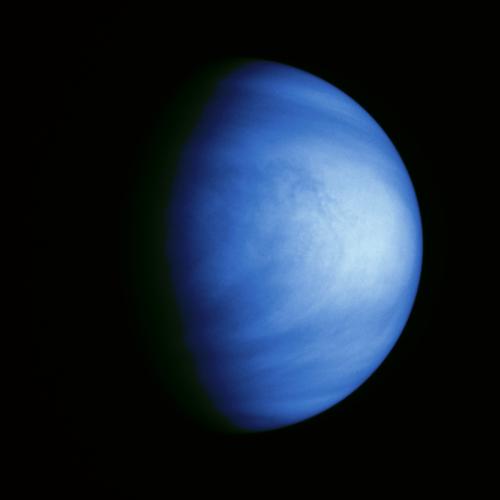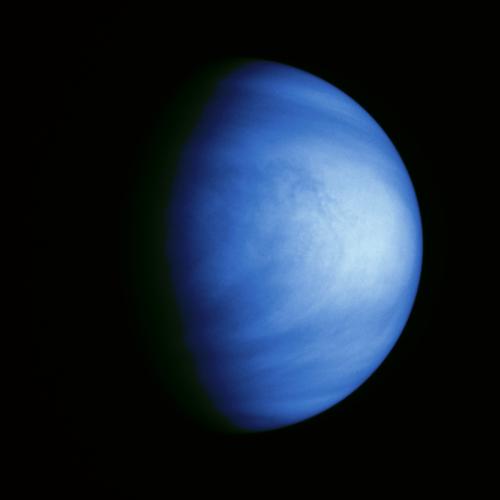
Venus, the second closest planet to the Sun, is by far the brightest of the three planets gathered in this weekend's western sky at sunset. It has also proven to be a popular way-point for spacecraft headed for the gas giant planets in the outer reaches of the solar system. Why visit Venus first? Using a gravity assist maneuver, spacecraft can swing by planets and gain energy during their brief encounter, saving fuel for use at the end of their long interplanetary voyage. This colorized image of Venus was recorded by the Jupiter-bound Galileo spacecraft shortly after its gravity assist flyby of Venus in February of 1990. Galileo's glimpse of the veiled planet shows structure in swirling sulfuric acid clouds. The bright area is sunlight glinting off the upper cloud deck.
Venus, el segundo planeta más cercano al Sol, es con mucho el más brillante de los tres planetas reunidos en el cielo occidental de este fin de semana al atardecer. También ha demostrado ser un punto de escala popular para las naves espaciales dirigidas hacia los gigantes gaseosos en los alcances exteriores del sistema solar. ¿Por qué visitar Venus primero? Utilizando una maniobra de asistencia gravitatoria, las naves espaciales pueden pasar cerca de los planetas y ganar energía durante su breve encuentro, ahorrando combustible para usar al final de su largo viaje interplanetario. Esta imagen colorida de Venus fue registrada por la nave espacial Galileo, dirigida hacia Júpiter, poco después de su sobrevuelo de asistencia gravitatoria de Venus en febrero de 1990. La perspectiva de Galileo del planeta velado muestra estructura en las nubes de ácido sulfúrico que se arremolinen. El área brillante es la luz solar reflejándose en la cubierta de nubes superior.