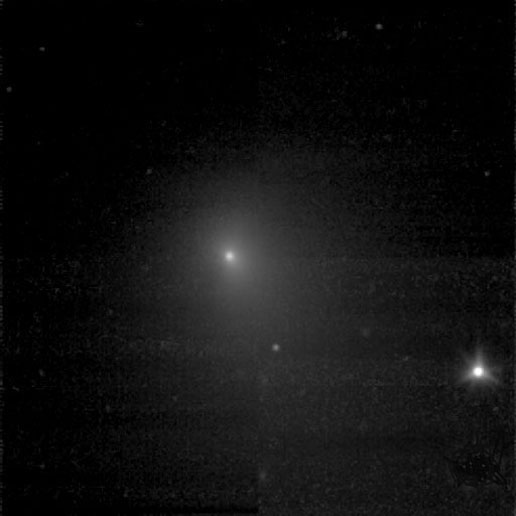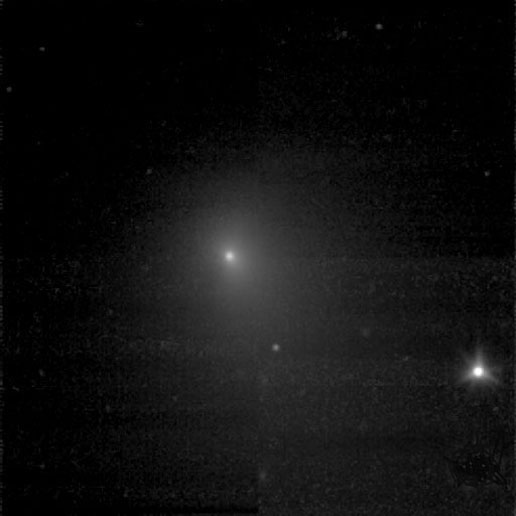
The Deep Impact spacecraft continues to close on Comet Tempel 1, a comet roughly the size of Manhattan. Early on July 3 (EDT), the Deep Impact spacecraft will separate in to two individual robotic spaceships, one called Flyby and the other called Impactor. During the next 24 hours, both Flyby and Impactor will fire rockets and undergo complex maneuvers in preparation for Impactor's planned collision with Comet Tempel 1. On July 4 (1:52 am EDT) if everything goes as scheduled, the 370-kilogram Impactor will strike Tempel 1's surface at over 14,000 kilometers per hour. Impactor will attempt to photograph the oncoming comet right up to the time of collision, while Flyby photographs the result from nearby. The above image was taken on 19 June from about 13 million kilometers out and used to help identify the central nucleus of the comet inside the diffuse coma. Telescopes around the Earth, including the Hubble Space Telescope, will also be closely watching the distant silent space ballet. The result may give crucial information about the structure of comets and the early history of our Solar System.
La sonda espacial Deep Impact continúa aproximándose al Cometa Tempel 1, un cometa aproximadamente del tamaño de Manhattan. A principios del 3 de julio (EDT), la sonda espacial Deep Impact se separará en dos naves robóticas individuales, una llamada Flyby y la otra Impactor. Durante las próximas 24 horas, tanto Flyby como Impactor encenderán sus cohetes y realizarán maniobras complejas en preparación para la colisión planeada de Impactor con el Cometa Tempel 1. El 4 de julio (1:52 a.m. EDT), si todo sale según lo planeado, el Impactor de 370 kilogramos golpeará la superficie de Tempel 1 a más de 14 000 kilómetros por hora. Impactor intentará fotografiar el cometa aproximándose hasta el momento de la colisión, mientras que Flyby fotografiará el resultado desde las cercanías. La imagen anterior fue tomada el 19 de junio desde aproximadamente 13 millones de kilómetros de distancia y se utilizó para ayudar a identificar el núcleo central del cometa dentro de la coma difusa. Telescopios alrededor de la Tierra, incluido el Telescopio Espacial Hubble, también estarán observando atentamente este distante ballet silencioso del espacio. El resultado puede proporcionar información crucial sobre la estructura de los cometas y la historia temprana de nuestro Sistema Solar.