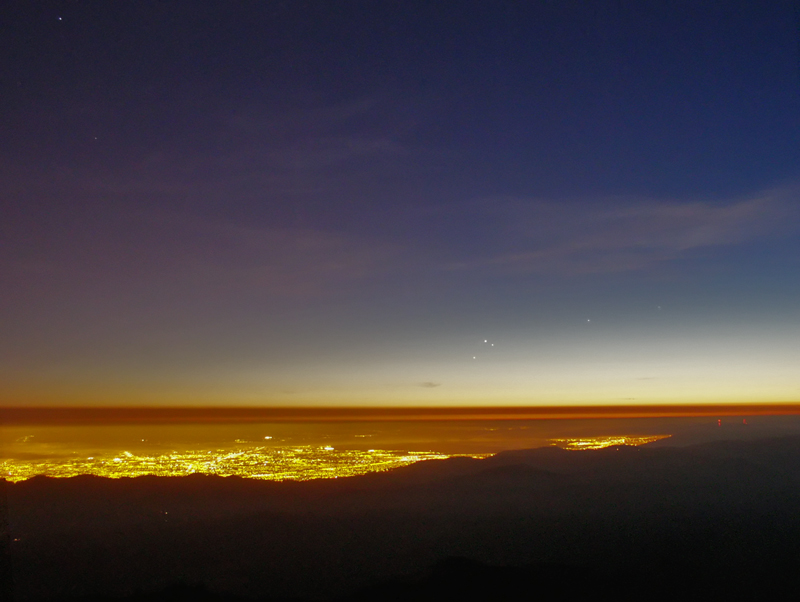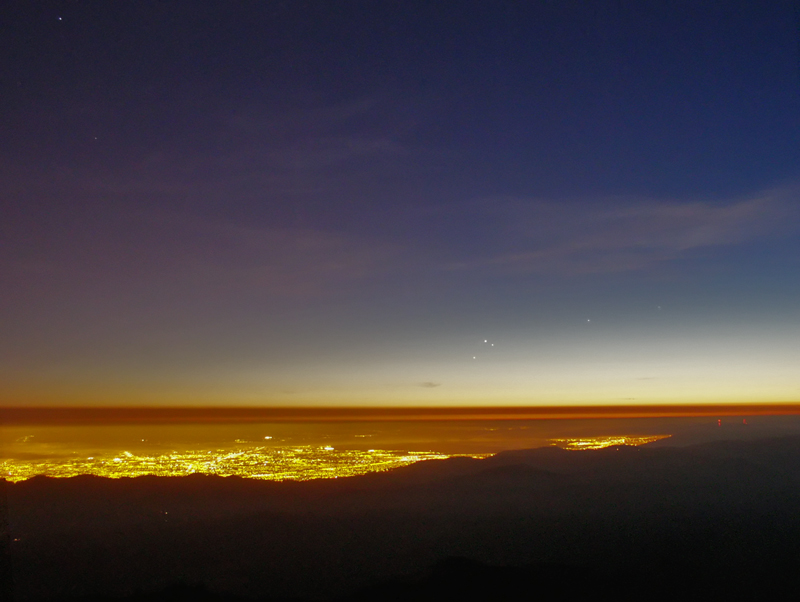
Venus, Mercury, and Saturn wandered close together in western evening skies last week. On Saturnday, June 25, astronomer R. Jay GaBany recorded this snapshot of their eye-catching planetary conjunction, from historic Lick Observatory on Mt. Hamilton, California, USA. The view looks toward the Pacific shortly after sunset with the lights of San Jose and the southern San Francisco Bay area in the foreground. Of course, Venus is the brightest of the trio. Mercury is nearby on the right and Saturn is below and left, closest to the horizon. Farther to the right of the planetary triangle are Pollux and Castor, twin stars of Gemini, with Regulus, bright star of the constellation Leo, at the very upper left corner of the picture. In the coming days, Venus and Mercury remain close, while Saturn continues to drop below them, toward the horizon.
Venus, Mercurio y Saturno se desplazaban muy próximos entre sí en los cielos vespertinos occidentales la semana pasada. El sábado 25 de junio, el astrónomo R. Jay GaBany registró esta instantánea de su llamativa conjunción planetaria desde el histórico Observatorio Lick en el Monte Hamilton, California, EE.UU. La vista se orienta hacia el Pacífico poco después de la puesta de sol, con las luces de San José y el área sur de la bahía de San Francisco en primer plano. Por supuesto, Venus es el más brillante de los tres. Mercurio se encuentra cerca, a la derecha, y Saturno está debajo e izquierda, más cerca del horizonte. Más allá a la derecha del triángulo planetario se encuentran Pólux y Cástor, las estrellas gemelas de Géminis, con Régulo, la estrella brillante de la constelación de Leo, en la esquina superior izquierda de la fotografía. En los próximos días, Venus y Mercurio permanecerán cerca, mientras que Saturno continúa descendiendo por debajo de ellos, hacia el horizonte.