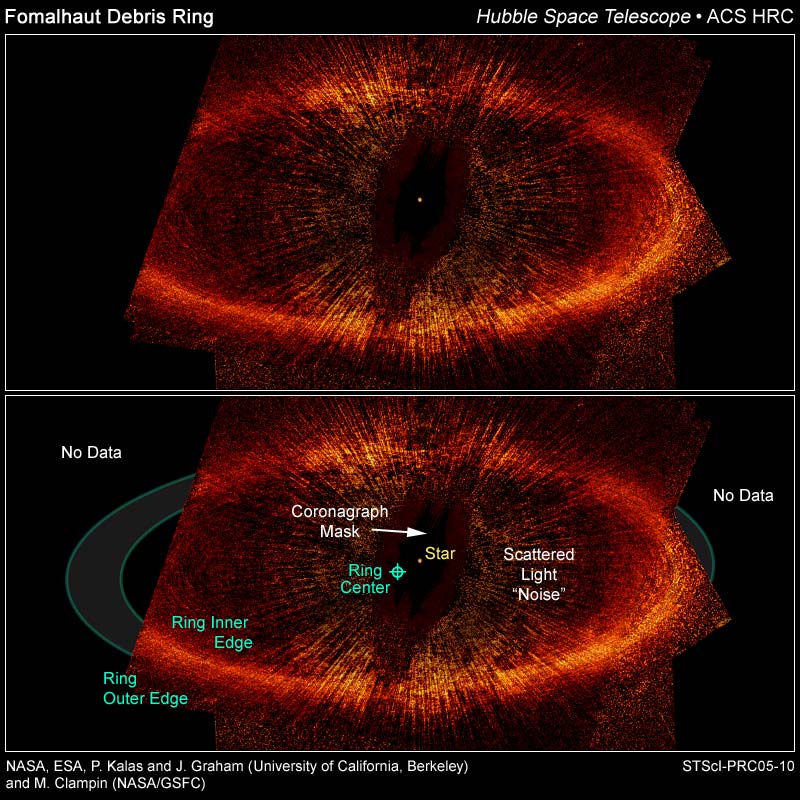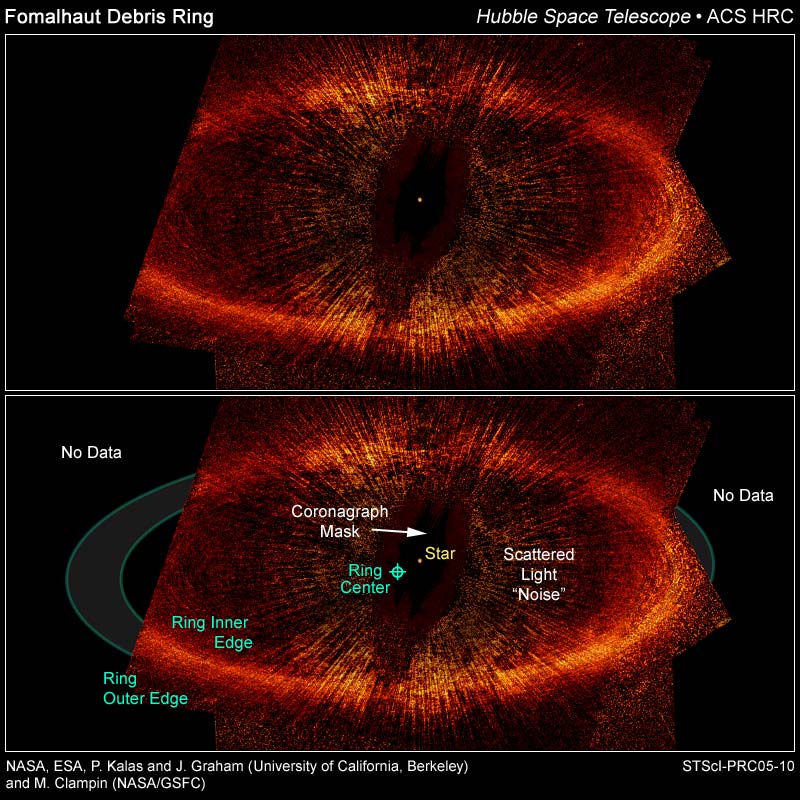
Fomalhaut (sounds like "foam-a-lot") is a bright, young, star, a mere 25 light-year trip from planet Earth in the direction of the constellation Piscis Austrinus. Earlier infrared observations identified a torus of cold material surrounding the nearby star but the panels above detail the sharpest ever visible light-image of Fomalhaut's dusty debris ring, recorded by the Hubble Space Telescope's ACS camera. Overwhelming glare from the star is masked by an occulting disk in the camera's coronagraph. The off-center ring with a sharp inner boundary is taken to be strong evidence of a massive planet orbiting far from Fomalhaut, shaping and maintaining the ring's inner edge. Starting 133 astronomical units (Earth-Sun distances) from Fomalhaut, the dusty ring itself is likely a larger, younger analog of our own Kuiper Belt - the solar system's outer reservoir of icy bodies.
Fomalhaut (pronunciado "fomalhaut") es una estrella joven y brillante, a apenas 25 años luz de distancia del planeta Tierra en la dirección de la constelación de Piscis Austrinus. Observaciones infrarrojas anteriores identificaron un toro de material frío alrededor de la estrella cercana, pero las imágenes anteriores presentan la imagen de luz visible más nítida jamás obtenida del anillo de polvo de escombros de Fomalhaut, registrada por la cámara ACS del Telescopio Espacial Hubble. El brillo abrumador de la estrella se enmascara mediante un disco ocultador en el coronagrafo de la cámara. El anillo descentrado con un borde interior afilado se interpreta como una fuerte evidencia de un planeta masivo que orbita lejos de Fomalhaut, dando forma y manteniendo el borde interior del anillo. Comenzando a 133 unidades astronómicas (distancias Tierra-Sol) de Fomalhaut, el anillo polvoriento es probablemente un análogo más grande y más joven de nuestro propio Cinturón de Kuiper, el depósito externo del sistema solar de cuerpos helados.