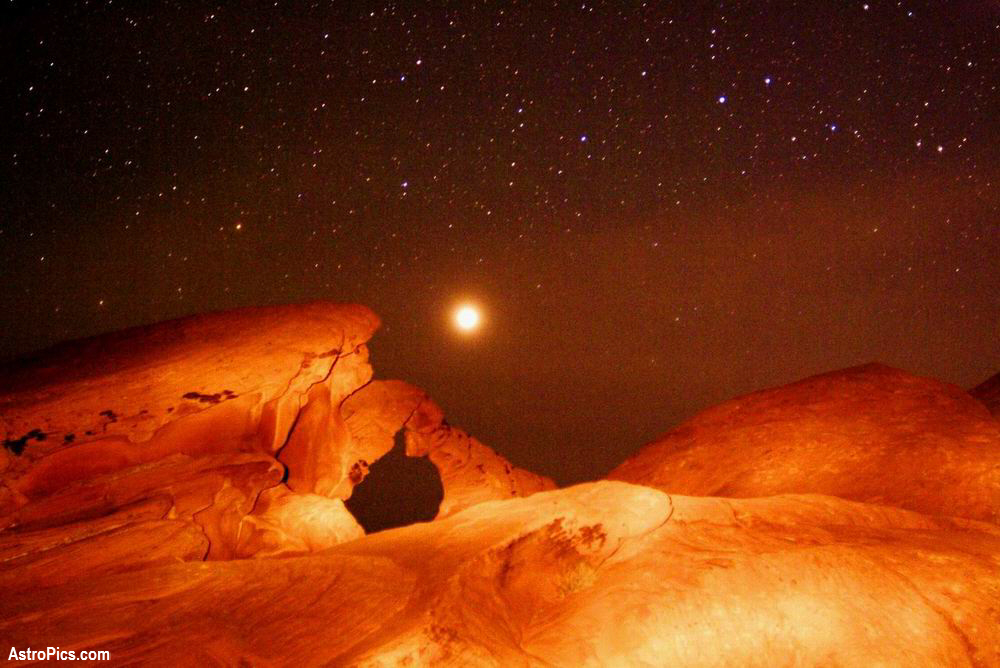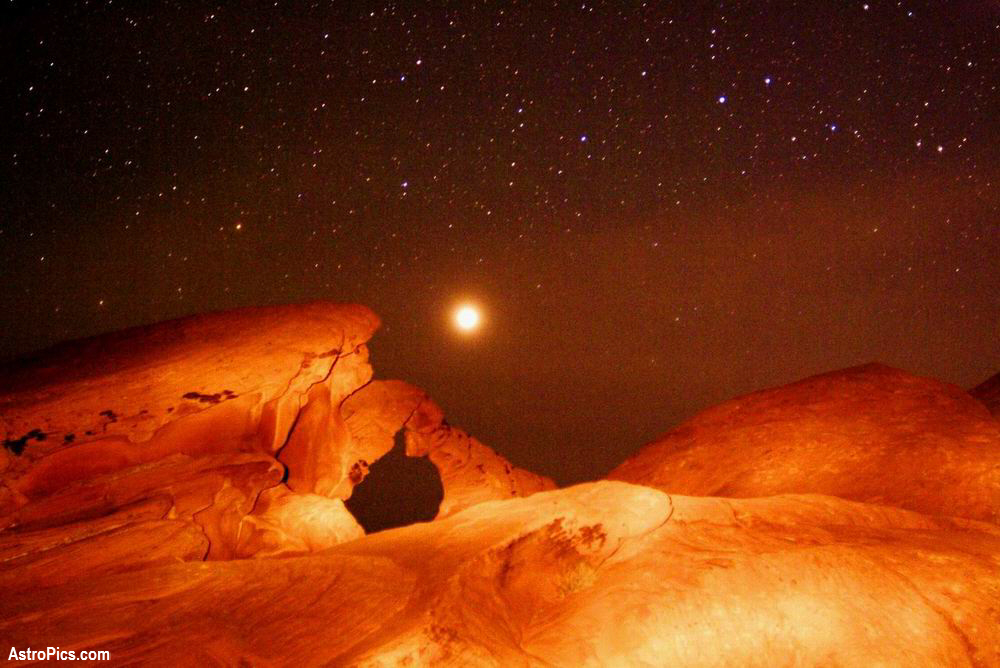
Will Mars appear extremely close and bright later this month? No. Regardless of numerous urban legends circulating, Mars will appear relatively normal in August. October is the best month to see Mars this year. The red planet is now visible in the morning before sunrise. As Earth catches up to Mars in their respective orbits around the Sun, Mars will keep rising earlier in the night. On 2005 October 30, Earth will have caught up to Mars and the planets will be the nearest to each other in their orbits -- this time around. On October 30, Mars will be nearly opposite to the Sun, rise at sunset, set at sunrise, and appear highest and brightest around midnight. Also on October 30, Mars will appear brighter than it has in the past two years, although still over 10,000 times smaller and fainter than the full Moon. Earth will then pass Mars, and Mars will appear to fade. Pictured above, Mars is shown as it appeared 2003 August 27, when it appeared slightly brighter than it had in nearly 60,000 years. The foreground setting is in the Valley of Fire state park in Nevada, USA. The ellipticity of orbits primarily determines the closeness and brightness of Mars during opposition.
¿Aparecerá Marte extremadamente cerca y brillante a finales de este mes? No. A pesar de numerosas leyendas urbanas que circulan, Marte aparecerá relativamente normal en agosto. Octubre es el mejor mes para ver a Marte este año. El planeta rojo es ahora visible por la mañana antes del amanecer. Conforme la Tierra alcanza a Marte en sus respectivas órbitas alrededor del Sol, Marte seguirá saliendo más temprano en la noche. El 30 de octubre de 2005, la Tierra habrá alcanzado a Marte y los planetas estarán más cercanos entre sí en sus órbitas, en esta ocasión. El 30 de octubre, Marte estará casi opuesto al Sol, saldrá al atardecer, se pondrá al amanecer, y aparecerá más alto y brillante alrededor de la medianoche. También el 30 de octubre, Marte aparecerá más brillante de lo que ha estado en los últimos dos años, aunque aún más de 10,000 veces más pequeño y tenue que la Luna llena. La Tierra entonces pasará a Marte, y Marte parecerá desvanecerse. En la imagen superior, Marte se muestra tal como apareció el 27 de agosto de 2003, cuando apareció ligeramente más brillante de lo que había sido en casi 60,000 años. El escenario del primer plano se encuentra en el parque estatal Valley of Fire en Nevada, EE. UU. La elipticidad de las órbitas determina principalmente la proximidad y el brillo de Marte durante la oposición.