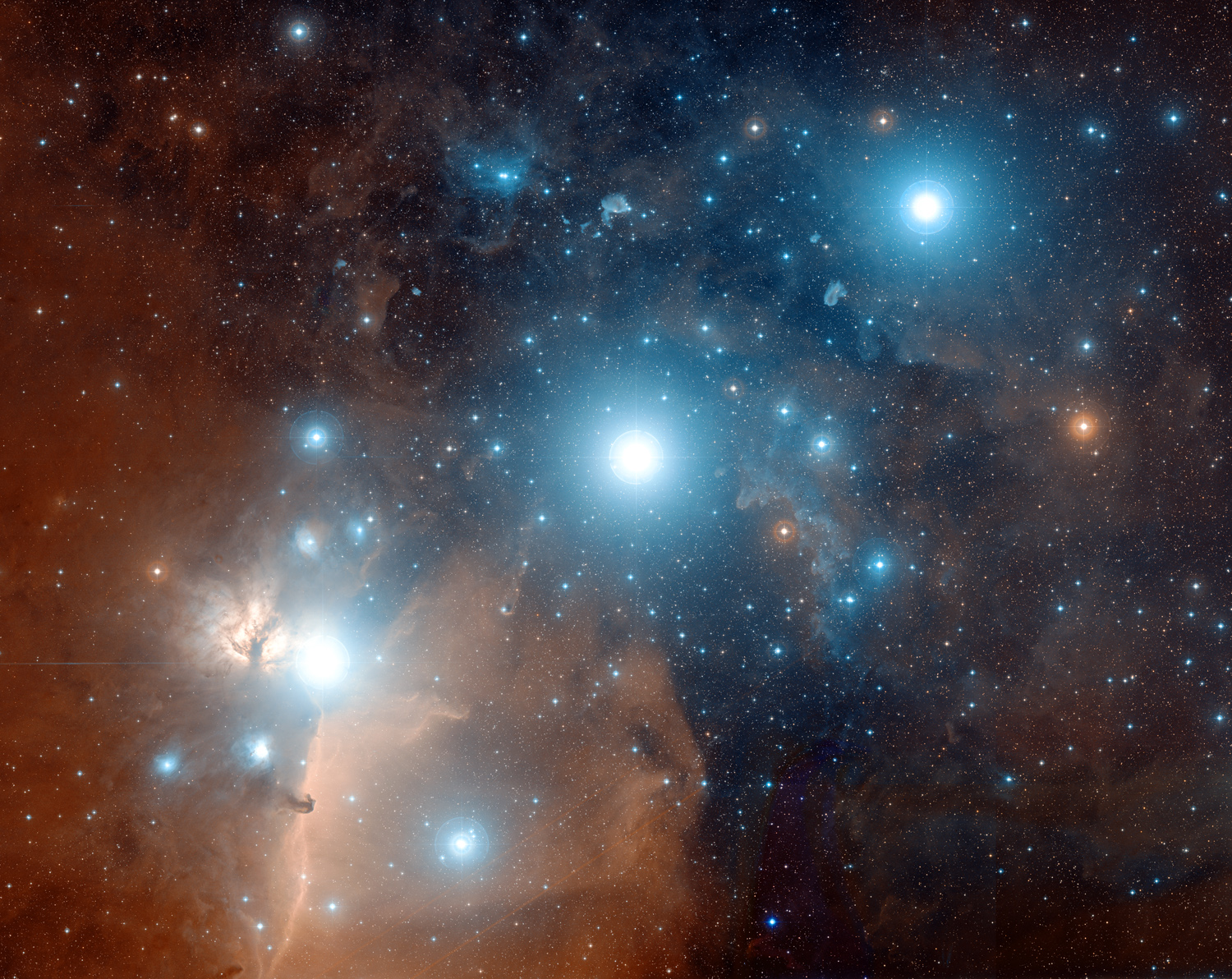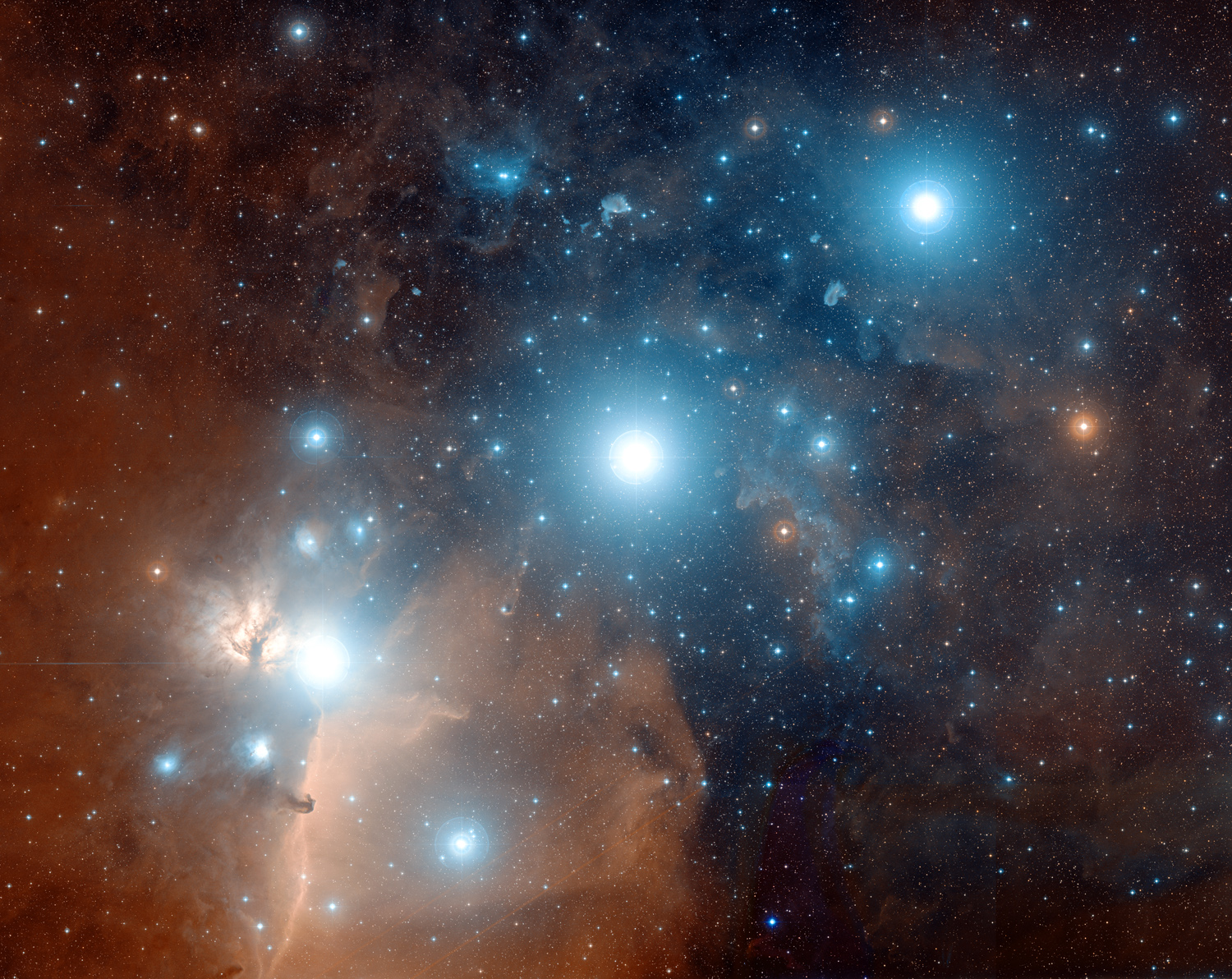
Alnitak, Alnilam, and Mintaka, are the bright bluish stars from east to west (left to right) along the diagonal in this gorgeous cosmic vista. Otherwise known as the Belt of Orion, these three blue supergiant stars are hotter and much more massive than the Sun. They lie about 1,500 light-years away, born of Orion's well-studied interstellar clouds. In fact, clouds of gas and dust adrift in this region have intriguing and some surprisingly familiar shapes, including the dark Horsehead Nebula and Flame Nebula near Alnitak at the lower left. The famous Orion Nebula itself lies off the bottom of this star field that covers an impressive 4.4x3.5 degrees on the sky. The color picture was composited from digitized black and white photographic plates recorded through red and blue astronomical filters, with a computer synthesized green channel. The plates were taken using the Samuel Oschin Telescope, a wide-field survey instrument at Palomar Observatory, between 1987 and 1991.
Alnitak, Alnilam y Mintaka son las brillantes estrellas azuladas que se extienden de este a oeste (de izquierda a derecha) a lo largo de la diagonal en esta magnífica vista cósmica. También conocidas como el Cinturón de Orión, estas tres estrellas supergigantes azules son más calientes y mucho más masivas que el Sol. Se encuentran a aproximadamente 1.500 años luz de distancia, nacidas de las nubes interestelares bien estudiadas de Orión. De hecho, las nubes de gas y polvo que flotan en esta región tienen formas intrigantes y algunas sorprendentemente familiares, incluyendo la oscura Nebulosa Cabeza de Caballo y la Nebulosa de la Llama cerca de Alnitak en la parte inferior izquierda. La famosa Nebulosa de Orión se encuentra fuera del borde inferior de este campo estelar que abarca impresionantes 4,4 x 3,5 grados en el cielo. La imagen a color fue compuesta a partir de placas fotográficas digitalizadas en blanco y negro registradas a través de filtros astronómicos rojo y azul, con un canal verde sintetizado por computadora. Las placas fueron tomadas utilizando el Telescopio Samuel Oschin, un instrumento de búsqueda de gran angular en el Observatorio Palomar, entre 1987 y 1991.