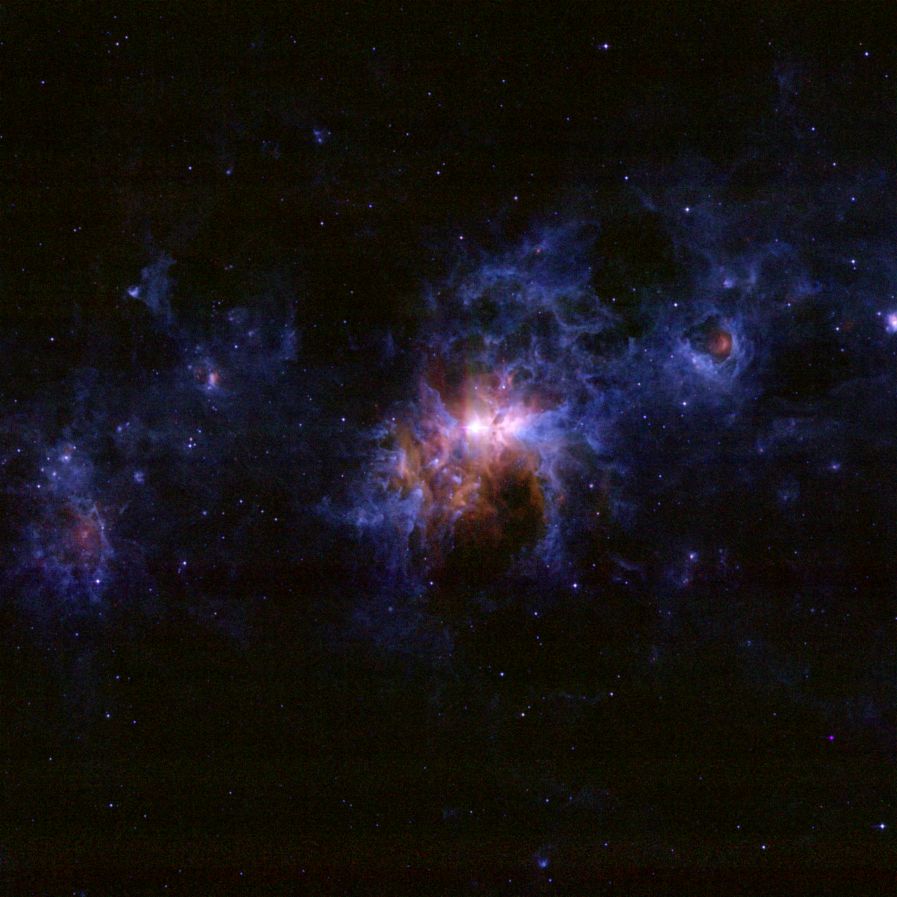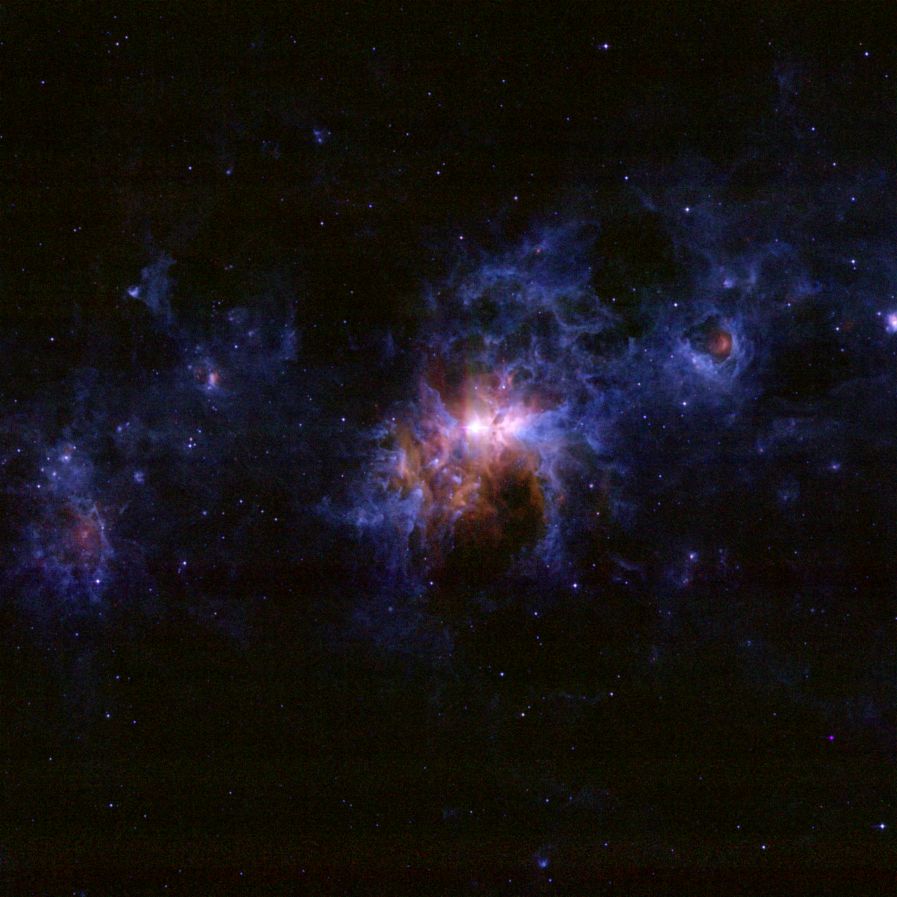
Car is a massive star, but it's not as bright as it used to be. Now only easily visible in binoculars or a small telescope, Eta Carinae has a history of spectacular flaring and fading behavior. In fact, in April of 1843 Eta Car briefly became second only to Sirius as the brightest star in planet Earth's night sky, even though at a distance of about 7,500 light-years, it is about 800 times farther away. Surrounded by a complex and evolving nebula, Eta Carinae is seen near the center of this false-color infrared image, constructed using data from the Midcourse Space Experiment (MSX). The MSX satellite mapped the galactic plane in 1996. In the picture, wispy, convoluted filaments are clouds of dust glowing at infrared wavelengths. Astronomers hypothesize that Eta Car itself will explode as a supernova in the next million years or so. Massive Eta Car has even been considered a candidate for a hypernova explosion and the potential source of a future gamma-ray burst.
Eta Carinae es una estrella masiva, pero no es tan brillante como lo era antes. Ahora visible únicamente a través de binoculares o un pequeño telescopio, Eta Carinae tiene un historial de espectaculares erupciones y desvanecimientos. De hecho, en abril de 1843, Eta Carinae se convirtió brevemente en la segunda estrella más brillante del cielo nocturno de la Tierra, solo superada por Sirio, a pesar de encontrarse a una distancia de aproximadamente 7.500 años luz, es decir, unas 800 veces más lejos. Rodeada por una nebulosa compleja y en evolución, Eta Carinae se ve cerca del centro de esta imagen infrarroja de falso color, construida utilizando datos del Experimento Espacial del Punto Medio (MSX, por sus siglas en inglés). El satélite MSX mapeó el plano galáctico en 1996. En la imagen, los filamentos tenues y convolutos son nubes de polvo que brillan en longitudes de onda infrarroja. Los astrónomos especulan que Eta Carinae explotará como supernova en los próximos millones de años aproximadamente. La masiva Eta Carinae incluso ha sido considerada como candidata para una explosión de hipernova y como fuente potencial de un estallido de rayos gamma en el futuro.