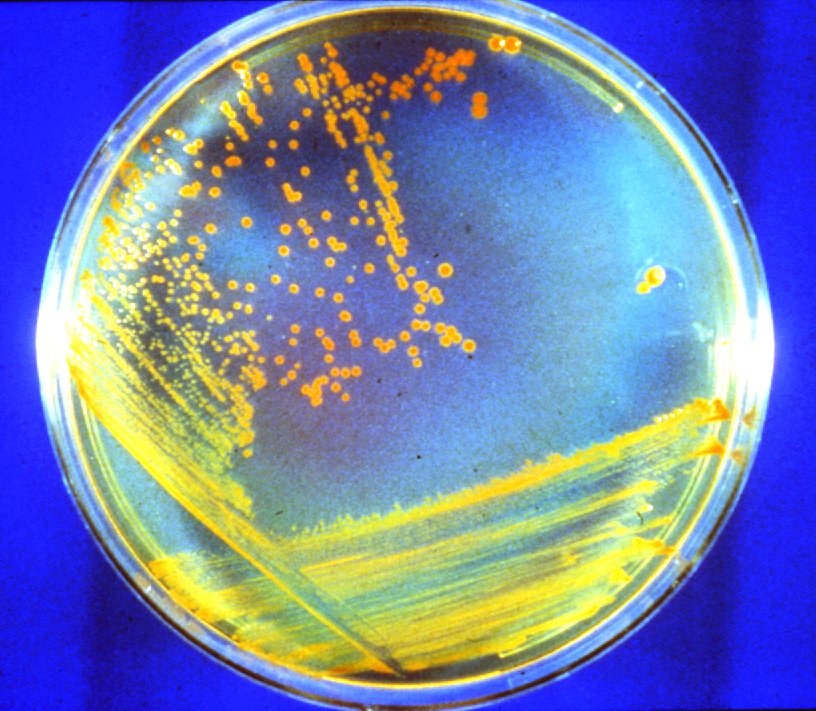
These bacteria could survive on another planet. In an Earth lab, Deinococcus radiodurans (D. rad) survive extreme levels of radiation, extreme temperatures, dehydration, and exposure to genotoxic chemicals. Amazingly, they even have the ability to repair their own DNA, usually with 48 hours. Known as an extremophile, bacteria such as D. rad are of interest to NASA partly because they might be adaptable to help human astronauts survive on other worlds. A recent map of D. rad's DNA might allow biologists to augment their survival skills with the ability to produce medicine, clean water, and oxygen. Already they have been genetically engineered to help clean up spills of toxic mercury. Likely one of the oldest surviving life forms, D. rad was discovered by accident in the 1950s when scientists investigating food preservation techniques could not easily kill it. Pictured above, Deinococcus radiodurans grow quietly in a dish.
Estas bacterias podrían sobrevivir en otro planeta. En un laboratorio terrestre, Deinococcus radiodurans (D. rad) sobreviven a niveles extremos de radiación, temperaturas extremas, deshidratación y exposición a químicos genotóxicos. Sorprendentemente, incluso tienen la capacidad de reparar su propio ADN, generalmente en 48 horas. Conocidas como extremófilos, bacterias como D. rad son de interés para la NASA principalmente porque podrían ser adaptables para ayudar a los astronautas humanos a sobrevivir en otros mundos. Un mapa reciente del ADN de D. rad podría permitir a los biólogos aumentar sus habilidades de supervivencia con la capacidad de producir medicinas, agua limpia y oxígeno. Ya han sido modificadas genéticamente para ayudar a limpiar derrames de mercurio tóxico. Probablemente una de las formas de vida más antiguas que aún sobreviven, D. rad fue descubierta accidentalmente en los años 50 cuando científicos que investigaban técnicas de conservación de alimentos no podían matarla fácilmente. En la imagen superior, Deinococcus radiodurans crecen tranquilamente en una placa de cultivo.