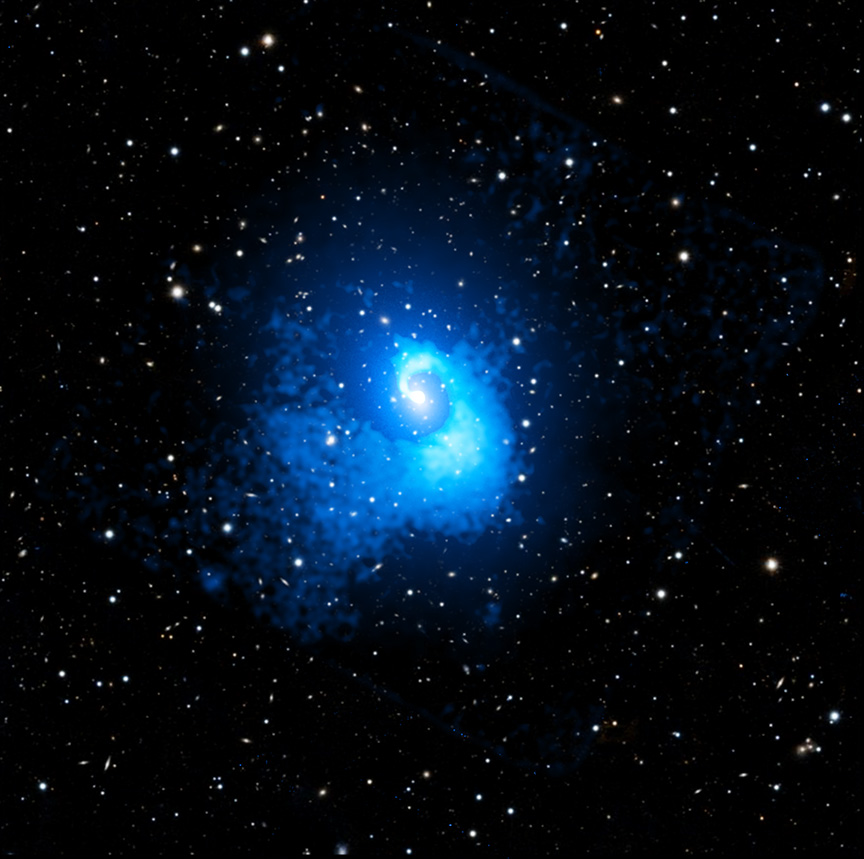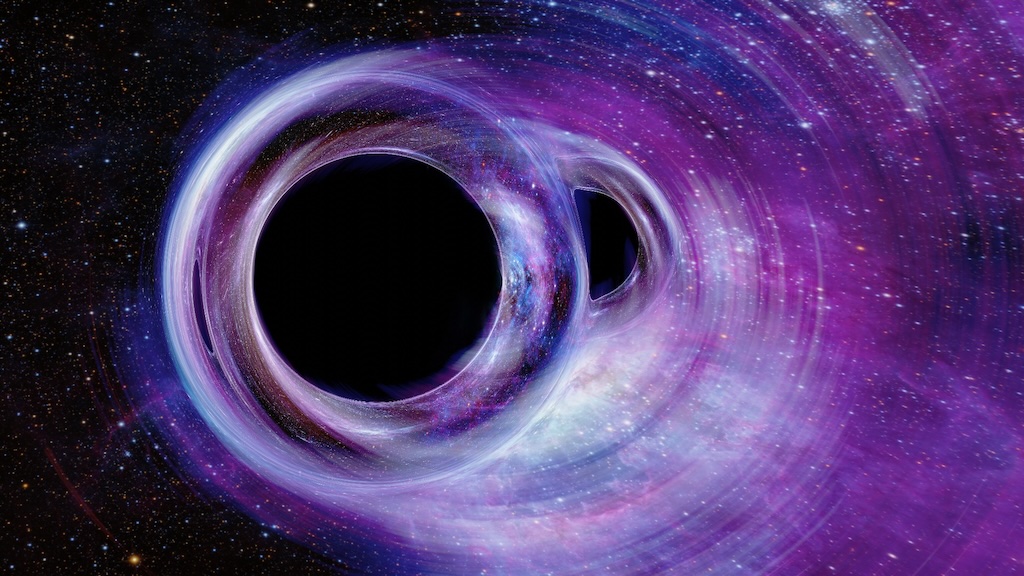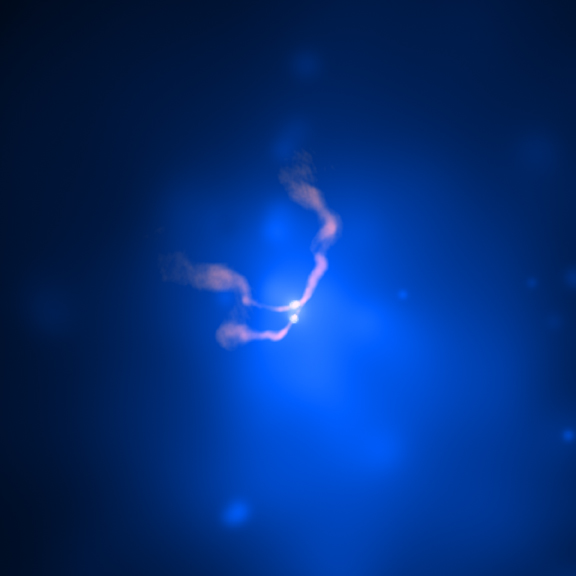
The two bright sources at the center of this composite x-ray (blue)/ radio (pink) image are co-orbiting supermassive black holes powering the giant radio source 3C 75. Surrounded by multimillion degree x-ray emitting gas, and blasting out jets of relativistic particles the supermassive black holes are separated by 25,000 light-years. At the cores of two merging galaxies in the Abell 400 galaxy cluster they are some 300 million light-years away. Astronomers conclude that these two supermassive black holes are bound together by gravity in a binary system in part because the jets' consistent swept back appearance is most likely due to their common motion as they speed through the hot cluster gas at 1200 kilometers per second. Such spectacular cosmic mergers are thought to be common in crowded galaxy cluster environments in the distant universe. In their final stages the mergers are expected to be intense sources of gravitational waves.
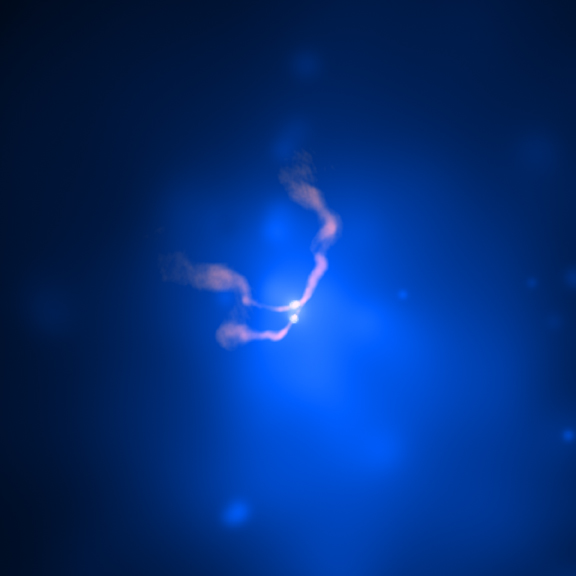
Las dos fuentes brillantes en el centro de esta imagen compuesta de rayos X (azul) y radio (rosa) son agujeros negros supermasivos que coorbitan y alimentan la fuente de radio gigante 3C 75. Rodeados por gas que emite rayos X a temperaturas de millones de grados, y lanzando chorros de partículas relativistas, los agujeros negros supermasivos están separados por 25.000 años luz. En los núcleos de dos galaxias en fusión en el cúmulo de galaxias Abell 400, se encuentran a aproximadamente 300 millones de años luz de distancia. Los astrónomos concluyen que estos dos agujeros negros supermasivos están unidos gravitatoriamente en un sistema binario, en parte porque la apariencia consistentemente inclinada de los chorros es muy probablemente debido a su movimiento común mientras se desplazan a través del gas caliente del cúmulo a 1.200 kilómetros por segundo. Se cree que tales fusiones cósmicas espectaculares son comunes en los densos ambientes de cúmulos de galaxias del universo distante. En sus estadios finales, se espera que estas fusiones sean fuentes intensas de ondas gravitacionales.