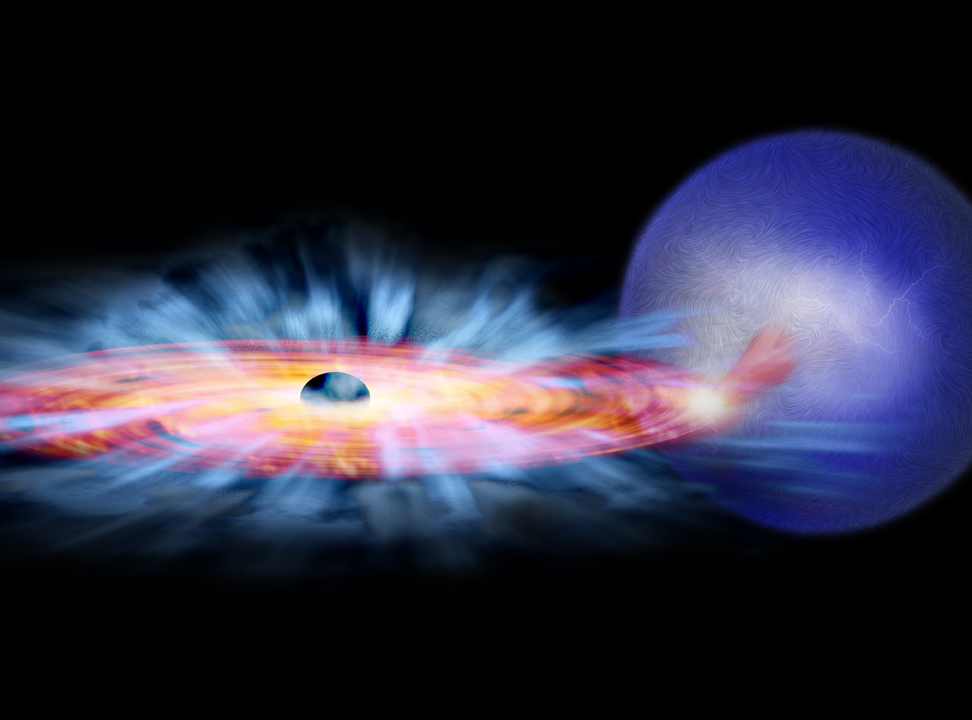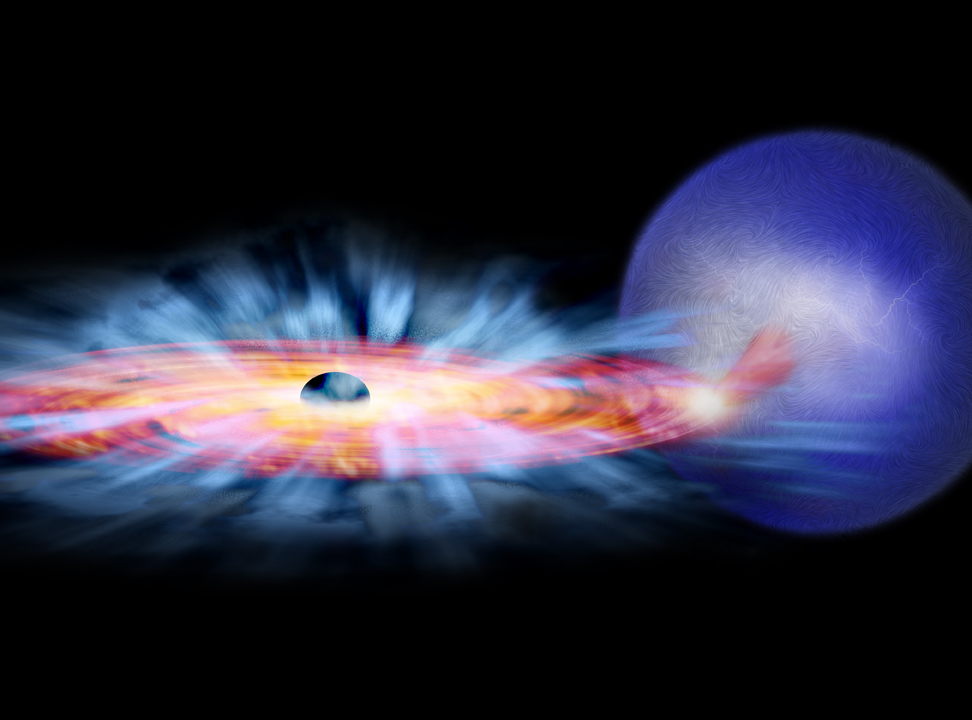
Binary star system GRO J1655-40 consists of a relatively normal star about twice as massive as the Sun co-orbiting with a black hole of about seven solar masses. This striking artist's vision of the exotic binary system helps visualize matter drawn from the normal star by gravity and swirling toward the black hole. But it also includes a wind of material escaping from the black hole's accretion disk. In fact, astronomers now argue that Chandra Observatory x-ray data indicate a high-speed wind is being driven from this system's disk by magnetic forces. Internal magnetic fields also help drive material in the swirling disk into the black hole itself. If you had x-ray eyes as good as Chandra's, you could find GRO J1655-40 about 11,000 light-years away in the constellation Scorpius.
El sistema binario de estrellas GRO J1655-40 consiste en una estrella relativamente normal aproximadamente dos veces más masiva que el Sol coorbitando con un agujero negro de unas siete masas solares. Esta visión artística llamativa del exótico sistema binario ayuda a visualizar la materia extraída de la estrella normal por la gravedad y arremolinándose hacia el agujero negro. Pero también incluye un viento de material escapando del disco de acreción del agujero negro. De hecho, los astrónomos ahora argumentan que los datos de rayos X del Observatorio Chandra indican que un viento de alta velocidad es impulsado desde el disco de este sistema por fuerzas magnéticas. Los campos magnéticos internos también ayudan a impulsar material en el disco arremolinado hacia el agujero negro mismo. Si tuviera ojos de rayos X tan buenos como los del Chandra, podría encontrar GRO J1655-40 aproximadamente a 11,000 años luz de distancia en la constelación de Escorpio.