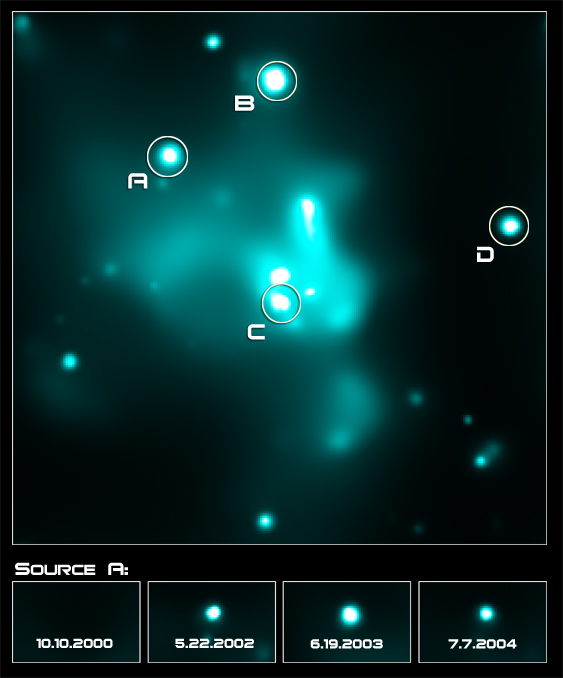
What do you call a group of black holes ... a flock, a brace, a swarm? Monitoring a region around the center of our Galaxy, astronomers have indeed found evidence for a surprisingly large number of variable x-ray sources - likely black holes or neutron stars in binary star systems - swarming around the Milky Way's own central supermassive black hole. Chandra Observatory combined x-ray image data from their monitoring program is shown above, with four variable sources circled and labeled A-D. While four sources may not make a swarm, these all lie within only three light-years of the central supermassive black hole known as Sgr A* (the bright source just above C). Their detection implies that a much larger concentration of black hole systems is present. Repeated gravitational interactions with other stars are thought to cause the black hole systems to spiral inward toward the Galactic Center region.
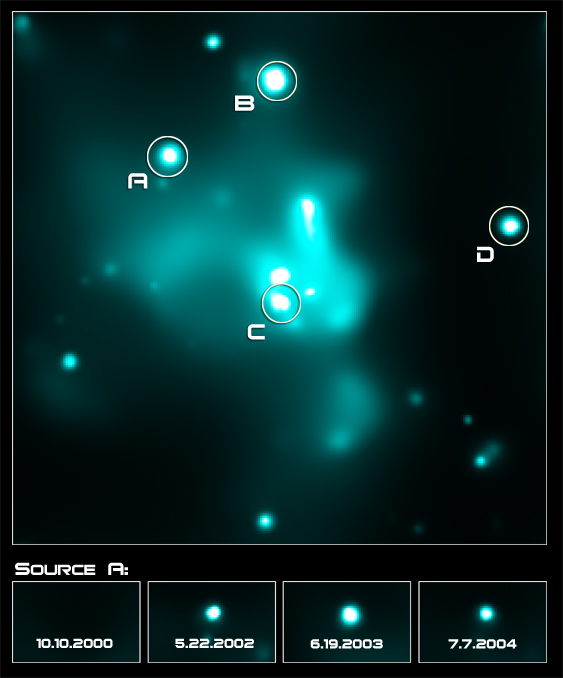
¿Cómo se llama a un grupo de agujeros negros... una bandada, un grupo, un enjambre? Al monitorear una región alrededor del centro de nuestra Galaxia, los astrónomos han encontrado evidencia de un número sorprendentemente grande de fuentes variables de rayos X, probablemente agujeros negros o estrellas de neutrones en sistemas binarios, congregándose alrededor del agujero negro supermasivo central de la Vía Láctea. La imagen combinada de datos de rayos X del Observatorio Chandra de su programa de monitoreo se muestra arriba, con cuatro fuentes variables marcadas y etiquetadas A-D. Aunque cuatro fuentes pueden no constituir un enjambre, todas se encuentran a solo tres años luz del agujero negro supermasivo central conocido como Sgr A* (la fuente brillante justo arriba de C). Su detección implica que existe una concentración mucho mayor de sistemas de agujeros negros. Se cree que las interacciones gravitacionales repetidas con otras estrellas causan que estos sistemas de agujeros negros espiraleen hacia la región del Centro Galáctico.