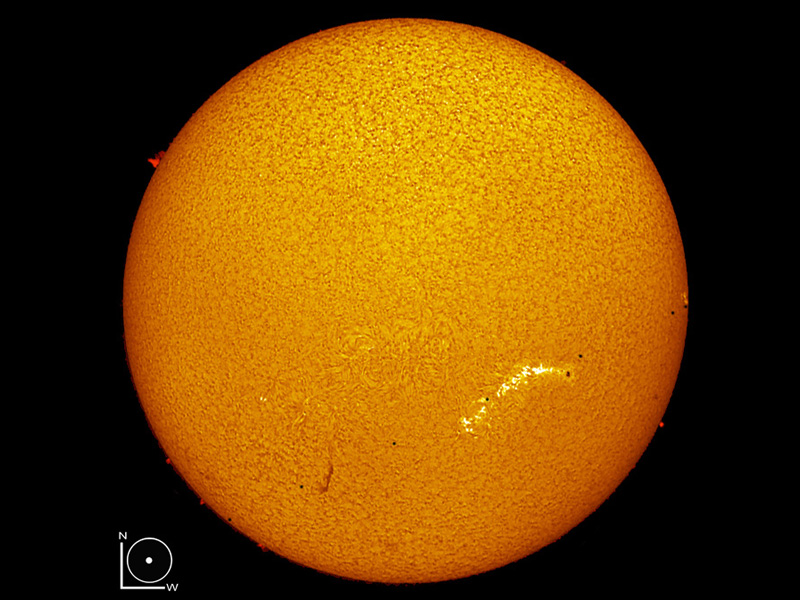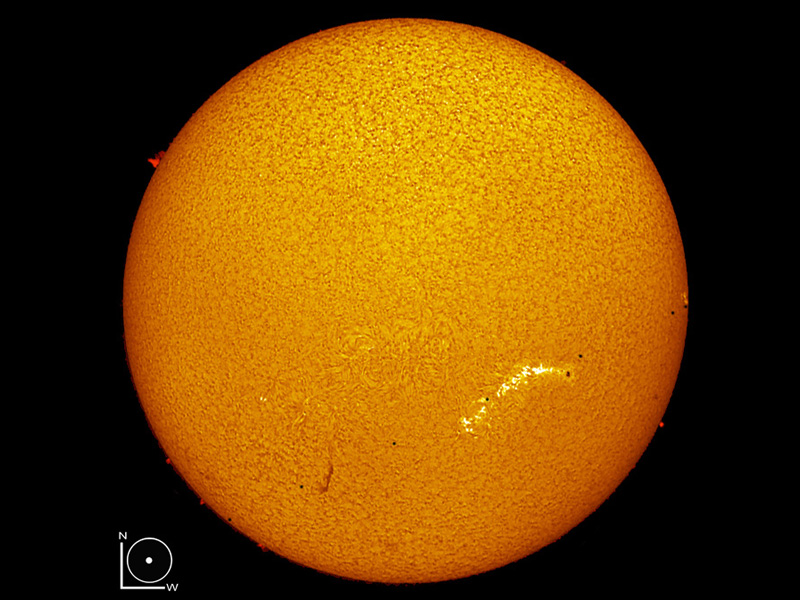
Mercury, the solar system's innermost planet, will spend about five hours crossing in front of the Sun today - beginning at 1912 UT (2:12pm EST), November 8. Specially equipped telescopes are highly recommended to safely spot the planet's diminutive silhouette however, as Mercury should appear about 200 times smaller than the enormous solar disk. This simulated view is based on a filtered solar image recorded on November 3rd. It shows active regions and the Mercury transit across the Sun at six positions from lower left to middle right. Depending on your location, the Sun may not be above the horizon during the entire transit, but webcasts of the event are planned - including one using images from the sun-staring SOHO spacecraft. This is the second of 14 transits of Mercury during the 21st century. The next similar event will be a transit of Venus in June of 2012.
Mercurio, el planeta más interno del sistema solar, pasará durante aproximadamente cinco horas frente al Sol hoy - comenzando a las 1912 UT (2:12pm EST), el 8 de noviembre. Se recomiendan encarecidamente telescopios especialmente equipados para observar con seguridad la silueta diminuta del planeta, ya que Mercurio debería aparecer aproximadamente 200 veces más pequeño que el enorme disco solar. Esta vista simulada se basa en una imagen solar filtrada registrada el 3 de noviembre. Muestra regiones activas y el tránsito de Mercurio a través del Sol en seis posiciones, desde la esquina inferior izquierda hasta el centro derecho. Dependiendo de tu ubicación, el Sol podría no estar por encima del horizonte durante todo el tránsito, pero se planean transmisiones en vivo del evento, incluyendo una que utilice imágenes del satélite SOHO que observa constantemente al Sol. Este es el segundo de los 14 tránsitos de Mercurio durante el siglo XXI. El próximo evento similar será un tránsito de Venus en junio de 2012.